
Egypt’s foreign policy on Israel and Palestine: Has there been a change?
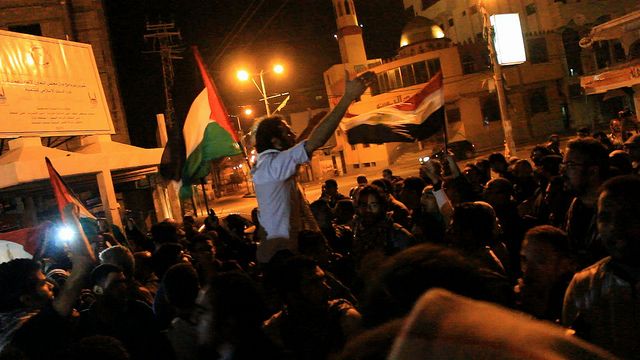
Eleven days after the Israeli bombing of Gaza began — retribution for Palestinians’ resistance to the forced displacement of Palestinian residents from the Jerusalem neighborhood of Sheikh Jarrah and the storming of Al-Aqsa Mosque — Egypt and a host of regional and international partners brokered a ceasefire agreement between armed resistance factions in Gaza and the Israeli occupation.
The ceasefire brought a halt to the immediate violence that saw hundreds of rockets fired from the Gaza Strip toward occupied territories and thousands of airstrikes and bombs ravage Gaza, killing more than 250 Palestinians, the majority of whom were civilians.
However, the escalation also brought out a new tone from Egypt. As early as May 11, one day into the crisis, Foreign Minister Sameh Shoukry adopted a strident tone on Israel’s move to seize Palestinian houses in Sheikh Jarrah and transfer them to Israeli ownership through a judicial verdict. “We are gathering here during the blessed days of a blessed month, but our brothers in Jerusalem were not given a chance to experience the holiness of this month because they are fighting an existential fight, trying to protect their sanctities and their homes in the face of a renewed Israeli attack on their rights to land they were born on,” Shoukry said during an emergency Arab League meeting.
As things escalated, state-sponsored newspapers in Egypt presented the situation as a legitimate resistance to Israeli aggression. Some daily papers even ran headlines about the “rockets of the Palestinian resistance” in the face of the “Israeli occupation.”
And then came President Abdel Fattah al-Sisi’s announcement on May 18, in which he said that Egypt will provide Gaza with US$500 million as aid for reconstruction.
And the ceasefire has also brought in a new narrative for Egypt at the international level, one that presents Cairo as a leading diplomatic player in Israel-Palestine affairs. The international press and various Western capitals lauded Egypt for its intervention, which has been further amplified by Egypt leading the efforts to “shore up” the ceasefire, having engaged in a flurry of diplomatic contact with the administration of United States President Joe Biden after months of frosty relations and kicking off a round of negotiations with Palestinian and Israeli political figures on Sunday.
Beyond the rhetoric, however, how has the high-profile flare up and changing global sentiments about Israel's occupation prompted Egypt, who has been an active partner in enforcing the siege in Gaza and was the first Arab country to normalize relations with Israel, to change its foreign policy on Palestine? Mada Masr spoke with several Egyptian officials to understand Cairo’s diplomacy over the last two weeks and what will come next.
Comparing yesterday to today
Egypt’s brokering of a ceasefire between Israel and the Palestinian armed resistance in Gaza, which suffers from extreme population density, shortage of resources, and the collapse of social services, is not a new feature of Egypt’s foreign policy in Palestine. Egypt played a similar diplomatic role after Israel attacked Gaza in late 2008, in early 2009 when Mubarak was still president, in 2012 during Morsi’s term and in July 2014, one month after Sisi came to power.
However, an Egyptian official, who spoke to Mada Masr on condition of anonymity, believes that Egypt’s handling of Israeli aggression this time “is indeed different” from its official position on the conflict in 2014, when Egypt tried to pressure Hamas from early on to stop firing rockets from Gaza to Israel. At the time, Egypt believed that it was an uncalculated adventure and not a legitimate act of resistance. This time, the official says, was different.
According to the official, Egypt now realizes that global public opinion, including in the United States, is more sympathetic toward Palestinians in Gaza. Further, Egypt’s political calculations on the regional and domestic levels are now different.
In 2014, an Egyptian diplomatic source stated that Egyptian-Israeli closeness was at an all-time high. In the past five years, Western diplomats in Cairo were quoting their Israeli counterparts expressing the same sentiment.
The same source had said that Cairo lost its strategic regional role — when it came to the Arab-Israeli conflict — when it decided that Israel was an ally that could not be sacrificed. Israel had played an influential role in pushing the Obama administration to support the political change that Egypt went through in 2013. After this, Jordan, which also has a peace treaty with Israel, became the Arab state most identified with the Palestinian cause.
During the term of former US President Donald Trump, Egypt deviated sharply from its traditional regional role as a mediator supporting Palestinian rights. Cairo went along with Trump’s plan to orchestrate an economic solution to the occupation through the much ballyhooed and apolitical “Deal of the Century” and even pressured Palestinian Authority President Mahmoud Abbas and the leaders of Palestinian factions to back the plan, according to previous statements from sources in the Palestinian Authority, Hamas, and Islamic Jihad. Egypt also did not come out in opposition to Trump’s decision to move the US embassy to Jerusalem, unlike Jordan, which publicly rejected Trump’s settlement plan and sought to dissuade him from pursuing it.
The Egyptian official says that it was not logical for Egypt to enter into a confrontation with the new US administration at the time, which was turning a blind eye to Egypt’s record of human rights abuses. Further, the Trump administration seemed willing to support the efforts to reach a binding agreement on the Grand Ethiopian Renaissance Dam between Egypt, Ethiopia and Sudan, which ultimately did not happen.
The years of rapprochement between Egypt and Israel were linked to a common regional vision to fight the “militant, fundamentalist movements that were spreading throughout the region,” the official says. “Especially in Sinai, the strong Egyptian-Israeli relations resulted in a higher level of armament on the Egyptian side to confront militant groups like ISIS and Al-Qaeda,” the official adds.
But with the development of the Abraham Accords, the US-UAE-brokered wave of agreements to normalize relations between Israel and Sudan, Bahrain and Morocco, things changed. Western diplomats in Cairo started speaking of Israel’s happiness with its new and public relations with Abu Dhabi, the former strong ally of Egypt. The partnership between Egypt and the UAE had begun to crumble toward the end of 2019 due to disputes over the management of the crisis in Libya.
According to two other government sources, Egypt senses that the UAE is conspiring against it on more than one front. For example, the UAE avoided putting any pressure on Ethiopia in the dispute over the filling and management of the Renaissance dam and chose to keep its investments in the country. Egypt was also alarmed by the UAE’s direct coordination with Israel, Cyprus and Greece on the Eastern Mediterranean Gas Forum without consulting Egypt, which happened after PA President Mahmoud Abbas opposed the UAE’s membership in the forum.
The Emirates are currently backing Mohamed Dahlan, the politically ambitious figure with contacts in both Fatah and Hamas and who is regionally described as Abu Dhabi’s henchman, to play a greater role in Palestinian politics. And while Cairo does not consider him one of Abbas’s potential allies, in the event that the latter leaves the PA presidency, it has kept communication channels with Dahlan open.
In the face of this friction, Egypt has reformulated its relations with different parties, including Turkey. Negotiations to normalize relations began taking place after the rupture from 2013 onwards when the Muslim Brotherhood was overthrown. This move angered the UAE, which perceives President Recep Tayyip Erdogan as its ultimate rival.
According to the three government sources, the latest ceasefire happened after numerous calls with Doha and Ankara.
The other important dimension to Egypt’s involvement with the Palestinian file is that it is one of the few important files that Cairo can have a positive contribution in with the Biden’s administration, which might open a productive communication channel between Washington and Egypt, one that can overcome the controversial disagreements over human rights and freedoms. Reaching a ceasefire, according to the Egyptian government sources, won Egypt some praise from Biden, who was not planning to visit Cairo anytime soon but decided to do so after Egypt succeeded in brokering the ceasefire.
According to the first government official, Egypt’s move to reinvigorate international attention on the Palestinian cause started before Trump left the White House. This effort manifested in Egypt’s engagement with Jordan, France and Germany to create a new diplomatic platform, known as the “Munich Quartet,” to discuss Palestinian affairs and offer new ideas to revive the political process. This diplomatic forum, away from the UAE, established a framework for Washington’s engagement with Palestine a few months after the Biden administration was sworn in.
Now what?
According to the three government sources, the Egyptian plan does not include total antagonism to the UAE nor an intention to sabotage relations with Israel or undo the progress that has happened in the bilateral relationship over the past seven years. Instead, Egypt is trying to regain its traditional role in the Palestinian cause.
Security delegations and political contacts are currently trying to work out a security agreement with the aim of establishing a long-term armistice, the sources add.
Toward this end, Sisi sent his chief of intelligence Abbas Kamel on Sunday to meet with officials in Israel and the Palestinian Authority. Top Kamel aides had already arrived in Gaza on Saturday for talks with Hamas leaders.
Also on Sunday, a top Israeli official arrived in Cairo on an official, announced visit for the first time since the ouster of former President Hosni Mubarak in 2011. Israeli Foreign Minister Gabi Ashkenazi will be holding talks with his Egyptian counterpart Sameh Shoukry. Sisi is also scheduled to receive the visiting Israeli diplomat, according to an informed Egyptian official.
Later this week, Ismail Hanniyah, Hamas’s political chief, is expected to visit Cairo, where he will be meeting with Kamel. Other meetings for Hanniyah in Cairo are still being considered, the official said.
Kamel is going on both assignments with a list of points that Egypt is hoping to include in the text of a long term truce between Israel and Hamas to build on the mutually agreed unconditional ceasefire.
According to the same official, the parameters of Kamel’s working paper are similar to those that Egypt got the two parties to agree on at the close of the 2014 Gaza War, including commitments from both Israel and Hamas to refrain from any future military hostilities or taking particularly provocative political steps that could lead to military action. Securing a long negotiated prisoners swap deal is also high on the list of the Egyptian diplomatic security aims in these coming days.
This, the Egyptian official says, is not at all an easy truce to secure given the determination of Israel to move on with its settlement scheme in Sheikh Jarrah, where confrontations over the Israeli seizure of Palestinian territories triggered the recent confrontation.
However, the official says that Egypt is counting on the wish of both sides to avoid the renewal of hostilities any time soon. It is also counting on the support it has received during the past two weeks from several influential world and regional capitals, including Washington DC, Paris, Berlin and Doha.
The official adds that both sides have shown willingness during preliminary talks conducted in Gaza and Israel.
“I am not saying we are going to have a deal tomorrow, but I am saying we will work for a deal and there is a possibility that we could reach one,” the official says.
Cairo is hoping to have secured some progress on the long-term ceasefire before a meeting that Qatar is planning to host early next week for Arab foreign ministers. Top Egyptian diplomats are scheduled to take part in the meeting.
The timeline for progress on a security framework is complicated, however, given the unstable domestic political sphere in Israel.
Netanyahu, who is the longest standing Israeli prime minister, having held his position since 2009, is facing an existential crisis for his political future.
Far-right Israeli politician Naftali Bennett announced on Sunday night that he is joining a coalition bloc headed by Yair Lapid. The terms of the coalition are still unknown, but Israeli media reports that preliminary indications are that the two would share power.
“We think that Netanyahu has proven to out maneuver all political opponents but in any case we are starting a motion that we could work on with any Israeli government,” one of the officials says.
In parallel to the security discussions, the three officials say that Cairo is conducting internal discussions with Hamas and the Palestinian Authority about the process of reconstruction. Even if Egypt cannot guarantee a quick ignition of the political process on the regional and international level, it wants to be a principal party in the efforts for reconstruction, and this comes as a part of a wider Egyptian interest in reconstruction efforts in Gaza, Iraq, Libya and Syria.
According to the sources, Egypt believes that its involvement in the reconstruction efforts in Gaza might reassure Israel, which, according to the statements of the Israeli defense minister, does not want Hamas to exploit the reconstruction process to its favor. Therefore, Egypt is trying to provide Israel with enough security guarantees so that the latter does not obstruct any internationally coordinated effort to reconstruct Gaza.
Hamas for its part has been determined that it will not allow the PA to take control of the reconstruction. It openly told Egyptian officials that the PA is corrupt and that it has no legitimacy among Palestinian people, given the fact that it continued all forms of security cooperation with Israel during the Israeli attack on Gaza in May.
Egypt, the official says, has proposed a mechanism where it would be working with relevant UN bodies, international and regional capitals and Hamas, the PA, and Israel to start the reconstruction work as soon as possible.
Egypt has hoped to host a donor conference for the reconstruction of Gaza, but no date has been set yet. Several possible donors have sent assessment missions to Gaza to decide on the most pressing needs.
According to two Cairo-based foreign diplomats, it will take a while to decide and coordinate what will be done. “We are going to start with the basic humanitarian assistance line and then move,” one of the officials says. “This is a long process.”

تقارير ذات صلة

The long and costly wait for a new personal status law
Bassant Soliman’s suicide triggered renewed public backlash against personal status laws in Egypt
We will sit together on Srifa hill, Qassem
Two friends try to reclaim a memory other than what the Israeli genocidal machine carved into them.

How Israel recognized Somaliland
Somaliland officials have pursued formal diplomatic recognition for over 30 years.
Your support is the only way to ensure independent, progressive journalism survives.
You have a right to access accurate information, be stimulated by innovative and nuanced reporting, and be moved by compelling storytelling. Subscribe now to become part of the growing community of members who help us maintain our editorial independence.
Join us