
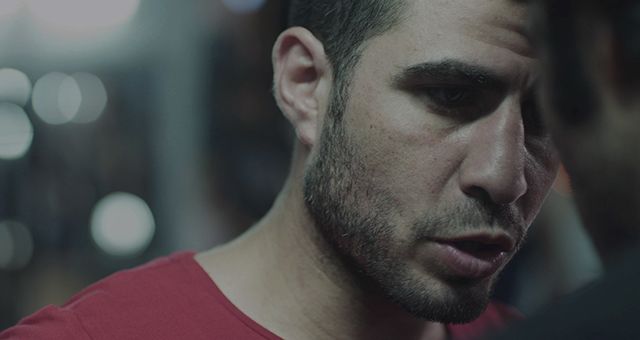
What first struck me in Ahmed Ghoneimy’s most recent short, The Cave (2013), was the performance of Adham. The protagonist is a man in his late twenties, bold and somewhat aggressive. He’d stand up for a friend when harassed at the gym. He’d lead others to a remote area only to get mugged.
Adham is likable in an eerie way, making viewers as uncomfortable as the other characters in the 23-minute drama. His body language is incredibly expressive. I thought how he’s a brilliant actor. Only he’s not an actor at all.
Adham Fazary was a childhood friend of Ghoneimy’s, although the two had lost touch for a good eight years. He only returned to Egypt in June of last year to take part in Ghoneimy’s fictional film, which is “inspired” by his character, possibly in some other life. Fazary has never conned his friends, but he is an aspiring musician from Alexandria who’d allow no one to step on his toes, and he’s highly unpredictable, as shown in The Cave.
In this film, Ghoneimy wanted to highlight notions of machismo and violence in Egypt’s urban centers, rather than make a biopic. Fazary’s character seemed like the perfect choice. So he carefully built the storyline and cast around him. His approach to pulling it all together is as interesting as the film, which was screened this month at both the Masry Asly Film Festival and the Luxor African Film Festival, having premiered at the Durban International Film Festival in South Africa last July.
In the opening scene, we see Fazary auditioning. He brings along tracks he has recorded with a friend (actor Amr Washahy) and his bass guitar to perform for 100Copies music producer Mahmoud Refat. One immediately feels the inevitable tension that arises on such a first encounter. It is based on real dynamics that unfolded during rehearsals when Refat critiqued the music. Ghoneimy played Fazary’s music as soon as Refat entered the set for the first time, allowing things to evolve naturally but without using this footage in the final film. He then carefully re-wrote the scenes, based on this and numerous other such interactions between Fazary and the rest of the cast.
Ghoneimy approached Refat (who is not an actor) for the role because of his respected position in the underground music scene. Only he could bring out such spontaneous intimidated reactions from Fazary. Washahy, who played the lead in Ghoneimy’s 2011 film Bahari, was another natural choice. He plays the guitar. And after several off-camera jamming sessions with Fazary, a friendly relationship was built, later reflected in “The Cave.” Amira El Ghoneimy, who plays Washahy’s mother in the film, is in fact Ghoneimy’s mother. She was cast for the role because Fazary would be comfortable around her in the dinner table scene filmed in Ghoneimy’s family flat. The entire film was built so that Fazary would perform the screenplay Ghoneimy wrote as spontaneously as possible, showing a different side of his character with every scene.

Ghoneimy likes the challenge of working with non-actors to present viewers with a slice of his life. He followed a similar approach in Bahari, although that film was inspired by real-life events that happened to him while filming at a children’s playground. Suspected by two locals of being a pedophile, Ghoneimy was locked up for the night in a warehouse. He later went back and convinced his aggressors to take part in a film about the incident. For him, working with people to show real life attributes is what can make his films powerful and captivating. This is his drive, which he admits can make or break a film. He starts with an idea and loose narrative inspired by personal experiences. Then he develops it, re-writing and re-shooting based on new human dynamics that arise.
In a scene in which Fazary meets up with two friends, Adma and Mouda, to split the money from a con, they fight over how much each will get. This is because when Ghoneimy had the three spend time together at weddings (Adma and Mouda are both real people from the working class neighborhood of Matareya in east Cairo), there was a constant rivalry over everything throughout their meetings. It was intuitive that such tensions would come out in the film as well.
The Cave is very personal and relatable, keeping viewers hooked even when they can foresee that tensions among the characters are about to culminate. It does not try to make any didactic or moralistic claims as the story unfolds.
The film was produced as part of the African Metropolis Project, which supported the production of six shorts set in different African cities. Initiated by the Goethe-Institut South Africa and South African producer Steven Markovitz, the project was meant to challenge stereotypes of the continent rather than create more about social and economic hardships. Contrary to how one synopsis of The Cave on a festival website describes it, Fazary is not “working class,” nor does he have “limited opportunities.” He’s simply a layered character that could reflect one of the city’s many complex dynamics.
So the next time The Cave is shown in your town, make sure not to miss it.
تقارير ذات صلة
Alexandria’s filmmakers make the most of their city
On Friday, Zawya's second night of “Shorts Revisited” was at full capacity. A crowd waited eagerly at the cinema's entrance. But this crowd was full of faces new to the…
Egypt’s cinematic gems: ‘Bahari’
Bahari broaches the fact that art about poverty, or even just art-making in general, is often exploitative
Your support is the only way to ensure independent, progressive journalism survives.
You have a right to access accurate information, be stimulated by innovative and nuanced reporting, and be moved by compelling storytelling. Subscribe now to become part of the growing community of members who help us maintain our editorial independence.
Join us