
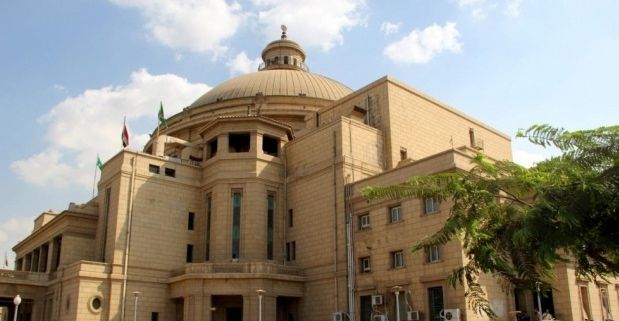
Dozens protest ban on niqab at Cairo University
Dozens of Cairo University students, faculty members and medical staff protested on Sunday against a ban on wearing niqab, both on campus and at university-affiliated medical centers.
Although the demonstration was short lived and may not affect university policy, it allowed them to briefly voice their fears that they are being targeted for their faith.
This month, university president Gaber Nassar banned all female medical staff working at the university’s hospitals from wearing niqab, maintaining that patients have the right to know the identity of the medical staff treating them. The February decision was an expansion of his September 2015 ban on female faculty members from wearing niqab on the grounds that the full-face veil hindered effective communication between professors and students. A group of professors appealed the order, but in January, the Administrative Court ruled in favor of Nassar’s decision.
February’s ban provoked a resurgence of anger among university faculty and medical staff, who perceived it as a clear violation of their personal freedoms. Students joined them in protest at the Cairo University Qasr al-Aini Medical School, but they told Mada Masr that they were forced to leave after only 20 minutes.
A faculty member at the medical school who wears niqab (she declined to give her name for fear of jeopardizing her job) told Mada Masr that university security refused to allow external visitors to enter the campus to prevent supporters from joining the protesters.
“Few journalists managed to enter to cover the protests,” she said. And just about 20 minutes “after the protest started, a few people who looked like thugs started harassing the female protesters to force us to end the protest.”
Nassar claims the ban is intended to protect the community’s general well-being. Speaking to the privately owned news site Sada al-Balad after the September order, he said he simply wanted to address problems in courses where strong communication is needed between students and their professors, not eradicate the niqab from campus altogether. In any case, Nassar claimed, the ban is “not a big deal,” since only 10 professors wear niqab at Cairo University and they all agreed to abide by the rule.
But the anonymous faculty member believes the ban is a political gesture that Nassar hopes will bring favor with President Abdel Fattah al-Sisi’s administration.
The niqab has long been a source of contention among Islamist scholars, with the hardline Salafi movement proposing the full-face veil as the ideal attire for Muslim women. The debates took on a more political flavor when the now-banned Muslim Brotherhood ascended to power in 2012, causing some to fear that Egypt’s largest Islamist organization would impose the niqab on women as a matter of law.
Following the military-engineered ouster of former President Mohamed Morsi in 2013, men with long beards and women wearing niqab — public signs of a conservative adherence to their faith — came under intense scrutiny.
The anonymous faculty member, who also works at Qasr al-Aini Hospital, explained that all medical staff prove their identities at work with a fingerprinting system and with their university IDs (which show their faces) worn on their white gowns. “My identity is already revealed to patients,” she argued, even if a veil covers her face.
“Faculty members and medical staff who wear niqab have been working at Cairo University for decades and never caused any problems, so I really cannot take [the ban] outside of this obvious political context,” she argued.
Nourhan Ahmed, a student at the nursing school who expects to graduate this year, also finds the move political. She argued that students have never complained of having problems communicating professors who wear niqab, nor have patients complained about veiled doctors or nurses.
Mohamed Medhat, a researcher in law and society at the American University in Cairo (AUC), previously told Mada Masr that there is no clear system for students to evaluate their professors, “so we don’t know for sure if wearing niqab is really hindering effective communication between professors and students."
Ahmed said rather than complaints from students, there is a general feeling that all public displays of any form of an Islamic lifestyle are prohibited. “I don’t think that it’s in anyone’s favor to feed this feeling,” she added.
She worries what the ban could mean for her career: “Next year I will have my residency at one of the university’s hospitals, which means that this decision will also apply to me.”
Wearing niqab “is a matter of personal choice,” Ahmed continued. “Only students or patients who have been harmed by niqab have the right to oppose it, not the university president. I wonder why Nassar issued these decisions at this time?”
Ahmed also pointed to Nassar’s order to shut down all small mosques across the university’s different schools. “They built one big mosque in the university’s main campus, which is very difficult to accommodate all students at an extremely huge campus like ours,” Ahmed argued. “We are even denied our basic right to pray.”
A similar sentiment was shared by Benha University students in January when the dean of the applied arts faculty reportedly harassed a female student for wearing niqab and forced her to remove it. Following a wave of outrage from the student community, Dean Yassir Sohail was referred to internal investigations.
The problem of the niqab is mired in a legal maze shaped by several conflicting court rulings. In 2001, an Al-Azhar University professor appealed against a ban on entering the AUC library due to her face veil. After a complicated judicial process, in 2007 the Supreme Administrative Court ruled that a complete ban on the niqab was illegal.
The Egyptian Initiative for Personal Rights (EIPR) hailed the ruling at the time, saying it was in line with international human rights law. "Women should be free to choose their dress code without facing discrimination based on their choice," EIPR said. "The ruling supports women's right to privacy and non-discrimination by setting strict legal conditions for any interference with a woman's freedom to choose how to dress."
Lawyer Ahmed Mahran, who represents many of the protesting female faculty members, told Mada Masr that the recent court ruling upholding Nassar’s ban violates the Constitution and previous court verdicts, including the 2007 judgement.
“I believe the court ruling supporting Nassar’s decision encouraged him to further extend the ban in almost all university institutions, like the hospitals. We are going to appeal the verdict again,” Mahran said.
The lawyer decried Nassar’s decision as a rogue, arbitrary move, pointing by way of contrast to Alexandria University President Roushdy Zahran’s declaration that he would not implement the ban, as wearing niqab is “a matter of personal freedom.”

Mai Shams El-Din
Mai graduated from the American University in Cairo with a degree in journalism. She worked mostly for local English-language news outlets but has also been writing in Arabic, particularly when…
تقارير ذات صلة
Cairo University professor exposes security intervention in academic freedoms
Egypt’s academic community has been fighting intervention by security bodies into academic life since former President Hosni Mubarak. Many scholars have voiced major concerns over the state’s tight grip on…

Interview: X’s new restrictions fail to protect users from AI image manipulation
Mada Masr spoke with digital helpline coordinator Tasneem Mounir on why X’s ban falls short
Navigating digital consent violations: Speak Up’s founder talks partnering with Pornhub
In February, Speak Up partnered with Aylo — parent company of Pornhub and other adult websites
Your support is the only way to ensure independent, progressive journalism survives.
You have a right to access accurate information, be stimulated by innovative and nuanced reporting, and be moved by compelling storytelling. Subscribe now to become part of the growing community of members who help us maintain our editorial independence.
Join us