
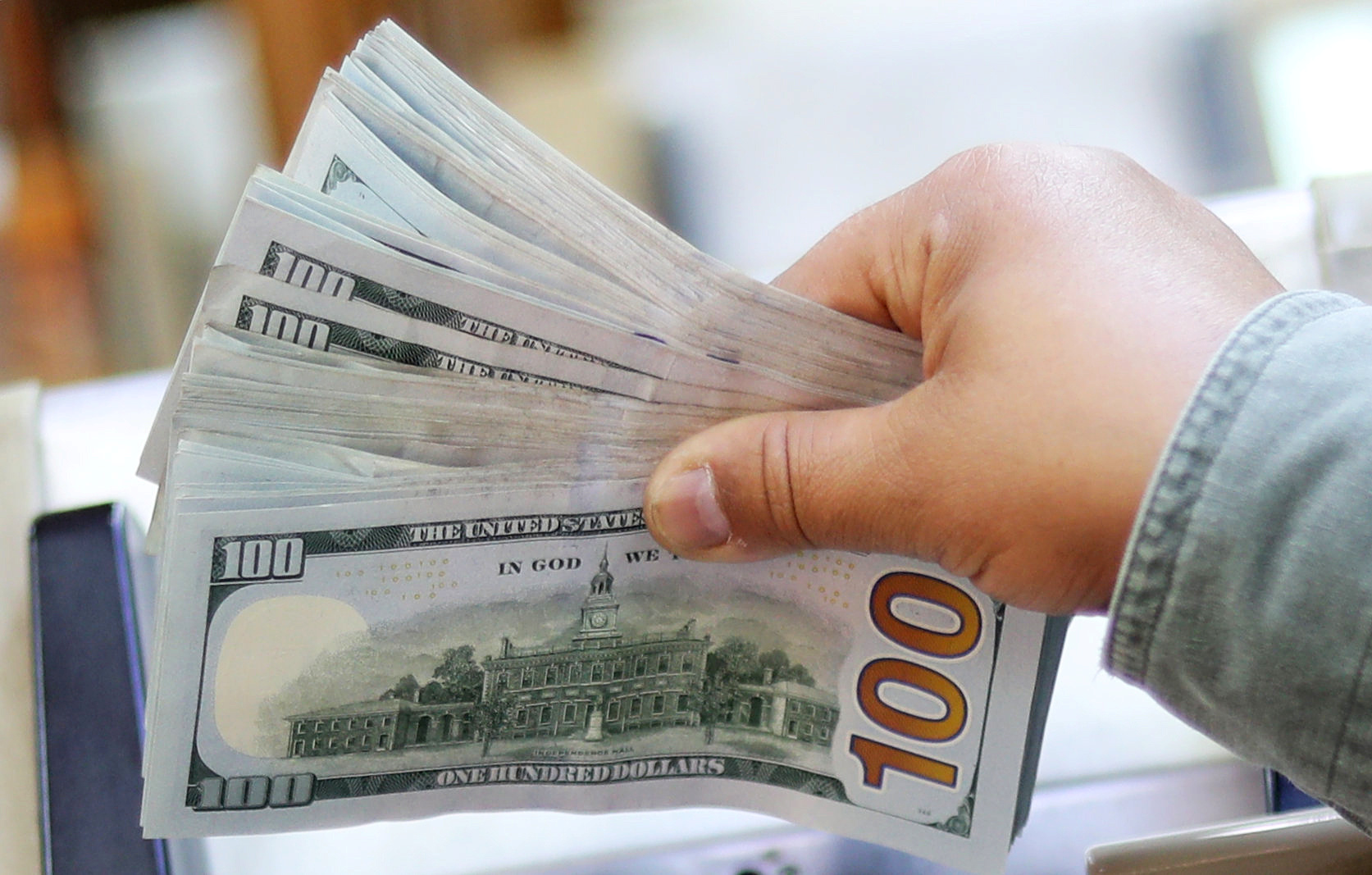
Dollar inflows at last? Not so fast
Amid a spiraling economic crisis and with over US$42 billion in looming debt payments over the course of this year, the government has been working in recent weeks to secure vital foreign currency inflows that will allow it to devalue the currency and enact economic reforms without seeing the pound’s value bottom out and the crisis worsen.
The government is in talks with four parties to secure over $20 billion in financing, according to an informed government source. The financing, which would flow from the United Arab Emirates, the European Union, Libya and the International Monetary Fund, would come in the form of new deposits in the central bank and private investments in the tourism and infrastructure sectors, the source adds.
However, these payments are far from a done deal, several government sources tell Mada Masr.
Tapping into new sources of foreign currency has been a years-long pursuit centered on bond market offerings, high interest rate CDs, attempts to collect more tax revenue and to sell state-owned companies.
On most of these fronts, however, the state has only been able to put bandaids in place, securing small inflows of money, while its sought-after bigger temporary fixes, such as the sale of its companies to Gulf countries, remain stuck at political impasses.
To this point, the government has been content to bide its time in order to find political solutions, delaying economic reforms laid out in its deal with the IMF that would have unlocked the disbursals of meager sums of a few hundred million dollars several times a year. But the delay has come at a cost, as the crisis has worsened and the deal with the IMF has become a glaring marker of little confidence in Egypt’s economy.
The crisis reached new lows last week, when the dollar exceeded LE70 on the black market, more than twice the official exchange rate.
Fearing popular anger at the pound’s continued fall, security bodies conducted raids on informal currency traders last week, raids that portray traders as accelerating the crisis despite the fact that the government has itself turned to the black market to meet its dollar needs.
At the same time, the government allowed word to get out that it had “reached an agreement” with the IMF and allowed several political figures to begin spreading information via word of mouth that a mega tourism investment of tens of billions of dollars was incoming from the United Arab Emirates.
The raids, combined with the coordinated provision of information to the public, sent the pound rallying, climbing back to around LE56 to the dollar at one point this week.
Despite official and unofficial comments regarding an imminent deal with the IMF and a major influx of foreign currency, neither has been finalized and both will still require a careful choreography of political maneuvers to conclude.
Last week, several government sources and IMF officials told Mada Masr that rather than a final deal, what both parties agreed to was a formula to secure an increase in the amount of money allocated to Egypt. However, the exact amount of the increase and a deal as such hinge on whether the central bank moves to devalue the pound.
Government sources who spoke to Mada Masr at the time and over the last week have given widely differing opinions about the value that the government would allow the pound to move to in the event of devaluation.
On Thursday, a government source familiar with the IMF talks told the privately owned Al-Shorouk news outlet that the state refuses to liberalize the exchange rate before at least $6 billion are deposited in its central bank in order to support it in dealing with the currency flotation.
To reach this threshold, the Egyptian government is working to obtain additional financing. The government source tells Mada Masr that the UAE promised officials in Cairo that it would make a $3 billion deposit in the Central Bank of Egypt, to be added to previous deposits, estimated at more than $10 billion. Abu Dhabi recently agreed to raise the value of the under-negotiation deposit from the $2 billion the sides had discussed in October and November to $3 billion, the source adds.
In addition to Abu Dhabi, the central bank is negotiating with the Central Bank of Libya to obtain a new $4 billion deposit, which was the subject of discussions between the governors of the two banks, Hassan Abdulla and Al-Siddiq al-Kabir, who met in Cairo in December and January, according to two Egyptian government sources.
Senior officials in Egypt and Saudi Arabia are also negotiating a new $2 billion deposit, according to the first government source. The negotiations for the deposit faltered at the close of last year due to the Egyptian government’s non-commitment to implementing the economic reform program that it had agreed upon with the IMF in 2022, the source adds.
In addition to the deposits, there are projects underway that will bring “huge foreign currency resources into the country,” Prime Minister Mostafa Madbuly said on Thursday.
Madbuly didn’t clarify what the projects are, but his comments echoed widespread speculation that Egypt could be about to finalize a major development project in cooperation with the UAE in Ras al-Hikma, a beach town on the north coast.
Only the government is entrusted with announcing the details of major investment projects once they are finalized, said Madbuly on Thursday.
Madbuly said that the government has received investment offers for important projects which will bring about the state’s development aims and provide hundreds of thousands of jobs, employ Egyptian companies, and revive the industrial sector. He said the government is working with an international legal company to formulate the final agreement.
Just one day prior, CEO of the General Authority for Investment and Free Zones Hossam Heiba told CNBC Arabic that Egypt had received offers from multiple investment consortia regarding a project in Ras al-Hikma, becoming the first official to go on record about the development after weeks of speculation.
The government chose an Emirati consortium to undertake the project, said Heiba, adding that initial investments could total over $22 billion, though this would not all be paid out at once.
Egypt could retain around 20 percent of the ownership of the 180 million square meter land in question, according to “sources with knowledge of the talks between Egypt and Abu Dhabi” cited in Bloomberg on Thursday. These would be held by the companies of real estate magnate Hesham Talaat Mostafa, and several other Egyptian entities, Bloomberg reported.
Lands in the north coast are worth around $100-120 per square meter, according to sources that spoke to Bloomberg, meaning the agreement with Abu Dhabi could be worth at least $18 billion.
A third government source tells Mada Masr that Abu Dhabi promised to help Egypt secure $10 billion in foreign investments in the form of development agreements. The agreements in question include luxury tourist resorts in Ras al-Hikma. Additionally, the UAE would convince international companies to operate in the north coast and contribute to developing the Gargoub and Salloum ports in order to support the Gulf country in undertaking construction projects in Libya if the divided powers there were to greenlight such initiatives.
“But all of this is just talk and promises that haven’t translated into agreements,” the source says.
If these agreements were formalized, the source says, they would be “state investments and not private sector investments” that would aim to revive trust in the Egyptian economy in light of the deep economic crisis the state is facing due to the lack of foreign currency resources.
According to a source close to the Al-Abbar Group, the Emirati construction company involved in leading the negotiations on the development in Ras al-Hikma, talks are proceeding slowly due to the Egyptian government's high expectations as far the company's first payment and the company’s right to take loans from Egyptian banks at some point for the construction of a mega project.
The source adds that there are also disagreements on the segment of land that will be allocated to a consortium of Egyptian contractors who will be partially representing state interests.
The source says that the deal could eventually be finalized, but it will not be the key source of dollars to Egypt’s coffers in the near term. Even if Egypt takes the deal to where it wants to in terms of the overall price, the volume of the first installment and subsequent payments, it still won’t get $10 billion in a single disbursement from Al-Abbar.
Another source with knowledge of the UAE’s position says that, at some point, the Egyptian government was expecting the Abu Dhabi sovereign wealth fund to be part of the deal. This, the source says, does not seem to be the case, partially, but not only, due to the many political disagreements between Cairo and Abu Dhabi.
A source who works for one of the mega Egyptian companies involved in the deal says that, while the project is ambitious, it is not something that could be done overnight and it cannot be expected to bring any big money to the Egyptian state in the very short term.
"We have seen how the state tried to do New Alamein or the New Administrative Capital, where things were conceptualized and executed in a way that failed to secure the financial deliverables expected," the source says.
The third government source says that Cairo expects the European Union to make good on its promise to pay it $10 billion over the course of four years, under a plan set to be launched in March at an investment forum organized by the EU. This will include a grant and investments earmarked for migration management and counterterrorism, as well as oil and gas.
Though the government has earned itself reprieve with promises of things being “implemented soon,” it is also raising expectations that it will devalue the currency in the coming days despite not having yet secured the necessary inflows.
A research note from Goldman Sachs published on Wednesday, reviewed by Mada Masr, said that the recent appreciation in the pound’s value on Egypt’s parallel market has raised expectations that the official exchange rate is likely to move soon.
The investment bank expected, however, that Egypt’s inability to build its foreign currency inflows in a sustainable way is preventing it from moving toward greater exchange rate flexibility. Therefore, even if Egypt closes the gap between the parallel and official foreign exchange markets, it will be unable to prevent the black market from reemerging and its foreign currency reserves from continuing to be depleted.
Building sustainable foreign currency inflows is something that will take some time, the research note spelled out, presenting a forecast that currency liberalization will therefore be delayed until inflows come from the IMF and its partners.
تقارير ذات صلة
Between rising inflation and shrinking foreign currency: What is the state doing?
The Egyptian pound resumed its slide on Thursday, reaching LE52.42 for the dollar, after a brief rise in value to LE51.92 the previous day. The currency’s slide had begun in…
Land-for-dollars Beit al-Watan scheme marred by profiteering, leaving diaspora applicants empty-handed
Analysts warn the dollar-based land sales are pushing prices higher and limiting housing options
How will the Israel-Iran war affect the Egyptian economy?
The Egyptian economy continues to tremble with uncertainty in the face of the widening regional war escalated when Israel attacked Iran on Friday night. By the end of Sunday’s trading…
Your support is the only way to ensure independent, progressive journalism survives.
You have a right to access accurate information, be stimulated by innovative and nuanced reporting, and be moved by compelling storytelling. Subscribe now to become part of the growing community of members who help us maintain our editorial independence.
Join us