
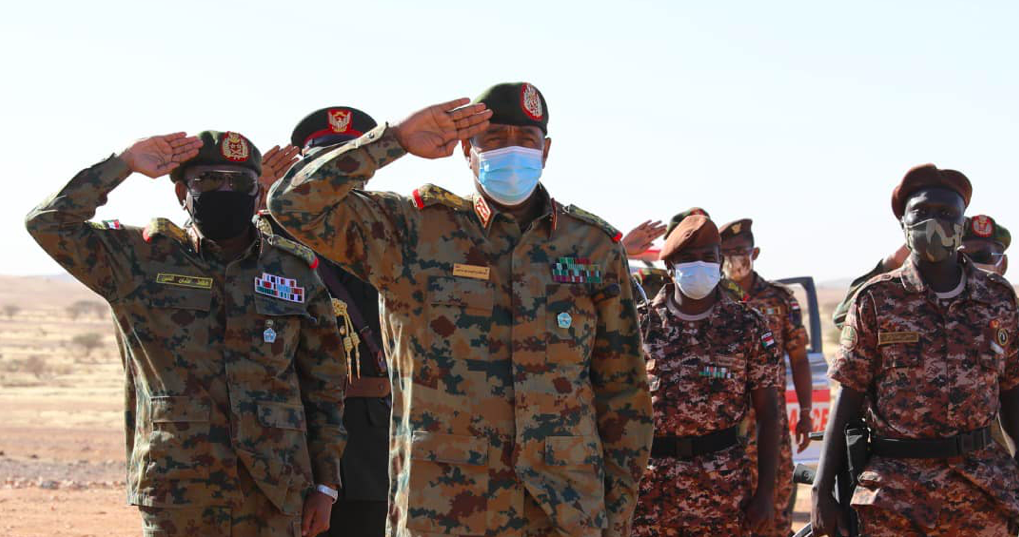
Diplomatic escalation, military reinforcements by Sudan following Ethiopian ‘aggression’
Khartoum intends to file a complaint to the African Union and the Intergovernmental Authority on Development, and the Sudanese army has announced a state of high alert and sent military reinforcements to the border with Ethiopia, following an Ethiopian attack on its forces that took place on the Sudan side of their shared border.
In a statement issued on Wednesday, the army’s media center announced that Sudanese forces on their way back from a scouting operation in Jabal Abutiour on Tuesday were ambushed by Ethiopian forces and militias inside the Sudanese territory, which resulted in the loss of lives and equipment.
According to the statement, the army sent reinforcements to the border region in order to prevent Ethiopian forces from gaining a foothold on Sudanese land, and to protect Sudanese territories from any threat.
Four soldiers, including a ranking officer, and 12 others were wounded in the attack, according to the Sudanese military.
Sudanese military sources confirmed to Mada Masr that bloody clashes took place after a series of ambushes were set up by Ethiopian forces. But the area was evacuated quickly after Sudan deployed more military forces on the ground. The sources added that the Ethiopian army, backed by Amhara militias, was involved in attacks and artillery shelling against defenseless Sudanese farmers and herders.
“We did not initiate the aggression, and our reinforcements came as a response to an attack by the Ethiopian army against our forces,” a Sudanese military source tells Mada Masr. “We have the right to respond and defend ourselves and our territories that are occupied by Ethiopian forces. We will clear the area of all Ethiopian forces and militias, especially since Addis Ababa disavowed them and declared that it can no longer control them,” they stated.
On Thursday, Chairman of Sudan’s Sovereign Council Abdel Fattah al-Burhan arrived in the border state of Qadarif, in the east of Sudan, accompanied by Chief of Staff Mohamed Othman al-Hussein and other military generals. They met with the military generals of the eastern region and were briefed about the army’s concentration and deployment along the border strip in the wake of the Ethiopian attack, which took place in the Abu Tayyour area in Quraisha last Tuesday.
Sudanese Parliament announced its support for the Armed Forces and affirmed its confidence in the army’s ability to defend the country’s territories and respond to any aggression.
Jabal Abutiour is part of the Fashaga locality, an agriculturally rich 600 km strip along the Sudanese-Ethiopian border. Ethiopia has allowed farmers to cultivate Sudanese land for decades, while former President Omar al-Bashir turned a blind eye to the incursion.
In early December, Sudan deployed troops into Fashaga to reassert its sovereignty in the area.
Sudan deployed at least 6,000 troops to the border at the beginning of November when an armed conflict between the federal government and Tigray People’s Liberation Front broke out in the northern Ethiopia state. While Ethiopia Prime Minister Abiy Ahmed declared victory after seizing the Tigray capital of Mekelle, fighting has continued.
Over 52,000 Ethiopians have been displaced into Sudan as a result of the fighting.
Sudanese forces are continuing to expand along the border strip with Ethiopia, a task mainly carried out by the Fifth and Sixth infantry brigades.
Last Sunday, Sudanese Prime Minister Abdallah Hamdok made a brief visit to the Ethiopian capital, where he met with Prime Minister Abiy Ahmed to express his concerns regarding the threats to Sudan’s security along the border with the Tigray region.
Following Tuesday's clashes, Sudanese diplomatic sources told Mada Masr that Sudan intends to file a complaint with the African Union and the IGAD concerning Ethiopian “aggression.” The sources added that Khartoum is seeking peaceful and diplomatic resolutions without compromising its sovereignty over its lands and the security of the country’s borders.
Abiy tweeted on Thursday that the Ethiopian government is closely following the incident with local militias on the Ethiopia-Sudan borders, asserting that border fighting will not break the bond between the two countries.
Ethiopia officially recognizes the Harrington-Menelik border treaty, which was signed in 1902, as well as the border protocol that was signed the following year and the 1972 agreement with the Sudanese government which designates the Fashaga region as Sudanese territory. But in reality, a portion of the Ethiopian Amhara elites, who exert vast economic, political and social influence, do not acknowledge the border demarcations and have exerted their control over a portion of the Fashaga region. According to media reports, there are over 1,700 Ethiopian farmers farming 721,000 acres of land in Fashaga.
When there have been clashes between the two sides in the past, Ethiopia has attributed blame for the attacks on bandits from the Welkait region of Tigray.
Sudanese Major General Amin Ismail Majzoub stressed to Mada Masr the importance of resolving the border issue and that trying to establish strategic partnerships with Ethiopia for its food security concerns via intergovernmental cooperation comes second.
Majzoub believes that the military reinforcements along the Ethiopian border are necessary, in addition to setting up “defense villages'' with the required equipment and services. “To prove its good intentions and credibility,” Majzoub says, “ the Ethiopian government must allow the Sudanese army to confront the Welkait bandits freely and to recognize this as our legitimate right to protect the national sovereignty of Sudan, which must eliminate militants who cross the borders.”

تقارير ذات صلة

The return to Sudan: Redrawing politics from square one
After more than a year and a half in Cairo, Um Mohamed is back to her home in Khartoum. But like many of the hundreds of thousands who have heeded…
The fall of Fasher: ‘Darfur’s old wound that has never healed’
The fall of Fasher to the RSF marks a turning point that may reshape the future of Sudan itself
Concealed sieges: Sexual violence in Sudan’s war
Obtaining clear information about the sexual violations committed against women in Sudan’s current war was not easy. Many stories remain trapped beneath the rubble of Khartoum’s destroyed buildings, mingled with…
Your support is the only way to ensure independent, progressive journalism survives.
You have a right to access accurate information, be stimulated by innovative and nuanced reporting, and be moved by compelling storytelling. Subscribe now to become part of the growing community of members who help us maintain our editorial independence.
Join us