
Development plans in Arish, Sheikh Zuwayed push ahead with little public transparency
Residents across North Sinai are facing military-led development projects that will threaten their homes. However, despite opposition to at least one of these projects earlier this year that culminated in the formation of a committee to form an alternative proposal, the military is continuing its development work while providing very little transparency to anxious residents.
Outside of the road network, residents near Arish’s coast are also facing home demolitions as the state looks to expand the Arish Port project. And in Sheikh Zuwayed, the military is building a wall that will completely cut the city off from the coast.
While the last two months have seen a decline in Province of Sinai attacks, three military officers have been killed in Sinai, where the state is locked in a long conflict with the militant Islamic State affiliate. The militant group has also redoubled targeted attacks on civilians working with the Armed Forces and tried to rebuff claims that its supply lines are being stretched thin.
Arish highways: North Sinai Engineers Syndicate tables proposal to avoid home demolitions, governor says decisions lies with the military engineering authority
Two months have passed since the North Sinai Engineers Syndicate submitted an alternative proposal for highway construction to the Armed Forces Engineering Authority that would avoid home demolitions while advancing the state’s development plans. And while the North Sinai Governor Major General Mohamed Abdel Fadil Shousha has announced the development work would begin to be implemented, Arish residents are still in the dark regarding what will happen to their homes.
In mid-February, government committees unexpectedly surveyed the area surrounding the coastal Fatih and Geish roads, marking several homes overlooking the two streets with numbers. Residents later learned the markings indicated the number of meters needed in order to widen the streets, as part of the Armed Forces Engineering Authority’s LE500 million plan to build new highways throughout the governorate, a plan that comes as a presidential directive.
Trying to find alternatives, owners of the homes to be demolished held several meetings, inviting the city’s representative in the House. On April 1, they convened a governorate-approved committee made up of members of the syndicate to reexamine the highway construction plans in order to try to find alternatives that would home demolitions.
In mid-April, the North Sinai Engineers Syndicate President Amin Gouda announced that the committee had completed its task and developed new plans for implementation. He said that they “maintain the development objective while achieving civil society’s desires,” adding that the engineering authority approved the syndicate’s plans and notified the governor.
According to a syndicate source, the new proposal separates Al-Sahaa al-Shaabiya highway into two streets: Saha Street and Shabat al-Muslimat Street. Each street would be comprised of three lanes to meet the requirements put forth by the engineering authority. Meanwhile, Bahr Street — between the areas of Kholafaa al-Rashideen and Nafoura — would have only three lanes, which would prevent home demolitions.
The source tells Mada Masr that the committee officially sent its proposals to the Armed Forces Engineering Authority, adding that, at the time, a committee from the authority was close to making a decision.
At the end of April, the North Sinai governor told a radio station that the decision was in the hands of the Armed Forces Engineering Authority, which was expected to send a committee to study the syndicate’s proposals. But last Thursday, he announced the start of a phased implementation of the highways, without providing any information about the Engineering Authority’s decision about the syndicate committee’s proposals.
Port development proposal swallows Risa beach
Residents on the far east of Arish, who live on the coast of Risa, an area known for its luxury chalets and villas, are also looking toward development plans with worry, as some of their homes fall within an area that has been allocated for public use to develop the Arish Port as per a 2019 decision. Others live in adjacent neighborhoods added in recent months to the port development proposal.
Residents of the Saad Chalets area, part of the port development proposal, have been waiting to formally learn the fate of their homes and futures. Their neighbors on the street leading to the part were taken by surprise in March when a city council committee arrived to inspect homes in the area, surveying the exterior and interior of homes flanked by military and police armored vehicles. The committee informed citizens that there is a proposal to add the land that their homes sit on to the port development proposal.

Despite the committee members’ comments, North Sinai Governor Mohamed Abdel Fadil Shousha said in recent statements to a local radio station that no final decisions had been made to add further land expropriations to the Arish Port project, explaining that the governorate sent inspection reports to the bodies charged with implementing the project.
Nonetheless, construction crews have begun to erect a concrete wall to enclose Risa’s coastline. There are plans to widen the port in this area, according to a source at a construction company operating in Arish.
According to the source, their company has been subcontracted by another larger construction company, which is in turn contracted by the Armed Forces Engineering Authority, to build a wall adjacent to the international road that will enclose the Risa coast. The source tells Mada Masr that some well-finished residential homes will be preserved to house engineers and workers, while the rest of the homes will be demolished.

An Armed Forces Engineering Authority plan to develop Sheikh Zuwayed and cut it off from the sea, residents say compensation more important
Development is also playing out in North Sinai away from Arish. On May 20, the North Sinai governor announced on the radio that the remaining residential bloc in Sheikh Zuwayed had been added to development plans for the city, in line with the president’s directives. Meanwhile, the city’s Senate representative Fayez Abou Harb announced that an Armed Forces Engineering Authority delegation inspected the city on May 26 to study the implementation of development plans.
According to governorate announcements, development plans include upgrading the water network and establishing a sanitation network, as well as developing the coastal road and the Arish-Sheikh Zuwayed International Road and setting up an internal road network.
The road network worries residents the most, as they fear it could be a reason to remove the city’s remaining residential bloc, which has been eroded by war between the military and armed militants over the past several years. Mada Masr previously quoted sources close to construction companies operating in North Sinai saying that there are plans to build new highways and roads in the city, which the governor denied at the time.
However, Abdel Fadil Shousha later announced a development plan for the city, and the governorate’s media center released a statement explaining that it includes building a southern road and another on the coast of Sheikh Zuwayed, which aligns with details Mada Masr previously published.
Fear of development plans comes as city residents, who still live in Sheikh Zuwayed or have fled because of the war, demand quick disbursement of compensations awarded for their homes and farms that have collapsed and been bulldozed for years. Others demand surveying their properties, which have not been surveyed due to the security situation, to add them to the compensation list.
The development plan announcement coincided with the Armed Forces constructing a large wall and fortified guard towers west of the city, which starts in the south and extends toward the coastal village of Shallaq. A source working in the construction field says that the wall will end 250 meters off the city’s coast, then move east along the coast all the way to Rafah, completely cutting Sheikh Zuwayed off from the sea.
Away from the sea in the southern part of the city, an electrical transformer was installed in the village of Dhahir in mid-June. Along with Joura, Dhahir is unique among southern Sheikh Zuwayed villages in that it retains residents, despite being in the most dangerous battleground between the military and the Province of Sinai. Residents have been able to stay in part due to extra security by series of fortified military checkpoints – most notably, the Zilzal and Burkan checkpoints.
Sheikh Zuwayd and its surrounding villages have suffered over the past few years from an electricity crisis, which has seen improvements recently after a new high voltage transformer was installed drawing power from Arish. Residents of Dhahir celebrated the improvement in the electricity situation and the Armed Forces’ decision to open the main road leading to the village, which allows electricity teams to enter.
The decision to open the main road leading into Dhahir also gives hope to those who have been displaced from the village, as well as from the other villages south of Sheikh Zuwayed, that they could once again return home. Six families have already returned, according to a local source, who noted that such returns happen in coordination with the Armed Forces. The source pointed out that other families from nearby villages and communities moved, in turn, to live in shacks by the residential bloc, hoping to return soon.

Despite a decline in Province of Sinai attacks, three officers killed in Bir al-Abd and Sheikh Zuwayed
Concern over development plans is not the only thing making news in North Sinai, as the “war on terrorism” across the governorate is not over.
The Armed Forces have made significant steps to curtail the Province of Sinai’s capabilities and attacks in the year’s first quarter. Military forces have succeeded in expelling the group from the villages to the south of Bir al-Abd, which it controlled for a short while. When the military cut off the group’s supply routes, many militants and their families turned themselves in in Sheikh Zuwayed and Rafah due to hunger.
The decline in the Province of Sinai’s capabilities and operations was reflected in the Islamic State’s electronic magazine Al-Naba, which has published several issues without mention of attacks by the Sinai group.
Nonetheless, three officers in the Armed Forces were killed over the past two months. The first was Major Ahmed Samir al-Shahat, a military intelligence officer who served in the 26th Surveillance Battalion. Shahat was killed in an IED explosion south of Bir al-Abd, according to a local source who spoke to Mada Masr. Local pages from the governorate of Monufiya posted clips from his funeral on June 19. Two weeks earlier, another officer in the same branch, the battalion’s commander General Staff Lieutenant Colonel Ahmed Mohamed Gomaa, was killed in an IED blast in an unidentified location.
In Sheikh Zuwayed, General Staff Colonel Khaled al-Erian was killed by sniper fire in late May, according to media reports of his funeral. The Province of Sinai took responsibility for killing him in the latest issue of the Islamic State publication Al-Naba.
Aside from these three officers, seven other officers have been killed this year during their service in North Sinai, according to our previous bulletins. It is notable that a statement last week by the Islamic State’s spokesperson Abou Hamza al-Qorashi, broadcasted by media platforms affiliated with the group, called on Province of Sinai members to expand their operations inside cities and focus on targeting officers. Qorashi said these attacks “take patience.”
Over the past month, at least four conscripts were also killed in Sinai, according to media coverage of their funerals: Sohag’s Mohamed Hosni, Assiut’s Montasser Ahmed Abdel Baqi, Monufiya’s Ahmed Ragab and Fayoum’s Ahmed Awad.
The military spokesperson has not made an official statements about the death of Armed Forces officers in Sinai in recent months. His latest statements on April 18 mentioned military operations in Sinai without noting any deaths or injuries from the Armed Forces.
Aside from military deaths, the Union of Sinai Tribes announced in late June the death of one of its fighters, Hossam Soliman Hussein, who was killed while taking part in operations alongside the Armed Forces.
Province of Sinai escalates attacks on civilians, boasts abundance of food
The Province of Sinai intensified its targeting of civilians over the past two months, including those fighting alongside security bodies or private contractors in projects overseen by the Armed Forces. Most of the targeted attacks happened in Bir al-Abd and central Sinai, areas where militants were pushed during the last quarter of 2020.
In the central Sinai area of Magharah, a Bir al-Abd citizen was injured while fleeing in his car from a roaming checkpoint on June 25, according to a local source. Five days earlier, two other civilians were killed and a third was injured in the same area when an IED exploded near their car, according to a local source, who explained that the victims worked at a quarry that was contracted by the Armed Forces for work on road projects.
The same source noted that the Province of Sinai recently carried out attacks against quarries in central Sinai where it seized food rations and cautioned workers of dealing with the Armed Forces.
On June 8, the Associated Press reported, citing security sources, that five civilians – three engineers, a worker and a driver – working in a project southeast of Bir al-Abd, had been abducted by armed militants who stopped their car and led them to an unknown location.
While the Province of Sinai did not take responsibility for the abduction, it announced in mid-April that it has killed two of three citizens it had kidnapped from the village of Amouriya east of Bir al-Abd three months prior. The fate of the third remains unknown. The group also announced the death of another young man from Eastern Qantara who works as a camel herder. They abducted and killed him on the grounds that he worked with the Armed Forces. The Province of Sinai published several photographed publications featuring operations in which unarmed citizens were killed by group members, without mentioning further details.
In the Sheikh Zuwayed area of Karam al-Qawadees, militants targeted equipment owned by a contractor working with the Armed Forces in late May. Three pieces of heavy equipment used in constructing roads were severely damaged in the attack, according to a source working in the construction field who spoke to Mada Masr.
While the Armed Forces Operation Sinai 2018 wrested control over Arish from militants, the group emerged in the city last quarter. About 15 armed militants stormed the village of Amal southeast of Arish on April 29 with a wanted list. They searched homes but did not find most of the individuals they were looking for. However, they did abduct three citizens, a man from the Sawarka tribe and a man and a woman from the Tarabin tribe, and executed them near the village, according to a source close to the Union of Sinai Tribes who spoke to Mada Masr.
A few hours later, the Union of Sinai Tribes announced the death of the two young men and published their names and photos, without any mention of the woman, which the source asserted was killed as well. The Province of Sinai took responsibility for the attack and killing the two men shortly afterward. The group claimed they were trackers who helped the Armed Forces follow movements of militants.
The Province of Sinai issued a publication titled “Profile Makers 2” in mid-April, listing the group’s operations against those who “cooperate” with the Armed Forces. The publication featured the killing of two young men, whom the militants assert confessed to being members of the Tarabin tribe that fight alongside the Armed Forces and track militants around the Hemair, Halal, Maaqaf and Marahil mountains.
In response to pressure that the military has placed on its supply lines, Province of Sinai publications have tried to highlight an abundance of food rations.
In a publication titled “Diaries of Caliphate soldiers during Ramadan in the eastern sector of the Province of Sinai,” militants can be seen preparing meats, rice, vegetables and pastries.

Mada Masr previously reported that the Province of Sinai was suffering from a food crisis as the Armed Forces had cut off its supply lines, especially in Rafah and Sheikh Zuwayed, which led to several of its fighters and families turning themselves in.
In recent months, the Province of Sinai intensified its attacks against inhabited areas in Sheikh Zuwayed and villages east of Bir al-Abd with a focus on stealing food and supplies from residents, including sheep and poultry at times.

تقارير ذات صلة

‘We want to die as martyrs with our children’: Stories of Palestinians from Gaza stuck in North Sinai
“Some of us have lost contact with our families and are no longer receiving updates”
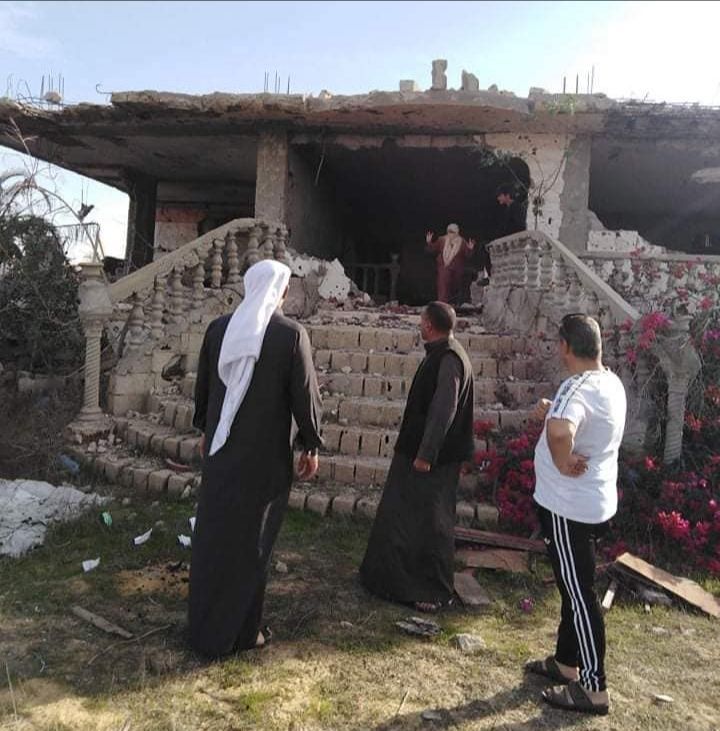
Displaced for 7 years due to fighting, North Sinai residents return home to rubble
Residents of eastern North Sinai returned to the area at the beginning of this week to inspect homes they were displaced from seven years ago and found their houses and…

Arish residents fear planned house demolitions for highway development, Province of Sinai steps up kidnap, ransom operations in Bir al-Abd
Authorities appear to be moving ahead with plans to demolish a number of residences in Arish.
Your support is the only way to ensure independent, progressive journalism survives.
You have a right to access accurate information, be stimulated by innovative and nuanced reporting, and be moved by compelling storytelling. Subscribe now to become part of the growing community of members who help us maintain our editorial independence.
Join us