
Detox | What now?
What’s Up?
Alright, so we’re in isolation. What are we supposed to do now? Well, there’s not much to do. We give in to the passage of time, we keep on physically distancing while trying to find new ways of being social.
The coronavirus is actively putting an end to the world as we know it, and a new world is now taking shape. We’re currently existing within this transitional shock, witnessing the powerlessness of humanity in the face of a tiny virus that looks like a crown when seen under the microscope. There’s an age-old Arabic saying that goes: “Health is a crown on the heads of the healthy.” Today, it is a crown that threatens our survival.
We are becoming obsessive, regarding others with fear: people are no longer people, they are potential virus transmitters. We fear for ourselves, and we fear ourselves after coming in contact with another person. Wash your hands, disinfect your surfaces, stay home, touch nothing, touch no one: we exchange these pieces of advice as though they’re our only life raft in this sea of uncertainty we find ourselves in. But that’s no way to live, is it? We need to stay safe, but we also need to keep reminding ourselves of what it is that makes us human; we need to stay grounded. Perhaps this small manifesto could help:
[wonderplugin_video iframe="https://www.youtube.com/watch?v=JeEXki3IVAc" lightbox=0 lightboxsize=1 lightboxwidth=960 lightboxheight=540 autoopen=0 autoopendelay=0 autoclose=0 lightboxtitle="" lightboxgroup="" lightboxshownavigation=0 showimage="" lightboxoptions="" videowidth=600 videoheight=400 keepaspectratio=1 autoplay=0 loop=0 videocss="position:relative;display:block;background-color:#000;overflow:hidden;max-width:100%;margin:0 auto;" playbutton="https://thefuturebegins.today/wp-content/plugins/wonderplugin-video-embed/engine/playvideo-64-64-0.png"]
Alright then, we’re staying home, and we’re creating new routines for ourselves. Those of us who spent our lives going to work for eight hours a day, five days a week, now discover that everything we used to do in the office can actually be done at home — in bed, even. Here, you can read about several artists and authors who made masterpieces in bed, among them, of course, Frida Kahlo. You can take a virtual stroll through the Mexican artist’s home (and later museum), the Casa Azul, here.
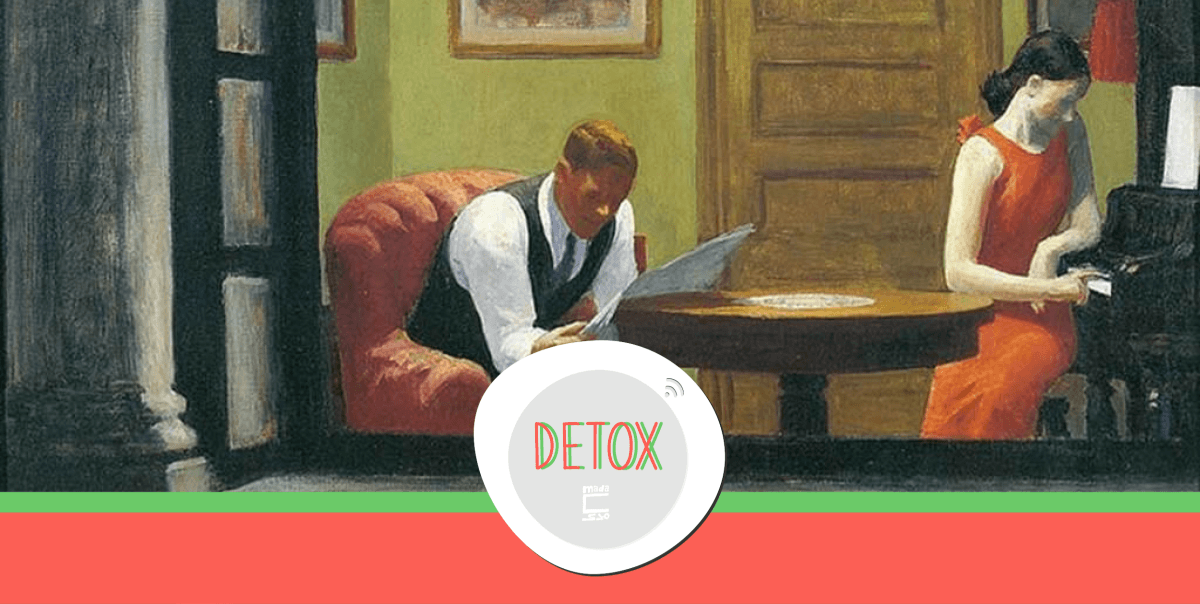
The outside world, after we’ve abandoned it — fearfully, prudently — is more and more coming to look like an Edward Hopper painting, with his evocative landscapes of lonely urban life. His 1926 work titled “Sunday” especially comes to mind:

READ
-In this interview, David Kessler — a world-renowned expert on grief, who co-wrote the seminal On Grief and Grieving: Finding the Meaning of Grief Through the Five Stages of Loss with Elizabeth Kübler-Ross — highlights the importance of identifying the discomfort we’re feeling right now as grief, then goes on to discuss how we can manage it and even find meaning in it: “Understanding the stages of grief is a start. But whenever I talk about the stages of grief, I have to remind people that the stages aren’t linear and may not happen in this order. It’s not a map but it provides some scaffolding for this unknown world. There’s denial, which we say a lot of early on: This virus won’t affect us. There’s anger: You’re making me stay home and taking away my activities. There’s bargaining: Okay, if I social distance for two weeks everything will be better, right? There’s sadness: I don’t know when this will end. And finally there’s acceptance. This is happening; I have to figure out how to proceed.”
-In a piece titled “How Loneliness from Coronavirus Isolation Takes Its Own Toll,” author Robin Wright speaks with a number of psychologists and neuroscientists about the stresses caused by the current global impasse: “... the danger is that people remain isolated after the risk dissipates. In situations where public drinking-water systems became unsafe, even after the problem was resolved and the water was made safe again, people didn’t trust them and refused to drink from them. Another psychologist cited survivors of the Holocaust who ended up living in developed nations and doing well financially afterward but still hoarded food because the trauma was so imprinted on their brains. ‘When we get out of a habit, it’s hard to get back in.. So, just like we’re worried about an economic recession, we should worry about a social recession — a continued pattern of distancing socially, beyond the immediate pandemic, that will have broader societal effects, particularly for the vulnerable.”
Too Loud a Solitude
Karoline Kamel
From within my solitude, I write these words, completely crushed. My isolation is “too loud,” like that which is described in the title of Bohumil Hrabal’s novel. Only it’s somehow void.
I read the headlines without going through the details. At odd times I stumble upon a well-written, powerful piece. English or Arabic, it doesn’t matter. My heart trembles and my hands shake. ‘Why me?’ I scream silently before I dive back into hopelessness fueled by indifference: the world is ending and there’s no point in fighting back.
I thought of writing about the impact of quarantine on mentally ill people like myself. How staying at home is affecting those with a usual aversion to going out. Out of every 10 gatherings with friends, I probably only choose two. Then again, it’s not really a choice; I’m beholden to the whims of my bipolar mind.
My disease dictates how I feel and what I dread. Now I’m anxious about not finding my medication: it disappears whenever pharmacists decide to raise its price. It’s happened three times since last year and it’s happening right now.
The coronavirus pandemic is hard on everyone, but for many of those suffering from mental illness, it’s truly destructive, especially if you live in a place like Egypt with frequent shortages in medication.
I fancy that we, the mentally ill, are unconsciously part of a union. I wonder, do other members feel as fragile as I do during this quarantine? The term “Solidarity of the Shaken,” coined by Czech philosopher Jan Patočka, comes to mind. It’s the invisible bond that unites those whose lives were capsized by one of history’s great tides. The bond is an act of rebellion against everything that interrupts life.
But is my rebellion, so far, a positive one?
It all started when the World Health Organization declared COVID-19 a pandemic. Dozens of story ideas that I could pitch to my editors jumped to my head. Too many ideas. I decided to give myself over to writing. I started reading on the impact of major events on the mentally ill, and I vowed to avoid triggers of depression and of obsession — the top of which is following the news relentlessly around the clock.
I had everything I needed to make the best use of the precious time ahead: Baking ingredients, puzzles, my threads and canvas panels. I made a list of the films I want to watch, the museums I want to virtually visit and everything in between. For news, I decided to use Twitter because it’s fast, updated and brief.
It only took 24 hours for Twitter to take hold of me. My resolve vanished and my mind withered; I started ignoring my family’s phone calls so as not to miss any bit of news, analysis or commentary. I dropped my books even though I had finally begun reading for the first time in months, after an acute depressive episode that had halted all my reading activities.
I lost my appetite and became unable to perform the simplest chores. I just couldn’t let my phone go. All the warning sirens were sounding and a faint voice deep inside pleaded with me to get off social media even for a few hours. I quickly silenced it. I thought to myself: “Everybody is sharing their problems in isolation, it’s good to follow them so as not to feel alone...After all, this is just remote socializing; it’s healthy.”
And so it went. It’s been 10 days and I haven’t written a word of all the stories I had thought about.

The voluntary isolation didn’t bother me at first; I thought of it as doing my part in slowing the spread of the coronavirus. But then staying home became an order given by the state, one I am forced to abide by along with millions of other people.
So quickly did ‘life' become a click away. There are countless live streams of concerts, virtual museum tours and even movies screened at film festivals, all for free. But I have yet to partake in any of these activities. Instead, I was consumed by plans and deadlines, obsessing about finishing all the books, the museums, and the films before returning to my normal busy life — so consumed I was crippled and couldn’t do any of it.
Naturally, my mind gave way under the weight of shame, guilt and the feeling of missing out. I was left with an empty skull and glaring eyes, mindlessly reading one tweet after the other. Everything else became boring; once I start a film or a book I quickly go back to the news, hopelessly looking for some kind of reassurance I will probably never find.
Now I am stuck with this sentence from Hrabal’s Too Loud a Solitude: “We won’t show our best until we’re completely crushed.” I am haunted by a cruel voice reminding me of my weakness and of my mortality, that time is running out, and that there are no second chances to make up for what’s missed. It reminds me of all the times I chose staying on my couch and staring at nothing over an outing, and now I find myself consumed with regret for all those times I chose not to leave the house.
WATCH
This week, we put together a film program fit for the isolation we’re currently experiencing, and the meditative state it sometimes evokes. It also speaks to the anxiety and fear gripping many of us right now. Some of these works explore the notion of loneliness and the self-reflection that ensues, others try to imagine what the end of the world would look like, and how the new world that follows in its wake might take form. Most titles are available online, either on YouTube or streaming platforms, while others are available to download as torrents.
Alfred Hitchcock, 1954
Jeff (James Stewart) is a photographer forced to stay home after fracturing his leg during a work adventure. He sits in a wheelchair next to the window, watching his neighbors through his binoculars with the curiosity of a man used to observing and understanding life through a lens. He’s alone most of the time; the only people he sees are his fiance and his nurse, who visit during specific hours. Gradually, he becomes one with his solitude, and grows obsessed with what’s happening in other people’s apartments. Through the scenes he watches — which we watch along with him — and without once leaving the setting of his home, we witness the unfolding of a full-fledged murder mystery, and it’s an extremely entertaining and engaging affair. It is a film about the obsession induced by solitude and the solitude induced by obsession, with a perfect dose of classic Hitchcockian suspense.
[wonderplugin_video iframe="https://youtu.be/m01YktiEZCw" lightbox=0 lightboxsize=1 lightboxwidth=960 lightboxheight=540 autoopen=0 autoopendelay=0 autoclose=0 lightboxtitle="" lightboxgroup="" lightboxshownavigation=0 showimage="" lightboxoptions="" videowidth=600 videoheight=400 keepaspectratio=1 autoplay=0 loop=0 videocss="position:relative;display:block;background-color:#000;overflow:hidden;max-width:100%;margin:0 auto;" playbutton="https://thefuturebegins.today/wp-content/plugins/wonderplugin-video-embed/engine/playvideo-64-64-0.png"]
Lars von Trier, 2011
Melancholia is the name of the rogue planet about to collide with earth in this film, putting a firm end to its protagonists’ problems and to the very world itself. It’s also the name of the mental illness Justine (Kirsten Dunst) is suffering from. The cosmic catastrophe around which the film centers is in fact a metaphor for the darkness that haunts her, refusing to subside even as she prepares for her wedding. Melancholia isn’t just a brutal story about depression, but also a magnificent visualization of the end of the world against a captivating soundtrack of Wagner’s symphonies. The film was inspired by the acclaimed Danish director’s personal struggles with mental illness.
[wonderplugin_video iframe="https://www.youtube.com/watch?v=wzD0U841LRM" lightbox=0 lightboxsize=1 lightboxwidth=960 lightboxheight=540 autoopen=0 autoopendelay=0 autoclose=0 lightboxtitle="" lightboxgroup="" lightboxshownavigation=0 showimage="" lightboxoptions="" videowidth=600 videoheight=400 keepaspectratio=1 autoplay=0 loop=0 videocss="position:relative;display:block;background-color:#000;overflow:hidden;max-width:100%;margin:0 auto;" playbutton="https://thefuturebegins.today/wp-content/plugins/wonderplugin-video-embed/engine/playvideo-64-64-0.png"]
Yousry Nasrallah, 1993
It’s almost been three decades since the release of this film, but we can still relate to the bewilderment of the 1990s, accentuated by the Egyptian state’s indifference to social issues and obsession with the accomplishments of the national football team. The film’s protagonist, Nubi (Zaki Fateen) finds solace from his confusion in a new surreal world, perhaps giving us some hope as we rewatch the film in 2020.
[wonderplugin_video iframe="https://www.youtube.com/watch?v=u4SI5WhFBa4" lightbox=0 lightboxsize=1 lightboxwidth=960 lightboxheight=540 autoopen=0 autoopendelay=0 autoclose=0 lightboxtitle="" lightboxgroup="" lightboxshownavigation=0 showimage="" lightboxoptions="" videowidth=600 videoheight=400 keepaspectratio=1 autoplay=0 loop=0 videocss="position:relative;display:block;background-color:#000;overflow:hidden;max-width:100%;margin:0 auto;" playbutton="https://thefuturebegins.today/wp-content/plugins/wonderplugin-video-embed/engine/playvideo-64-64-0.png"]
Ingmar Bergman, 1957
Death, sickness, alienation and the great existential questions come to mind when we think of Ingmar Bergman. Such themes take up the majority of the late Swedish director’s films, which are also hard to watch despite their cinematic value. Wild Strawberries is laden with Bergman’s usual themes, but here they are approached with a rare gentleness and warmth. The protagonist is an elderly, lonesome university professor reexamining his life and his relationship with his family, and we are taken through his journey to come to terms with imminent death (it is all right there in the film’s iconic opening scene). Here, we get a glimpse of Bergman’s compassionate view of the world and the centrality of forgiveness in human relations — most importantly forgiving oneself, so one can forgive others.
[wonderplugin_video iframe="https://www.youtube.com/watch?v=EwMgTyVbCS0" lightbox=0 lightboxsize=1 lightboxwidth=960 lightboxheight=540 autoopen=0 autoopendelay=0 autoclose=0 lightboxtitle="" lightboxgroup="" lightboxshownavigation=0 showimage="" lightboxoptions="" videowidth=600 videoheight=400 keepaspectratio=1 autoplay=0 loop=0 videocss="position:relative;display:block;background-color:#000;overflow:hidden;max-width:100%;margin:0 auto;" playbutton="https://thefuturebegins.today/wp-content/plugins/wonderplugin-video-embed/engine/playvideo-64-64-0.png"]
Todd Haynes, 1995
Carol (Juliane Moore) is a woman in her forties living a privileged life in a fancy California house. Her only concern is to care for her health and her appearance, and she agonizes over protecting herself against diseases and polluters of all kinds. But she catches a severe allergy that keeps getting worse as the movie progresses, and doctors and psychiatrists alike are unable to help her. Carol goes to extremes to avoid all contact with her surrounding environment (for fear of contamination), and ends up in complete isolation — yet she does not get any better. She loses control of her mind when she refuses to reconcile with her inability to control her surroundings; her immunity collapses in the face of her obsession and crushing anxiety. Perhaps this is what Safe tries to tell us, but perhaps you’ll find something else in there that corresponds to the current moment.
[wonderplugin_video iframe="https://www.youtube.com/watch?v=MP3kLKLaiTw" lightbox=0 lightboxsize=1 lightboxwidth=960 lightboxheight=540 autoopen=0 autoopendelay=0 autoclose=0 lightboxtitle="" lightboxgroup="" lightboxshownavigation=0 showimage="" lightboxoptions="" videowidth=600 videoheight=400 keepaspectratio=1 autoplay=0 loop=0 videocss="position:relative;display:block;background-color:#000;overflow:hidden;max-width:100%;margin:0 auto;" playbutton="https://thefuturebegins.today/wp-content/plugins/wonderplugin-video-embed/engine/playvideo-64-64-0.png"]
Al-Bedaya (The Beginning)
Salah Abo Seif, 1986
Catastrophes always carry the seeds of new realities. In Al-Bedaya, an airplane crashes, leaving its passengers — Ahmed Zaki, Yosra, Gamil Rateb and others — stranded in the desert. Abo Seif places his characters in an exceptional situation (like the malfunctioning elevator in Between Heaven and Earth) and explores how a community forms. How are the survivors building their new world? What are their priorities, and how are they expressing it? It’s not a guide on dealing with catastrophes, but it’s certainly entertaining, and somewhat comforting: As long as we exist, the end is just a beginning, and beginnings by nature are full of possibilities.
[wonderplugin_video iframe="https://youtu.be/CdvM-7XHHeg" lightbox=0 lightboxsize=1 lightboxwidth=960 lightboxheight=540 autoopen=0 autoopendelay=0 autoclose=0 lightboxtitle="" lightboxgroup="" lightboxshownavigation=0 showimage="" lightboxoptions="" videowidth=600 videoheight=400 keepaspectratio=1 autoplay=0 loop=0 videocss="position:relative;display:block;background-color:#000;overflow:hidden;max-width:100%;margin:0 auto;" playbutton="https://thefuturebegins.today/wp-content/plugins/wonderplugin-video-embed/engine/playvideo-64-64-0.png"]
Paolo Sorrentino, 2015
As the title suggests, in this film Sorrentino examines the notion of being young, albeit from the viewpoint of two old men. The Italian director succeeds in incepting this main question inside the viewer’s mind through the questions the protagonists — holidaying in a facility for the elderly in the Swiss Alps — grapple with throughout the film: questions of creativity, fatherhood, urination, immortality, and the urge to accomplish one final, lasting thing before death comes knocking.
[wonderplugin_video iframe="https://www.youtube.com/watch?v=-T7CM4di_0c" lightbox=0 lightboxsize=1 lightboxwidth=960 lightboxheight=540 autoopen=0 autoopendelay=0 autoclose=0 lightboxtitle="" lightboxgroup="" lightboxshownavigation=0 showimage="" lightboxoptions="" videowidth=600 videoheight=400 keepaspectratio=1 autoplay=0 loop=0 videocss="position:relative;display:block;background-color:#000;overflow:hidden;max-width:100%;margin:0 auto;" playbutton="https://thefuturebegins.today/wp-content/plugins/wonderplugin-video-embed/engine/playvideo-64-64-0.png"]
LISTEN
This week, music writer and journalist Maha El Nabawi curates a playlist for the current mood:
If music is where the world of the spirit and human intersect, then imagine this playlist as an open doorway to experiment with different forms of sonic wisdom. Within each song, we find an apt guide to lead us through the unknown. Let the music of Alice Coltrane and Maurice Louca cleanse our understanding, while the words of Wegz, Meriem Hassan, and A Tribe Called Quest inspire us. From there, the drums of Fela Kuti and the sounds of Alsarah & the Nubatones might collectively lift us into a post-corona realm rather than the deafening silence of solitude. In this way, we can be alone, together, anywhere.
-We also invite you to listen to the most recent episode of Mada’s music podcast Katalog, where Dina El Wedidi discusses the process of producing her latest album, Manam (Slumber), and we complement it with this playlist of music by Wedidi and some of her influences and collaborators:
SALAM
As we self-isolate, online platforms are pretty much the only way we can communicate, especially if we still want to see each other (albeit through a screen). We advise you to avoid using Zoom, as — according to SMEX — the application violates users’ privacy. Open-source platforms like Wire and Jit.Si are safer.
For some entertainment, the Cairo Opera House is live streaming its performances on the Culture Ministry’s YouTube channel, which you can access here. You can also learn some music history: In Maazef, Ammar Hassan recommends five music courses you can access online. You might also opt for a tutorial on the art of collage, offered for free by Place des Arts every evening at 7pm.
Until next time, dear readers — stay safe, and sane.

تقارير ذات صلة
Detox | An ode to the delivery worker
On curfew nights, only the roar of delivery motorcycles and the barking of dogs pierced the silence.
Detox | The final puff
I decided to quit, with the hope that I would continue to be kick-ass even without cigarettes.
Detox | A tuk tuk ride through the world of anthropology
We chat with anthropologist Mai Amer, the creator of a new show called Tuk Tuk.
Your support is the only way to ensure independent, progressive journalism survives.
You have a right to access accurate information, be stimulated by innovative and nuanced reporting, and be moved by compelling storytelling. Subscribe now to become part of the growing community of members who help us maintain our editorial independence.
Join us