
WHAT’S UP?
Nofri e-hò-ou!
That’s “good day” in the Coptic language, and we thought it’s the best way to greet you, dear readers, on International Mother Language Day. It’s an opportunity to acknowledge the languages spoken by minorities in Egypt, where for centuries now Arabic has had the higher power: Coptic, Siwi (a branch of Amazigh), and Nubian (in both its Fadicca and Kenzi dialects).
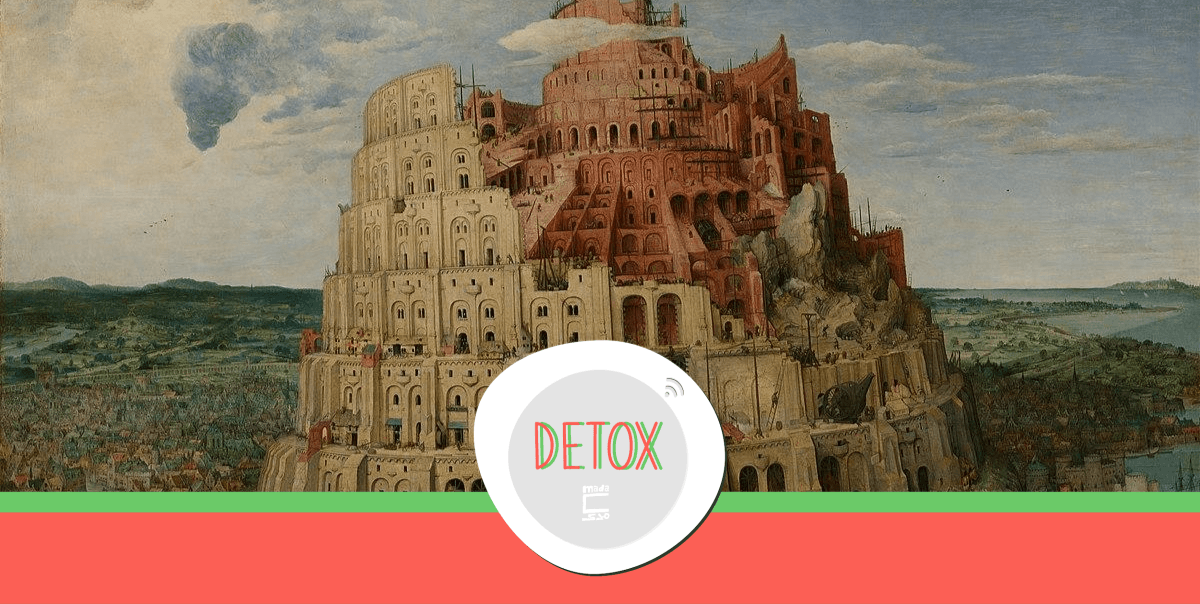
As we worked on this issue of Detox, we found ourselves thinking of the mother of all languages: that which humans supposedly spoke in the Tower of Babel — the city that touched the heavens — before God “confounded their speech and scattered them across the face of all the Earth,” as narrated in the Bible.
It’s very difficult to imagine: the entire world speaking the same tongue. What did it sound like? Was it written, or only spoken? Was it used as a vehicle for literature and legislation? Does it have a legacy? What were the letter’s shapes? Does it still remain, hidden in the words of one surviving language or more? It’s like trying to remember the first word one spoke as a child, but here we’re trying to recall the first words all humanity spoke — an act rooted in imagination rather than memory.

Pondering the notion of a “mother language,” we also thought of the ways that language was portrayed in art, particularly in film. One example that struck us is Denis Villeneuve’s Arrival (2016), where a new dimension of expressing language is conveyed: instead of sounds, language takes the shape of circular symbols created by aliens to communicate with humans, and the film centers on the attempts of its protagonist, a linguist, to decode them. Upon its release, the film stirred a wide conversation on language and its embodiment in cinema. In this LA Times piece, writer Steven Zeitchik speaks to Jessica Coon, the linguistics consultant hired by the filmmakers, about the research process behind the film. Here, we find out more about Coon’s practice as a linguist and how it corresponds with what was shown on-screen. In yet another intriguing interview, the film’s production designer discusses how he invented the alien language at the heart of Arrival, while here three translators respond to the experience of watching the film, and how it merges the role of linguist and translator into one.
[wonderplugin_video iframe="https://www.youtube.com/watch?v=tFMo3UJ4B4g" lightbox=0 lightboxsize=1 lightboxwidth=960 lightboxheight=540 autoopen=0 autoopendelay=0 autoclose=0 lightboxtitle="" lightboxgroup="" lightboxshownavigation=0 showimage="" lightboxoptions="" videowidth=800 videoheight=400 keepaspectratio=1 autoplay=0 loop=0 videocss="position:relative;display:block;background-color:#000;overflow:hidden;max-width:100%;margin:0 auto;" playbutton="https://thefuturebegins.today/wp-content/plugins/wonderplugin-video-embed/engine/playvideo-64-64-0.png"]
And on a lighter note: In the 1949 Egyptian classic Ghazal al-Banat (When Girls Flirt), directed by Anwar Wagdi, Ostaz Hamam (Naguib al-Rihani) is an Arabic teacher attempting to teach Laila (Laila Morad) the basics of nahw, or Arabic grammar, and she responds in the most famous rendition of the Arabic alphabet:
[wonderplugin_video iframe="https://youtu.be/yv-pHPcKHY0" lightbox=0 lightboxsize=1 lightboxwidth=960 lightboxheight=540 autoopen=0 autoopendelay=0 autoclose=0 lightboxtitle="" lightboxgroup="" lightboxshownavigation=0 showimage="" lightboxoptions="" videowidth=800 videoheight=400 keepaspectratio=1 autoplay=0 loop=0 videocss="position:relative;display:block;background-color:#000;overflow:hidden;max-width:100%;margin:0 auto;" playbutton="https://thefuturebegins.today/wp-content/plugins/wonderplugin-video-embed/engine/playvideo-64-64-0.png"]
READ
-In the same vein, we couldn’t help but think of authors who abandoned their native tongues to write in other languages. Albert Cossery, Joyce Mansour and Georges Henein are all Egyptians who wrote in French. Those of us who read them in Arabic translation wonder what it would have been like reading their work had it originally been written in Arabic — to what extent would their choices of words and phrasing have resembled those of their translators?
We recommend Cossery’s The House of Certain Death (available in English and Arabic translations), Mansour’s Open the Doors to the Night (Arabic translation by Beshir al-Sebaei) and this anthology of her work in English (with a bilingual poetry section), as well as Georges Henein: Select Works, also translated to Arabic by Sebaei but yet to be available in English.

-Another intriguing example of an Egyptian writing in a different language is Ahdaf Soueif, who wrote all her fiction in English, despite a strong relationship with her “mother language” that's evident in her work. The late author Radwa Ashour once said that Soueif “writes Arabic in English.” Conversations about language are often part and parcel of her stories. In this excerpt from her 1999 novel The Map of Love — translated into Arabic by Soueif’s mother, Fatma Moussa (so far the sole translator of her work) — one character teaches Arabic to another:
“Qalb: the heart, the heart that beats, the heart at the heart of things. Yes?”
She nods, looking intently at the marks on the paper.
“Then there's a set number of forms—a template almost—that any root can take. So in the case of ‘qalb' you get 'qalab: to overturn, overthrow, turn upside down, make into the opposite; hence 'maqlab': a dirty trick, a turning of the tables and also a rubbish dump. 'Maqloub': upside-down; 'mutaqallib': changeable, and 'inqilab': coup...."
So at the heart of things is the germ of their overthrow; the closer you are to the heart, the closer to the reversal. Nowhere to go but down. You reach the core and then you're blown away— (p. 82)
We also recommend Soueif’s debut novel, In the Eye of the Sun (1992), another work where the interplay between Arabic and English is vibrant and clear, and I Think of You (1996), a selection of her short fiction (some of the titles in the latter were translated into Arabic in a collection titled Zinat al-Hayah, also published in 1996).

-In the introduction to his 2007 novel Babel, Key to the World, author and translator Nael Eltoukhy writes: “I picked this novel’s title after I finished writing and was about to start the editing process. At the time, I came across scattered news pieces about a film called Babel, directed by Mexican filmmaker Alejandro González Iñárritu and starring Brad Pitt. It doesn’t matter, I told myself, no one will notice. But the film started to gain more attention as it won more and more awards, and it became too famous for the resemblance to go unnoticed, especially that it extended to the theme of both works, not just the title. The difference lies in the approach. I think that both of us — the director and I — came out winners. However, he was far too famous for me to claim that they’d stolen my title and I was too obscure for him to even know who I was, let alone come after me. For all of the above, and for the beauty of the biblical story that inspired us both, I decided, in the end, that I was not ready to change the title of the novel.”
You can read Eltoukhy’s full novel in Arabic here. As for the other Babel, the film he mentions in his introduction, it is also one that we thought of when considering films that deal with language on screen, although language itself isn’t the subject, but rather the extended aftermath of the Tower’s demise when language was “confounded” so much else was, and yet there remain ways to communicate across the schisms.
[wonderplugin_video iframe="https://www.youtube.com/watch?v=gzrHrTVaqJs" lightbox=0 lightboxsize=1 lightboxwidth=960 lightboxheight=540 autoopen=0 autoopendelay=0 autoclose=0 lightboxtitle="" lightboxgroup="" lightboxshownavigation=0 showimage="" lightboxoptions="" videowidth=800 videoheight=400 keepaspectratio=1 autoplay=0 loop=0 videocss="position:relative;display:block;background-color:#000;overflow:hidden;max-width:100%;margin:0 auto;" playbutton="https://thefuturebegins.today/wp-content/plugins/wonderplugin-video-embed/engine/playvideo-64-64-0.png"]
-On this day in 1933, Eunice Kathleen Waymon — better known as Nina Simone — was born. In this 1997 interview, conducted by Alison Powell and published in Interview Magazine, the late jazz legend — who passed away in 2003 — discusses her views on rap, desegregation and Nelson Mandela, among many other things (an Arabic translation by Sahar Gaafar was published by Ma3azef). Make sure you check out our Listen section, where we’ve included some of Simone’s most memorable songs.
-And on the occasion of Chuck Palahniuk’s 58th birthday, we share an excerpt from his recently released memoir about writing, Consider This, published on Literary Hub. Here, the American author — most famous for his 1996 novel Fight Club (adapted by David Fincher into a hit film in 1999, starring Brad Pitt and Edward Norton) — offers tips on how to imply the passage of time when writing stories, exploring the parallels between film and literary fiction, particularly when it comes to transition: “Films can cut or dissolve or fade to. Comics simply move from panel to panel. But in prose, how do you resolve one aspect of the story and begin the next?”
WATCH
Ahmed Wael recommends Youth Without Youth (2007):
Dominic Matei (Tim Roth) is an old man who invents a new language.
The close-ups show us intertwined letters, and they don’t look Latin and we don’t know much about its origin. Director Francis Ford Coppola is more occupied with narrating the journey of his protagonist rather than the particularities of the language he creates and adopts.
At the beginning of the film, the aging linguistics professor, who feels he has wasted his life searching for the origin of language, is struck by lightning and finds himself a young man again. Painful memories from his college years and a previous love story keep coming back to him in fragments while he sleeps, but in this second youth, he engages with his linguistic ambitions with a newfound passion.
Throughout Dominic’s journey, he miraculously masters Chinese, Sanskrit and other Eastern languages, and we are exposed to the baffling effects of his body’s sudden regeneration, the tumult of Europe in World War II, and his attempts at confronting loneliness with love. The film’s events are often puzzling, but its essence lies in Dominic’s refusal to be a subject of medical study after what happens to him; he insists on continuing his linguistic research and the development of his new language.

Dominic encounters an alternate persona, visible only to him, who introduces himself as the “Other,” from outside space and time. Together, they engage in swirling conversations about philosophy, religion and many other things. When Dominic is skeptical, the “Other” proves his presence by offering him two roses, one he places in his palm, the other he places on his knee, before asking: “Where do you want me to put the third rose?”
Years later, Dominic meets Veronica (Alexandra Maria Lara), a woman who speaks Sanskrit, in a cave in the Swiss Alps, and discovers that she, too, has been struck by lightning. The “Other” reveals to him that she is a reincarnation of his old love, Laura. The film takes a new turn with the appearance of Veronica, as the couple delves into an unprecedented world where language and self-expression take centerstage.
The film is especially interesting for Coppola’s aesthetic choices, as he relies almost solely on a unique visual language to relay the information that viewers need to know, as we simultaneously discover the world of the film along with its protagonist who — after the cataclysmic event he’s been subjected to — does not know much about it himself. The film is based on a novel of the same name by Romanian author Mircea Eliade, and it is definitely worth watching if you’ve never seen it before.
[wonderplugin_video iframe="https://youtu.be/mn0XGlwTKCI" lightbox=0 lightboxsize=1 lightboxwidth=960 lightboxheight=540 autoopen=0 autoopendelay=0 autoclose=0 lightboxtitle="" lightboxgroup="" lightboxshownavigation=0 showimage="" lightboxoptions="" videowidth=800 videoheight=400 keepaspectratio=1 autoplay=0 loop=0 videocss="position:relative;display:block;background-color:#000;overflow:hidden;max-width:100%;margin:0 auto;" playbutton="https://thefuturebegins.today/wp-content/plugins/wonderplugin-video-embed/engine/playvideo-64-64-0.png"]
-Saturday marks the 105th anniversary of beloved dancer and actress Tahia Carioca’s birth. Her work on the screen has garnered much attention, and so here we recommend three of her plays, in an attempt to shine a light on her exceptional stage performances as well. We also share a 1980s TV interview with Carioca, where she opens up about her life and work.
Kol el-Reggala Keda (All Men Are the Same, 1964), written by Abu al-Souod al-Ibyari and directed by Sayed Bedair:
[wonderplugin_video iframe="https://www.youtube.com/watch?v=LVr1pL_3b20" lightbox=0 lightboxsize=1 lightboxwidth=960 lightboxheight=540 autoopen=0 autoopendelay=0 autoclose=0 lightboxtitle="" lightboxgroup="" lightboxshownavigation=0 showimage="" lightboxoptions="" videowidth=800 videoheight=400 keepaspectratio=1 autoplay=0 loop=0 videocss="position:relative;display:block;background-color:#000;overflow:hidden;max-width:100%;margin:0 auto;" playbutton="https://thefuturebegins.today/wp-content/plugins/wonderplugin-video-embed/engine/playvideo-64-64-0.png"]
Al-Baghl fil Ibreeq (The Mule in the Jug, 1967), written and directed by Fayez Halawa:
[wonderplugin_video iframe="https://www.youtube.com/watch?v=V-V4ZKTfisc" lightbox=0 lightboxsize=1 lightboxwidth=960 lightboxheight=540 autoopen=0 autoopendelay=0 autoclose=0 lightboxtitle="" lightboxgroup="" lightboxshownavigation=0 showimage="" lightboxoptions="" videowidth=800 videoheight=400 keepaspectratio=1 autoplay=0 loop=0 videocss="position:relative;display:block;background-color:#000;overflow:hidden;max-width:100%;margin:0 auto;" playbutton="https://thefuturebegins.today/wp-content/plugins/wonderplugin-video-embed/engine/playvideo-64-64-0.png"]
Robabecia (Bric-a-brac, 1967), written and directed by Fayez Halawa:
[wonderplugin_video iframe="https://www.youtube.com/watch?v=sXeIoazFng4" lightbox=0 lightboxsize=1 lightboxwidth=960 lightboxheight=540 autoopen=0 autoopendelay=0 autoclose=0 lightboxtitle="" lightboxgroup="" lightboxshownavigation=0 showimage="" lightboxoptions="" videowidth=800 videoheight=400 keepaspectratio=1 autoplay=0 loop=0 videocss="position:relative;display:block;background-color:#000;overflow:hidden;max-width:100%;margin:0 auto;" playbutton="https://thefuturebegins.today/wp-content/plugins/wonderplugin-video-embed/engine/playvideo-64-64-0.png"]
LISTEN
In a 1969 interview, Nina Simone said: "I hope the day comes when I will be able to sing more love songs, when the need is not quite so urgent to sing protest songs. But for now, I don't mind."
[wonderplugin_video iframe="https://www.youtube.com/watch?v=_hdVFiANBTk" lightbox=0 lightboxsize=1 lightboxwidth=960 lightboxheight=540 autoopen=0 autoopendelay=0 autoclose=0 lightboxtitle="" lightboxgroup="" lightboxshownavigation=0 showimage="" lightboxoptions="" videowidth=800 videoheight=400 keepaspectratio=1 autoplay=0 loop=0 videocss="position:relative;display:block;background-color:#000;overflow:hidden;max-width:100%;margin:0 auto;" playbutton="https://thefuturebegins.today/wp-content/plugins/wonderplugin-video-embed/engine/playvideo-64-64-0.png"]
Much has been said and written about Simone’s activism, her involvement in the civil rights movement and her relationships with other icons of black struggle in the United States, yet it would be reductive to assume that this is what gives her so much weight in the history of music.
Simone spoke often about her initial desire to be a classical musician, and once, at the peak of her success, she wrote her parents a letter from New York expressing disappointment that she never became one: “Yes, I’m in Carnegie Hall, finally, but I’m not playing Bach.” Yet her unparalleled innovation lies precisely in how she brought classical music to jazz, as this piece on Ma3azef points out, she did play Bach, sneaking him into her music to an audience that probably wouldn’t have listened to him any other way.
Through the following selection of tracks (which is far from comprehensive), we pay tribute to the genius of Nina Simone: the poignance, the anger, the tenderness, the unbridled power of her voice.
Sinnerman:
[wonderplugin_video iframe="https://youtu.be/yczJr9boPTQ" lightbox=0 lightboxsize=1 lightboxwidth=960 lightboxheight=540 autoopen=0 autoopendelay=0 autoclose=0 lightboxtitle="" lightboxgroup="" lightboxshownavigation=0 showimage="" lightboxoptions="" videowidth=800 videoheight=400 keepaspectratio=1 autoplay=0 loop=0 videocss="position:relative;display:block;background-color:#000;overflow:hidden;max-width:100%;margin:0 auto;" playbutton="https://thefuturebegins.today/wp-content/plugins/wonderplugin-video-embed/engine/playvideo-64-64-0.png"]
Feelings:
[wonderplugin_video iframe="https://youtu.be/C2IKm9gGipY" lightbox=0 lightboxsize=1 lightboxwidth=960 lightboxheight=540 autoopen=0 autoopendelay=0 autoclose=0 lightboxtitle="" lightboxgroup="" lightboxshownavigation=0 showimage="" lightboxoptions="" videowidth=800 videoheight=400 keepaspectratio=1 autoplay=0 loop=0 videocss="position:relative;display:block;background-color:#000;overflow:hidden;max-width:100%;margin:0 auto;" playbutton="https://thefuturebegins.today/wp-content/plugins/wonderplugin-video-embed/engine/playvideo-64-64-0.png"]
My Way:
[wonderplugin_video iframe="https://youtu.be/E5slKnOULnU" lightbox=0 lightboxsize=1 lightboxwidth=960 lightboxheight=540 autoopen=0 autoopendelay=0 autoclose=0 lightboxtitle="" lightboxgroup="" lightboxshownavigation=0 showimage="" lightboxoptions="" videowidth=800 videoheight=400 keepaspectratio=1 autoplay=0 loop=0 videocss="position:relative;display:block;background-color:#000;overflow:hidden;max-width:100%;margin:0 auto;" playbutton="https://thefuturebegins.today/wp-content/plugins/wonderplugin-video-embed/engine/playvideo-64-64-0.png"]
My Man’s Gone Now:
[wonderplugin_video iframe="https://youtu.be/jRpslp061UM" lightbox=0 lightboxsize=1 lightboxwidth=960 lightboxheight=540 autoopen=0 autoopendelay=0 autoclose=0 lightboxtitle="" lightboxgroup="" lightboxshownavigation=0 showimage="" lightboxoptions="" videowidth=800 videoheight=400 keepaspectratio=1 autoplay=0 loop=0 videocss="position:relative;display:block;background-color:#000;overflow:hidden;max-width:100%;margin:0 auto;" playbutton="https://thefuturebegins.today/wp-content/plugins/wonderplugin-video-embed/engine/playvideo-64-64-0.png"]
Love Me or Leave Me:
[wonderplugin_video iframe="https://youtu.be/6dDBrpCL5Qk" lightbox=0 lightboxsize=1 lightboxwidth=960 lightboxheight=540 autoopen=0 autoopendelay=0 autoclose=0 lightboxtitle="" lightboxgroup="" lightboxshownavigation=0 showimage="" lightboxoptions="" videowidth=800 videoheight=400 keepaspectratio=1 autoplay=0 loop=0 videocss="position:relative;display:block;background-color:#000;overflow:hidden;max-width:100%;margin:0 auto;" playbutton="https://thefuturebegins.today/wp-content/plugins/wonderplugin-video-embed/engine/playvideo-64-64-0.png"]
You Don’t Know What Love Is:
[wonderplugin_video iframe="https://youtu.be/BguiWbW5j3Q" lightbox=0 lightboxsize=1 lightboxwidth=960 lightboxheight=540 autoopen=0 autoopendelay=0 autoclose=0 lightboxtitle="" lightboxgroup="" lightboxshownavigation=0 showimage="" lightboxoptions="" videowidth=800 videoheight=400 keepaspectratio=1 autoplay=0 loop=0 videocss="position:relative;display:block;background-color:#000;overflow:hidden;max-width:100%;margin:0 auto;" playbutton="https://thefuturebegins.today/wp-content/plugins/wonderplugin-video-embed/engine/playvideo-64-64-0.png"]
Do I Move You:
[wonderplugin_video iframe="https://www.youtube.com/watch?v=31bD7QCiV1Q" lightbox=0 lightboxsize=1 lightboxwidth=960 lightboxheight=540 autoopen=0 autoopendelay=0 autoclose=0 lightboxtitle="" lightboxgroup="" lightboxshownavigation=0 showimage="" lightboxoptions="" videowidth=800 videoheight=400 keepaspectratio=1 autoplay=0 loop=0 videocss="position:relative;display:block;background-color:#000;overflow:hidden;max-width:100%;margin:0 auto;" playbutton="https://thefuturebegins.today/wp-content/plugins/wonderplugin-video-embed/engine/playvideo-64-64-0.png"]
Ain’t Got No, I Got Life:
[wonderplugin_video iframe="https://www.youtube.com/watch?v=L5jI9I03q8E" lightbox=0 lightboxsize=1 lightboxwidth=960 lightboxheight=540 autoopen=0 autoopendelay=0 autoclose=0 lightboxtitle="" lightboxgroup="" lightboxshownavigation=0 showimage="" lightboxoptions="" videowidth=800 videoheight=400 keepaspectratio=1 autoplay=0 loop=0 videocss="position:relative;display:block;background-color:#000;overflow:hidden;max-width:100%;margin:0 auto;" playbutton="https://thefuturebegins.today/wp-content/plugins/wonderplugin-video-embed/engine/playvideo-64-64-0.png"]
SALAM
Ougay — we bid you farewell, dear readers, in Coptic again. Until next time.

تقارير ذات صلة

Detox | An ode to the delivery worker
On curfew nights, only the roar of delivery motorcycles and the barking of dogs pierced the silence.

Detox | The final puff
I decided to quit, with the hope that I would continue to be kick-ass even without cigarettes.

Detox | A tuk tuk ride through the world of anthropology
We chat with anthropologist Mai Amer, the creator of a new show called Tuk Tuk.
Your support is the only way to ensure independent, progressive journalism survives.
You have a right to access accurate information, be stimulated by innovative and nuanced reporting, and be moved by compelling storytelling. Subscribe now to become part of the growing community of members who help us maintain our editorial independence.
Join us