
‘Deal of the century’ exposes shifts in Arab policies toward Palestinian cause
By bringing the Palestinian cause back to the forefront of Arab attention after a decade of negligence, United States President Donald Trump’s “deal of the century” has brought to the surface a considerable Arab split over the proposal for a resolution to the Palestinian-Israeli conflict.
The 181-page proposal, announced on Tuesday, sides with Israel on nearly every key issue, including borders, settlements, the status of Jerusalem and the right of return for Palestinian refugees.
Speaking from Ramallah on Thursday morning over the phone, a Palestinian political source close to the Palestinian Authority leader Mahmoud Abbas said that the Palestinians want Arab states to announce their full commitment to achieving a fair settlement for the Palestinian cause on the basis of the Arab Peace Initiative and relevant UN Security Council resolutions.
The 2002 Arab Peace Initiative, approved by the Arab League at the Beirut Summit, calls for an independent and viable Palestinian state created within the borders of June 4, 1967, with East Jerusalem as its capital and with a fair settlement for Palestinian refugees.
Those elements have constituted the basis of peace talks in previous Palestinian-Israeli negotiations, from the Madrid Conference of 1991 until about a decade ago, when Palestinians refused to negotiate directly as long as Israel continued building settlements on territories occupied in 1967.
The “deal of the century” abolishes this foundation.
“The proposal is a slap in the face to the Arab Initiative and to the UN Security Council — and certainly to the Arab League and its member states. We just want Arab states to say that they are not taking this slap,” the Palestinian politician says.
On Saturday, prompted by a Palestinian request, Arab foreign ministers convened for an emergency meeting at the headquarters of the Arab League in Cairo. In a joint statement, they adopted an unanimous position to reject Trump’s offer, describing it as falling short of granting the minimum requirements for a fair and sustainable settlement of the Arab-Israeli struggle.
The resolution that the ministers adopted was originally drafted by the Palestinian delegation chaired by Abbas. According to an Arab diplomat who follows the Palestinian-Israeli struggle closely, only minor changes were introduced to the text of the resolution to make it less confrontational in tone.
Palestinians have the immediate support of Jordan, which has a direct stake in any future Palestinian-Israeli settlement. Other countries with support for the Palestinians, according to the assessment of the Palestinian official, include Sudan, Algeria and Tunisia.
However, the official says that the support for the Trump deal expressed by Bahrain, Oman and the United Arab Emirates, who sent their ambassadors in Washington to the White House as Trump was announcing the offer, is “scandalous.”
Egypt, meanwhile, showed a more muted acquiescence to the proposal.
“In the absence of another political offer and in view of the fact that this offer is actually re-engaging the US in the Middle East peace process, it is not exactly wise to jump to reject the offer,” an Egyptian diplomat, speaking on condition of anonymity, said. “Egypt is not asking the Palestinians to take it as it is, but rather to read it and see how to negotiate their demands from there.”
On Tuesday, Egypt issued a statement calling on “both sides” to carefully consider the offer and to use it to re-open negotiation channels. In a less distant statement toward the Palestinians, Foreign Minister Sameh Shoukry addressed Abbas at the Cairo meeting on Saturday, where he went back to referencing the Arab Peace Initiative as well as UN resolutions as bases for peace negotiations. He also stressed that a Palestinian state must be set on 1967 land, with east Jerusalem as its capital, elements that were reportedly omitted from an earlier statement issued by Egypt on Tuesday following Trump’s announcement.
Shoukry also said that a Palestinian stance needs to be clearly articulated. And while Abbas openly spoke of plans to suspend all communication with the US and Israel, he is not currently in a situation to make such a radical decision, the Arab diplomat said. To make such tough decisions, the Palestinian leader would first need to end long internal Palestinian feuds. In Cairo, which has been the most involved capital in promoting an end to the rift between Hamas and Fatah, there has been no serious expectation that a reconciliation is possible before consolidating a position against Trump’s proposal.
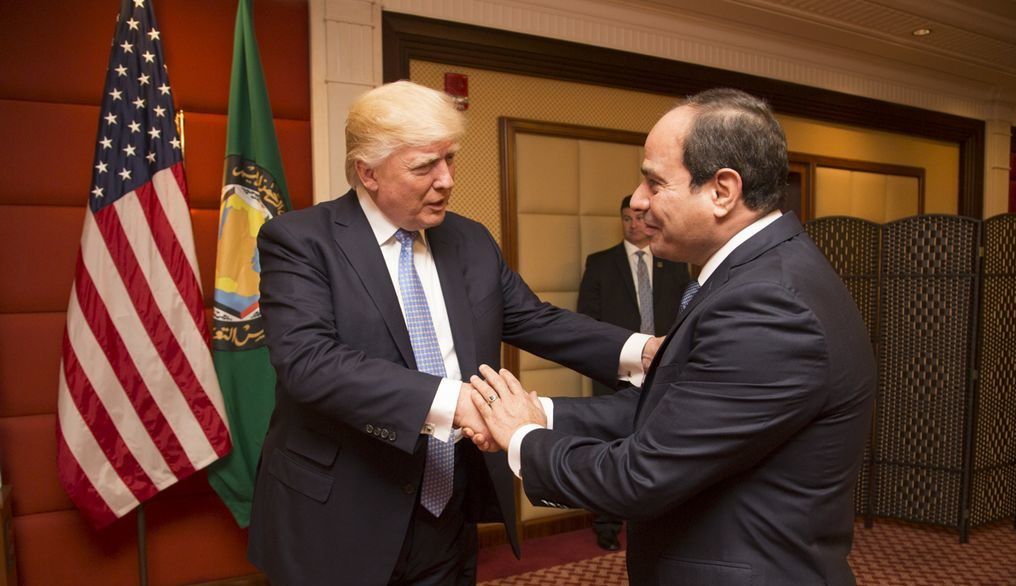
Egypt has long had a stake in the “deal of the century.” In a meeting with Trump at the White House in 2017, President Abdel Fattah al-Sisi told journalists that Egypt was willing to work with Trump on his “deal of the century.” By 2018, Trump’s team was in deliberations with Egypt about security and economic arrangements on the Egypt-Gaza and Egypt-Israel borders under the deal. One such arrangement includes the construction of a joint port on the Mediterranean between the Egyptian and Palestinian cities of Rafah as a prelude to expanded economic activity in North Sinai.
The Palestinian politician expects that Morocco and Saudi Arabia will take a slightly different position on the Palestinian demands. According to the source, Morocco — whose low-profile monarch is head of the Al-Quds Committee, a part of the Organization of Islamic Cooperation supporting Palestinian and Muslim interests in Jerusalem — and Saudi Arabia — which spearheaded the Arab Peace Initiative — are both unlikely to oppose Palestinian demands.
“They might not want us to oppose this humiliating offer as firmly as we do, but they would not say so openly,” the source says.
Over the past three years, several PA officials have repeatedly expressed dismay, off the record, at what they viewed as Egyptian, Emirati and Saudi pressure on the Palestinians to avoid rejecting the deal.
These officials repeatedly said that this pressure, especially from Egypt, was a huge shift from the traditional Egyptian position that always stood firm on the basic demands for Palestinians’ rights.
Although the Trump “offer” reveals the scarcely concealed wish of an increasing number of Arab states for the Palestinians to be less ambitious about statehood, the actual impact of the proposal is even more profound, according to a former Egyptian diplomat who had long been involved in the Middle East peace process.
What is more significant, according to the former diplomat, is the significant changes that the latest iteration of the “deal of the century” could induce on the ground. “[Israeli Prime Minister Benjamin] Netanyahu could, for example, go ahead and annex the full scope of territories on which there are Israeli settlements [in the occupied territories of the West Bank], and he could also go ahead and annex the Jordan Valley,” the former diplomat says.
In his remarks at the White House event on Tuesday, Netanyahu thanked Trump profusely for acknowledging Israel’s “sovereignty” over Israeli settlements in “Judea and Samaria,” as well as the entire Jordan Valley.
According to Israeli media, Netanyahu might well be mulling prompt annexation of both West Bank territories and the Jordan Valley, given that they are considered part of Israel under the Trump plan.
According to the former Egyptian diplomat, this would, at the very least, create a political problem for Jordan, whose 1994 peace treaty with Israel put off establishing borders along the Jordan Valley pending a Palestinian-Israeli peace deal that would have allowed Jordan and the Palestinian state to make this demarcation.
The former diplomat says the Trump proposal is a huge and devastating shift from the parameters under former US President Bill Clinton.
In 2000, Clinton hosted parallel talks with Palestinians and Israelis under the leadership of former Palestinian Authority head Yasser Arafat and former Israeli Prime Minister Ehud Barack. Clinton offered a set of parameters for a final resolution and expressed hope that, just as he began his first term in the White House with the signing of the Oslo Accords between Arafat and Israeli leaders Yitzhak Rabin and Shimon Perez, he would see the signing of a foundation for a final peace deal before the end of his second term.
The basis of the Clinton parameters included granting the Palestinians all the Palestinian quarters of East Jerusalem, over 90 percent of the West Bank and all of Gaza, as well as five possible scenarios for dealing with refugees.
None of this is in the Trump proposal. Trump had promised all of Jerusalem as “the eternal and undivided capital of Israel.”
“I had already given you that,” he said at the White House event to an applauding Netanyahu and Israeli diplomats. Moreover, under the Trump plan, the Palestinians get less than 50 percent of the West Bank.
How to address Palestinian refugees is entirely absent — or, as Netanyahu said during the White House event, it “needs to be solved out of Israel.”
For the former Egyptian diplomat, the Trump deal represents an implicit end to the two-state solution that considers a “viable Palestinian state,” because, while Trump mentions a state, what he actually offers falls far short of that.
“In fact, not in the long path of negotiating for Middle East peace, since the launch of the Madrid peace process, have we ever seen something so subjective as making the launch of a Palestinian state, irrespective of the nature of this state, dependent on an Israeli assessment that the Palestinians have rejected terror. This is unbelievably subjective. It is so unprecedented. This US administration is making an offer that is tailored to fit the Israeli right completely,” the former diplomat says.
“By further eliminating the chance for the two-state solution, Trump’s proposal might make it more inevitable for the world to pick up the term that has been gaining increasing attention over the past few years," the former diplomat says. "The one-state solution, with one man and one vote."

تقارير ذات صلة

‘The camp has grown tighter around us’: Palestinian refugees in Lebanon between war and internal restrictions
In the early hours of Thursday, March 5, an Israeli aircraft struck an apartment near the Khalil al-Rahman Mosque in the Beddawi Palestinian refugee camp in northern Lebanon. The attack…


The quiet power of Gaza’s One More Show
An intimate portrait of Gaza's only circus troupe and their resilience amid Israel's genocide
Your support is the only way to ensure independent, progressive journalism survives.
You have a right to access accurate information, be stimulated by innovative and nuanced reporting, and be moved by compelling storytelling. Subscribe now to become part of the growing community of members who help us maintain our editorial independence.
Join us