
Crumbling city: Why does Alexandria account for over half of all building collapses in Egypt?
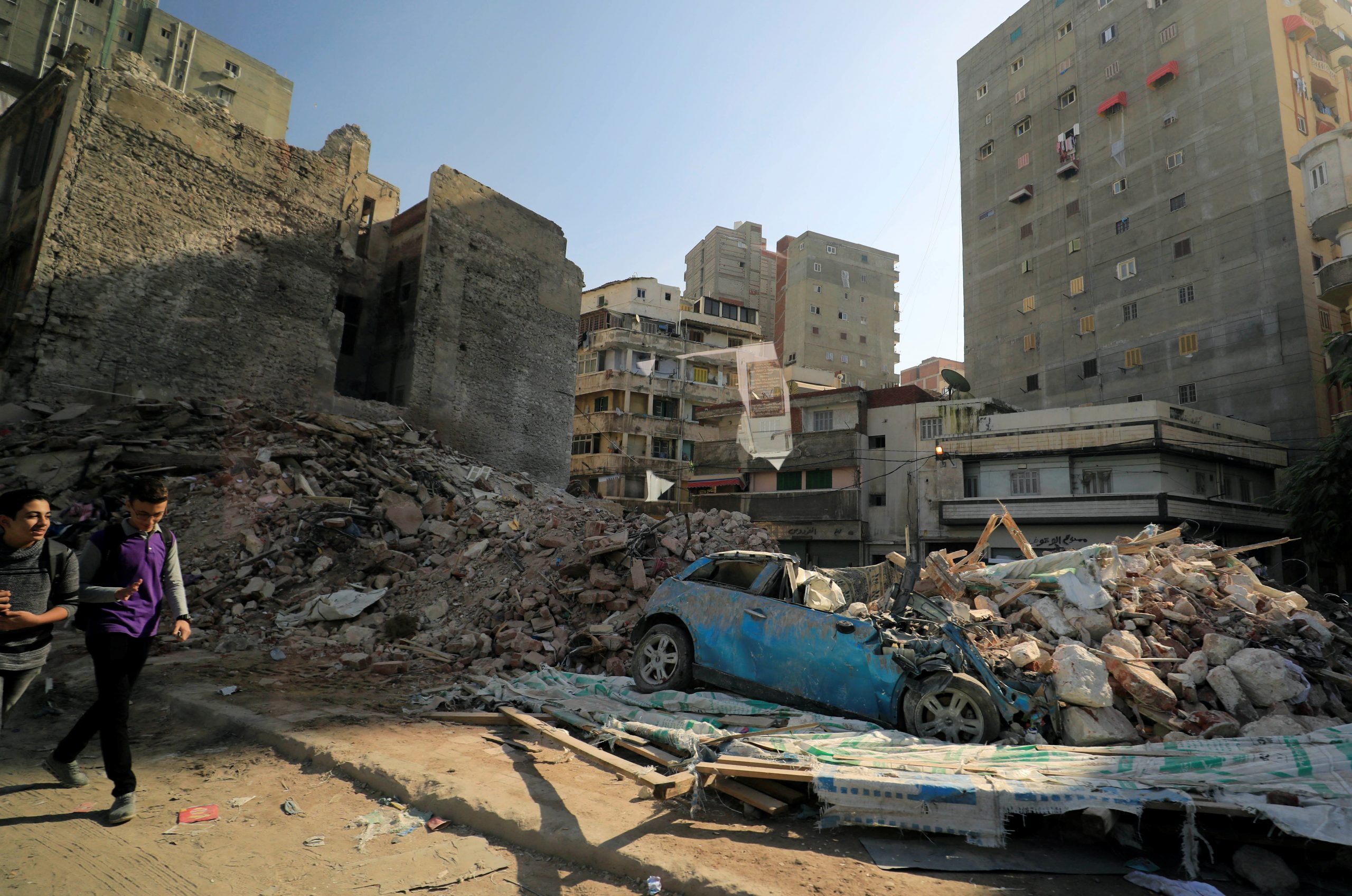
Off a busy square in Alexandria’s central district of Moharram Beik lies the narrow Fardous Street. Separated on one side by a wall from the adjacent railroad tracks, the only sound on this quiet side street is the low rumble of locomotives that run all through the day and night. The other side of Fardous is lined by medium-sized apartment buildings built in an older architectural style, one that tends to invoke nostalgic memories of times gone by. But such meditations are quickly interrupted by the sight of a pile of rubble — the remnants of what was once a building — collapsed over a parked car. Torn branches of a Christmas tree poke out from under the debris — a tree that had perhaps been decorated for a holiday celebration that never came when the building suddenly collapsed in early December, claiming six lives.
The sight of a toppled building is not uncommon here. The coastal governorate of Alexandria alone accounted for more than half of all building collapses in Egypt between 2014 and 2016, according to Daftar Ahwal, a Cairo-based research institute. And over the past few years, the city of Alexandria has seen some of the country’s most tragic building collapses, with dozens killed.
While bureaucratic obstacles and state negligence have led to building collapses across the country, why is Alexandria home to a disproportionate share of unsafe structures that are left to topple? According to urban experts and local officials, weather conditions on the coast, combined with a pattern of lax municipal oversight of older buildings as well as profit incentives to construct apartment blocks that do not adhere to building codes have left Alexandria particularly prone to building collapses.

The toppled building on Fardous Street was once home to Galal, a 30-year-old microbus driver. His family first rented an apartment there before he was born and continued to pay rent of just LE4 per month. Galal, who never married, lived in the apartment with his parents, both retired pensioners, and his older sister. His younger sister lived with her husband and was pregnant with their first child. On December 3, Galal and his older sister were out when his younger sister came to visit the family. She was inside when the building collapsed. Galal returned home to find that he had lost nearly his entire family. His father, mother, sister and her unborn child were all dead. Several weeks have passed since the tragic incident, and Galal appears as if is still trying to make sense of the calamity as he recounts the story to Mada Masr.
The apartment building was constructed in 1941. After the original owner died several years ago, his heirs, who do not live in the building, inherited the property and the legal responsibility for the building was transferred to them. Over 20 years ago, local authorities deemed the building structurally unsound and issued a demolition order. The order was disregarded. Two additional demolition orders followed, the most recent of which was issued just over two years ago
Why was no action ever taken? The answer lies in the maze of bureaucratic hurdles that must be crossed before such orders can be executed, a process that often leads to unsafe structures standing for years, sometimes with tragic consequences.
The procedures for addressing ramshackle or otherwise unsafe buildings are defined in the unified building law. One or more committees from the relevant district’s engineering affairs department are tasked with surveying a targeted building to determine whether it is in need of repairs or requires partial or total demolition.
The committee’s report is then submitted to the relevant administrative authority, which decides on a course of action to be executed within a certain time frame. Any demolition orders, either partial or total, must be submitted to the governor within a week for review. The building’s owner is then notified and is legally required to carry out the order at their own expense. Residents are also notified and a copy of the order is displayed in a prominent location in the building. If the building owner or residents cannot be reached in order to notify them, copies of the decision are archived at the local police station that has jurisdiction over the building.
Once a building owner has been officially notified of the order, they have 15 days to file an appeal. The appeal is then reviewed by a committee set up by the aforementioned administrative authority which must issue a decision within 30 days. That decision is final and the owner must comply with it after being notified.
The first obstacle in this process is notifying the building owner — often, the owner’s current address cannot be ascertained. If the owners are located, they often take to bribing those serving them the papers in order to avoid officially registering receipt of the notification letter. In this way, demolition orders can go ignored for long periods of time.
If the owner is officially notified yet refuses to comply, the execution of the demolition order falls to the relevant local authority which reimburses expenses incurred by seizing the owner’s assets. Yet in order to proceed with any demolition, local authorities must first secure approval from an urgent matters court. Repairs, on the other hand, may be carried out by tenants without the owner’s permission and any expenses incurred are deducted from rent upon approval from an urgent matters court.
Some district heads have introduced “rapid intervention” committees dedicated entirely to dealing with unsafe buildings, according to Sahar Shaaban, the head of Alexandria’s Gharb district. These committees are made up of engineers who survey buildings and monitor their condition, and legal aides who follow up on procedures.
Despite these efforts, local authorities continue to face a raft of legal and financial limitations that effectively prevent them from carrying out demolitions or repairs. Shaaban, who is currently working out of a temporary office in the decrepit local council building, says ever-shrinking budgets combined with the multiple stages of litigation required against an owner ignoring a demolition order ultimately stand in the way of them being able to avert building collapses.
The building on Fardous Street is a case in point. Despite being issued multiple demolition orders dating back over 20 years, it was left untouched until its tragic collapse.
Old rent laws also lead to a lack of maintenance on buildings that eventually lead them to become structurally unsound. Building owners lack any incentive to pay for renovations as they receive a pittance in rent from tenants who have pay rent-controlled rates that have remained unchanged since the middle of the last century. By law, tenants would return to their units at the same rates after any repairs or partial demolition. Meanwhile, tenants are often unable to afford to pay for any maintenance or renovations themselves, forcing them to live in buildings that become increasingly decrepit, according to Mohamed Adel, a civil engineer with a focus on Alexandria’s urban landscape and a former volunteer at the now-defunct Save Alexandria initiative.
Aside from bureaucratic hurdles, the high costs of demolition are also an obstacle to demolition orders being carried out. According to Shaaban, a medium-sized building typically costs between LE100,000 and LE150,000 to demolish. An owner’s only incentive to carry out demolition would be to find a way out of contracts with tenants in order to sell the land (generous offers for land are common amid a booming real estate sector). Owners sometimes offer tenants a leasehold transfer fee: an amount paid by the owner to the tenant in exchange for terminating their contract and moving out. The tenants at the Fardous Street building were offered LE10,000 per unit, according to Galal, an amount that would barely cover one year’s rent at another apartment at market rates, let alone enable residents to buy one. Galal’s family, along with the other tenants, turned down the offer.
Conversely, the potentially lucrative prospects for building owners on sales of land have made tenants wary of any demolition orders by local authorities. Some tenants suspect owners of using corrupt practices to obtain a demolition order in order to drive them away. These factors all combine to create a situation whereby tenants remain in ramshackle buildings that are in danger of collapse.
These circumstances apply throughout the country, so the question remains: Why does Alexandria in particular have such a high number of building collapses?
The weather in the city is an important factor when it comes to older buildings constructed over a century ago, which are mostly located in the southern parts of the city, such as the Moharram Beik, Gumruk, and Gharb districts. The coastal city experiences bouts of heavy rain and extreme wind, which can have devastating cumulative effects on older buildings that have been poorly maintained over the years, if at all.
A special building code should apply where such weather conditions prevail, Adel says. Wind load and soil samples should be analyzed with the results dictating the required concentrations of various building materials and rebar specifications for certain structures. Roofs should also be sloped to prevent rainwater accumulation. These steps are often not applied to many of the older buildings in Alexandria, leaving them in particularly fragile condition.
The buildings on Fardous Street, for example, have been damaged by harsh weather. On the side of a three-story building next to the one that collapsed, a visible crack extends across the top two-thirds of the structure, according to a neighbor who spoke to Mada Masr. The building still stands despite it also being ordered demolished by local authorities. Residents and neighbors live in fear that the front of the building could splinter and fall in a particularly harsh winter storm.
Residents have appealed to the authorities, both through official channels and personal connections, to help them either safely demolish the building or reinforce its structural integrity and prevent another disaster — but to no avail.
The second group of buildings more prone to collapse are newly constructed buildings that do not adhere to building codes.
During his time with the Save Alexandria initiative, Adel observed a raft of new buildings being constructed in violation of proper safety standards. The situation, he says, has gone unchecked by the state, particularly in the years after the 2011 revolution when it seemed as if there was a construction site on every street in the city
A study conducted last year by Alexandria University’s engineering faculty and the General Authority for Urban Planning found that the city’s built environment shot up by 20 percent in size between 2011 and 2020.
With real estate investments becoming increasingly lucrative, investors have taken to making buildings as tall as possible to maximize profit. While some contractors put in the necessary foundations to maintain a building’s structural integrity, others cut corners and forgo the necessary specifications.
A group of senior architects and engineers volunteered with the Save Alexandria initiative during the rule of the Supreme Council of the Armed Forces after Hosni Mubarak’s ouster to document all the safety violations that took place in construction projects. With help from the deputy governor, their findings were delivered to the SCAF representative in Alexandria yet they received no response.

A prominent example of shoddy planning is a building in Batareya Alley that collapsed during construction in 2012, killing 19 people. The building was vacant at the time but it took down parts of four adjacent buildings when it collapsed.
Batareya is an alley off the relatively wide Nasr Street in Gumruk district. Several buildings on the main street have the hallmarks of structures made less than 50 years ago and are in good condition. But in the alley the urban landscape is different, with aging buildings crowded closely together. Through abraded facades, a type of brick that is no longer used in construction is visible. The structural integrity of the buildings are supported by recently installed wooden beams but time and weather conditions have taken a toll on them.
A handful of modern high-rise apartment buildings stand above the old houses. The collapsed building in Batareya rose disproportionately high to its foundation and was described by one resident as resembling “a cigarette.” The toll of the collapse was exacerbated by narrow surrounding alleyways, which prevented civil defense teams and ambulances from being able to bring equipment to the area to provide aid.
To this day, damage sustained by one of the adjacent buildings is still visible and residents say parts of the adjacent building fall off every now and then without warning. They have continued to appeal to local authorities to partially demolish the damaged sections, but have received no response.
When accidents do happen, officials typically deny any responsibility. Various officials come and go, yet their statements are nearly identical — saying that the governorate has already documented several unsafe buildings and observed several violations. Each time, such statements are presented as the beginning of an effort to root out the problem, but soon enough, another tragedy strikes, and the same cycle begins again. Government officials are often visibly on-site immediately after building collapses, but by the time the bodies are retrieved and the debris is cleared off the road, they are usually gone.
According to Ali Hassan, former secretary-general of the Gharb district, the government used to build public housing projects to resettle residents of unsafe or demolished buildings. But in 2003, the government abandoned its commitment to provide this type of housing for low-income communities. Former residents of affected buildings were no longer able to put their names on a waiting list. The only path for them to access alternative housing came to be through district administrations. An affected household could submit a request, and the administration would consider the possibility of providing them with a new unit, though the process took a long time.
In reality, residents are often left to shoulder the responsibility to secure alternative housing by themselves. Some of the Batareya residents told Mada Masr that the people who lost their houses to the 2012 collapse have not been given government housing. But donations were collected from the community and a new building was constructed in the same spot to house the affected families.
Meanwhile, Galal was forced to rent an apartment close to his family’s old house for LE1,500 per month to stay close to his place of work. He struggles every month to make the rent, especially now that he also supports his sister, his only surviving immediate family member, who lives with him.
تقارير ذات صلة
Govt to tear down Toson residential area of east Alexandria
Tension between the residents and local authorities has built over the course of the year

Video | Making her way
Mada hit the streets with three women in Alexandria who ride scooters in different contexts
Video | Keeping their eye on the ball
Some are trying to form professional teams in clubs, striving to compete internationally.
Your support is the only way to ensure independent, progressive journalism survives.
You have a right to access accurate information, be stimulated by innovative and nuanced reporting, and be moved by compelling storytelling. Subscribe now to become part of the growing community of members who help us maintain our editorial independence.
Join us