
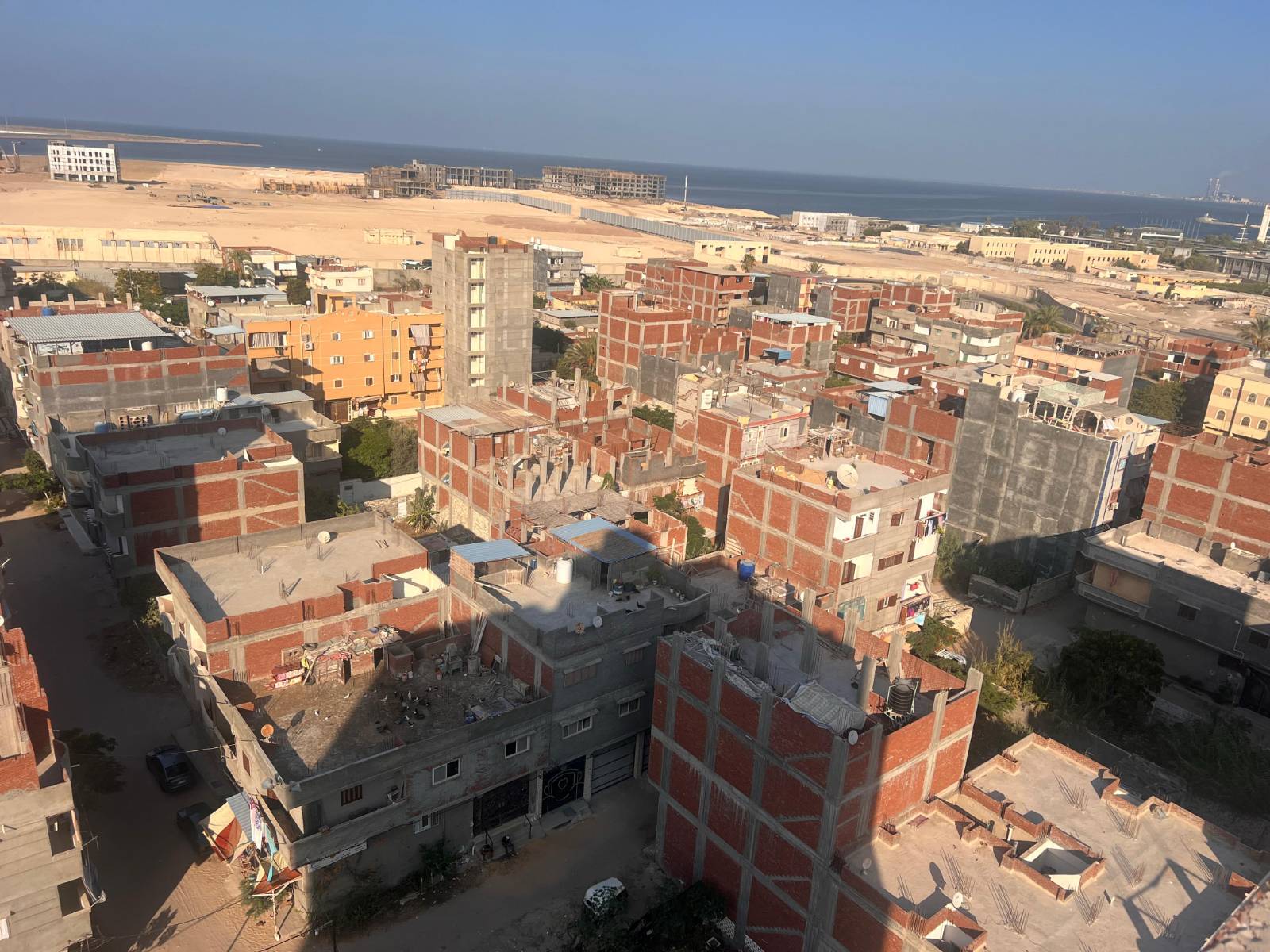
Govt to tear down Toson residential area of east Alexandria
Around 6,000 families who live in the crowded, red-brick residential areas in and around Toson, Alexandria, face the loss of their homes, which the government has decided to tear down to build a ring road and power station.
The neighborhood’s residents, who got legal title over a decade ago to the land their homes are built on, have battled for months to persuade authorities to change course.
A prime ministerial decree was published Thursday, however, ordering the expropriation of swathes of the land in east Alexandria’s Montazah 2 District, where their homes are located.
Toson is a collection of residential hubs that have grown together to form a crowded network of high-rise blocks of homes.
The east Alexandria area used to be arable, divided up between small-scale farmers, until the government filled in a canal in the area, rendering the land gradually unworkable for agriculture. Residents later bought up the land from farmers to build informal housing over the course of the 1990s — the way a majority of residential neighborhoods across the country have come into being.
Now, their homes are set to be demolished to make way for a flyover road that will extend Mahmoudiya axis and link it to New Abu Qir City, as per a map that residents obtained through personal contacts within the governorate.
Compensation will be paid out to the owners of 596 plots of land and buildings to the value of LE1.262 billion, or an average of LE2.117 million per property or plot, according to an explanatory memorandum by the local development minister, which accompanied the decree’s publication in the Official Gazette. The decision said the Armed Forces Engineering Authority will oversee both the compensation payments and the project’s implementation.
Mohamed Ramadan, a lawyer representing several residents from the area referred to as “Hod Tabiyet al-Raml” in the decree, told Mada Masr that he is currently consulting with the residents on possible legal action.
Ramadan has consulted with the residents over recent months over steps to oppose the governorate’s preparation for the demolitions, but authorities have responded harshly to their efforts so far. One of the residents, who was active in resisting surveys and inspections sent over the summer by Alexandria Governorate officials to enter streets and properties, has been detained.
The resident, Abdullah al-Sayed, is being held in remand detention at Prison 6 at the 10th of Ramadan prison complex pending investigation by the Supreme State Security Prosecution into charges of “joining a terrorist group, spreading false news, financing a terrorist group and misusing a social media account,” his lawyer Osama Salama, told Mada Masr.
Residents told Ramadan that plainclothes officers first went to Sayed’s home in the early hours of the morning and knocked repeatedly at his door, before later showing up to his workplace, where they identified themselves when questioned as National Security Agency personnel before taking Sayed away with them.
Ramadan told Mada Masr he believes the authorities’ pursuit of Sayed is meant to pressure residents to back down from their insistence on resisting displacement.
Tension between the residents and local authorities has built over the course of the year.
Initial surveys of homes in the Toson residential area began in July on the basis of a decision issued by Alexandria Governor Ahmed Khaled, which formed a committee of administrative development, real estate and military engineering officials to take an initial survey of properties affected by the new ring road project.
Residents in some areas pushed back fiercely against the survey teams, particularly Ezbet al-Kobaniyya, where their resistance caused temporary delays, the resident said, while in Ezbet al-Makana, the committee was not able to conduct any surveys at all.
In Toson itself, the resident said surveyors initially declined to explain why they were there, or whether compensation was planned. Residents later managed to speak with a naval officer accompanying the team, who told them in a “rough” tone that the area’s demolition was inevitable, saying, “The entire area will be taken and demolished.”
The surveys were carried out with a heavy police presence, the resident said, including Central Security Agency forces. Committee members set up surveying equipment on rooftops without entering apartments, while collecting data from residents on apartment sizes and occupants.
Some residents refused to allow access to the buildings, to which surveying staff replied with: “Fine, tomorrow you’ll come running to us to do your survey. You don’t exist for us now.”
By July, the committee had sent surveyors to inspect 227 buildings, according to a resident in Toson. These included a licensed, five-storey church and three mosques, one of which houses a charitable association.
In early September, the head of Montazah 2 District called residents again to inform them that a surveyance committee would soon arrive to survey the area.
The residents met with Ramadan, agreeing to refuse entry to any survey or valuation committees, and notified district officials of their categorical refusal to leave their homes. Residents hung banners reading, “We will not leave our homes.”
Plainclothes officers tore the banners down in the early hours of the morning — an act that was caught on surveillance footage.
When the residents requested a meeting with the head of Montazah 2 District, she refused to see them. But not long afterward, several residents were summoned by the district head of police investigations and warned against collective action, which they were told could be construed as politicizing their cause, a resident who attended the meeting told Mada Masr. The investigations head acknowledged during the meeting that police had taken down their banners.
Residents put new banners back up, and Ramadan told Mada Masr that the investigations head summoned some of them again, warning them that the state considered the banners a form of organizing protests. Protests have been heavily prohibited by law and hard-handed security responses since 2014.
The lawyer said informants were subsequently deployed across the neighborhood to pressure residents into taking the banners down. The resident who attended the meeting with the head of investigations noted a security presence after Friday prayers, including a vehicle carrying police officers, one of whom questioned residents about whether they were gathering for prayer or to protest.
The prime ministerial decree published Thursday clarifies that the expropriations are intended to make way for a 23-kilometer stretch of the ring road and the construction of the Sakakin power station, both part of the East Abu Qir development project being overseen by the Armed Forces Engineering Authority.
Ramadan, who has already filed complaints with the president, the prime minister and the transport minister requesting reconsideration of the road project, told Mada Masr that he intends to file an initial objection to the prime minister’s decree within 30 days of the decree’s publication with the authority for which the project is being implemented — which he anticipated would likely be the Transport Ministry.
If the objection is rejected, he will have 30 days to pursue legal action after the authority’s response.
تقارير ذات صلة
The monks’ revolution: St. Catherine’s battle for independence
For the monks, the new law amounts to nothing less than “erasing the monastery’s independence”

St. Catherine: Monks in the face of the state
In late May, the Ismailia Appeals Court ruled to evict the archbishop of Saint Catherine's Monastery from 14 land plots in South Sinai, part of a larger dispute with the…

Welcome to Sharm el-Sheikh: President’s City, City of Peace, City of COP27
Beneath the mask the city’s donned for COP27 are the marks of years of uncalculated redevelopment
Your support is the only way to ensure independent, progressive journalism survives.
You have a right to access accurate information, be stimulated by innovative and nuanced reporting, and be moved by compelling storytelling. Subscribe now to become part of the growing community of members who help us maintain our editorial independence.
Join us