
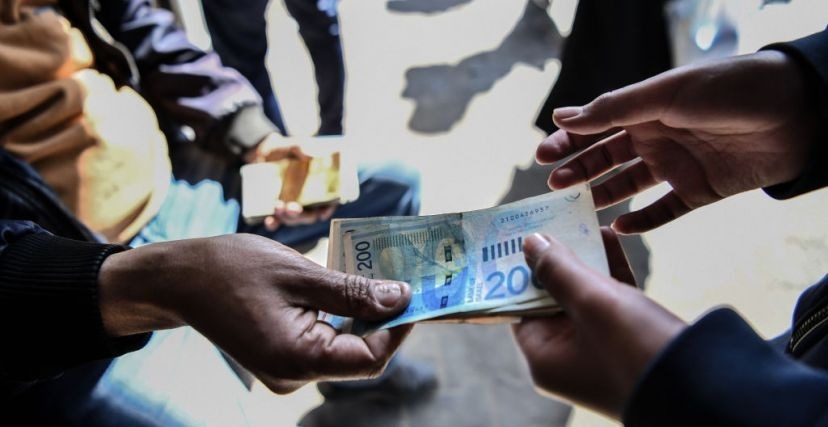
Commission traders charge over 50% as cash drain worsens Gaza starvation
Mohamed al-Arabeed wanted to withdraw around 800 shekels out of his bank account. To do so, he had to resort to the services of a “currency trader,” a class of businesspeople with rare access to cash in the Gaza Strip who are currently charging commissions of over 50 percent to cash out digital transfers.
Arabeed paid 54 percent of the sum as a commission, receiving only 380 shekels cash in hand (around US$110). He used the money to buy the ingredients for a single meal, as well as a pound of flour, a couple of tomatoes and two cucumbers — as far as the money stretches in Gaza’s markets.
A rapid inflation in the rate of commission rates charged by cash traders is exacerbating living conditions for consumers across Gaza amid the worsening starvation.
At the same time, consumers are forced to depend on the traders for cash after nearly two years of Israel’s genocidal war has extinguished access to banking and financial services inside the coastal enclave — conditions that the Mezan Center for Human Rights, a non-governmental organization based in Gaza, has called a tool of genocide.
Meanwhile, Israel’s five-month siege has not only throttled access to basic living necessities and sent prices soaring, but is also slowly draining already scarce cash reserves out of the strip.
The commission trade sprang up months ago to supplement declining access to banking services over the course of the war, but rates have spiked rapidly amid the starvation policies.
All ATMs in Gaza are now out of order, either destroyed by Israeli fire, located in inaccessible military zones, or lacking the cash to operate. But the last functioning bank branches were in central Gaza, in both Nuseirat and Deir al-Balah. With cash supply coming in only once a month since October 2023, these only operated partially. As a result, crowds would gather in huge numbers in chaotic scenes outside the facilities.
The jostling to access the ATMS meant that many people were already turning to the cash traders. Such was the case for Ibrahim Hussein, a former employee of Palestinian Airlines who was displaced from northern Gaza. He had to pay around 30 percent of his nearly 1,500-shekel paycheck as commission just to access his salary, he told Mada Masr.
By October 2024, however, even these last remaining ATMs were out of service, leaving the traders with a monopoly on cash access for banking or financial services customers in Gaza.
The commission rates have since soared, save for a temporary respite during the short-lived ceasefire in early 2025, when commission rates dropped to 15-30 percent.
With Israel renewing its military campaign and tightening the siege in March, the rates have skyrocketed again. Speaking on condition of anonymity, one dealer told Mada Masr that he had no choice but to participate in the “cashing” system, given Gaza’s dire economic conditions. He said that he had to pay a commission to another middleman to access money sent via bank transfer — forcing him to raise the commission he charged his own customers.
The soaring commission rate deepens the financial strain that households are already experiencing due to the “obscene prices” of market goods, said Mohamed Abu Hassanein, who recalled paying a 48 percent commission to cash out his salary last month.
Wafa Saqallah also described an “insane rise in food and vegetable prices” that she is struggling to purchase without access to cash. She is entitled to a 1,000-shekel financial assistance grant from the United Nations Children’s Fund (UNICEF), but the PayPal agents authorized by the organization to disburse the funds in Gaza have also run out of cash.
Saqallah tried to withdraw the money at a low commission rate, but was only offered tattered banknotes that no one would accept, she told Mada Masr.
With no new currency entering the strip and a growing proportion of existing notes worn and damaged, stalls specializing in repairing banknotes for a small fee have sprung up across Gaza’s markets and streets.
Prior to 2023, Palestinian and Israeli authorities coordinated to replace damaged or worn banknotes with new ones. But that coordination has ceased.
In an attempt to ease the crisis, Gaza’s police announced on July 10 that all denominations of the currency must be accepted, provided the serial numbers are still intact. The statement added that specialized inspection and control teams would monitor compliance with the decision, especially among traders and market stall owners, warning that violators would be subject to “legal accountability and strict measures.”
But many banknotes have effectively become worthless as traders and vendors refuse to accept them due to their poor condition, leaving consumers with no way of purchasing what they need as many vendors also refuse to accept bank transfers.
At the same time, cash is draining from the strip under the siege policies. Another merchant in Gaza who spoke to Mada Masr said that traders are stockpiling funds to pay for truckloads of commercial goods that can be brought in through the Karam Abu Salem crossing, where Israel mandates that all transactions be completed in cash.
Occasional commercial deliveries are now entering the strip in heavily guarded convoys, since Israel began to allow occasional deliveries in recent weeks.
But many of the few goods and aid supplies entering the strip are being looted then resold at extortionate prices.
Economist and member of the Palestinian Businessmen Association in Gaza Mohamed Abu Jiyab said that this parallel economy, facilitated by the tight siege conditions and Israel’s policies at the border crossings, has fueled an informal trade that is now sucking cash out of the strip’s markets.
Individuals involved in looting and reselling aid are hoarding cash, said Abu Jiyab, with the cash they accumulate kept out of circulation.
Citing the multiple accounts of Israeli forces enabling or protecting looters, and Israel’s insistence on taking cash only in exchange for imports into Gaza, Abu Jiyab described this phenomenon as part of an Israeli strategy to worsen the economic collapse and undermine Hamas’s financial base.
This cash vacuum has pushed Gaza’s residents into adopting alternative means of exchange: bartering.
Social media groups have become hubs for commodity exchange, with people offering to trade rice for sugar, or canned goods for any other available food. In some cases, sellers have offered goods at pre-war prices, but only in exchange for cash.
تقارير ذات صلة

Gaza’s phase two arrives. Kind of …
Consensus over key questions lags behind the United States' announcement of progress.

Gaza’s child amputees

Israel finally approves Egypt’s gas deal after nail-biting battle
In an unexpected move, Israeli Prime Minister Benjamin Netanyahu announced on Wednesday Israel’s final approval of a controversial gas export deal with Egypt, months after Israeli hesitation following the initial…
Your support is the only way to ensure independent, progressive journalism survives.
You have a right to access accurate information, be stimulated by innovative and nuanced reporting, and be moved by compelling storytelling. Subscribe now to become part of the growing community of members who help us maintain our editorial independence.
Join us