
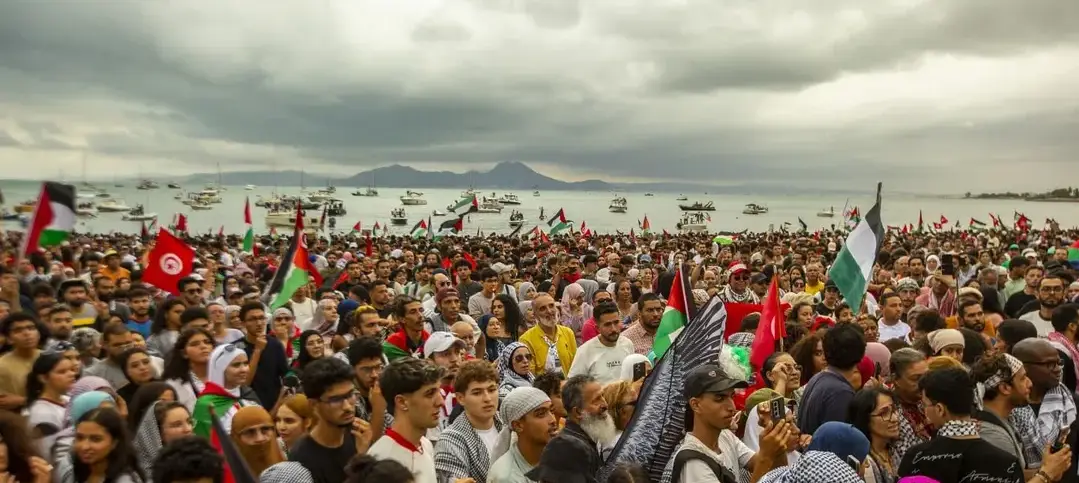
Breaking the siege on Gaza and our political imaginary: Ali Kniss on sailing with the Maghreb Sumud Flotilla
The Global Sumud Flotilla set sail last week toward the Gaza Strip in hopes of breaking Israel’s siege and starvation campaign against Palestinians in the coastal enclave.
Ships that began moving last week from the coasts of Tunisia, Spain, Italy and Greece, among others, are gathering in the Mediterranean to take their journey together.
It’s the fourth attempt by global activist movements to break the siege during the current genocidal war on Gaza, after Israeli forces intercepted and attacked two previous single flotillas before they reached Gaza.
For North Africans, who have decades of support and solidarity with Palestine and its people behind them, from Tunisia hosting the Palestinian Liberation Organization in the 1980s to former Tunisian President Moncef Marzouki’s participation in the 2015 Freedom Flotilla III voyage that departed from Greece to Gaza. The current flotilla marks their second attempt to break the siege during this war, after efforts to reach Gaza by land were shot down in June by authorities in Egypt and eastern Libya.
For Ali Kniss, a Tunisian leftist organizer and a member of the Maghreb Sumud Flotilla ships joining the fleet, persisting in trying to break the siege is about solidarity with the people on Gaza as Israel’s genocidal war heightens on Gaza City, as much as it about combatting the sense of despair haunting people in the region.
Kniss, who was one of the participants in the convoy that was turned down in Libya, has now been sailing for days toward Gaza on the ship Yasser Jradi, ready to face the very real risk of an Israeli attack on the fleet.
Before he set sail, he spoke to Mada Masr about organizing for Gaza against the sense of defeatism in Tunisia and the need to reignite popular political imagination in the face of an international and regional system that serves Israel’s actions.
***
Mada Masr: What was the political climate in Tunisia before October 7 and before the launch of the Sumud Convoy, which brought people together in Tunis to travel across North Africa by land in an attempt to break the siege on Palestinians earlier this year?
Ali Kniss: The situation in Tunisia during that period was one of general despair amid the beginning of the political impasse and crackdown in national matters. The Palestinian cause was a gateway to the mobilization of society and redrawing the dynamics of political action.
There has been an erosion of official political parties, major organizations and civil society in Tunisia. So, organizing took the form of open, popular campaigns, outside the official political sphere, even for people who are organized within party frameworks or other associations. Other frameworks for action emerged because everyone is united on the cause of Palestine.
This gave people confidence in this form of organization, and even the authorities were unable to obstruct it. Because, in the end, you are talking about masses of people. There were attempts at restriction, ultimately, using administrative procedures or technical shortcomings. But thousands were mobilizing by collecting donations and or demonstrating, and around 1,500 people are participating in the convoy. This is a popular path that neither the partisan opposition nor the state is capable of accomplishing.
MM: How was this mobilization achieved and sustained despite the obstacles and the prevailing sense of despair in the region? Has renewed organizing around Palestine affected people’s political engagement?
AK: The problem since October 7 has been the absence of action at the level of activists and the popular masses. There is a feeling that people are incapable of doing anything tangible. And the attempts to do something came very late. The first attempts to act, with the Sumud Convoy, was at first viewed as a utopian and impossible idea.
This general despair in the Arab region is clearly a result of the political reality we have been living through since before the Aqsa Flood, that of counter-revolutions and the Abraham Accords. But despair is not the problem; the problem is what we will do. The problem is the inability to think about reality in order to change it. And there is a narrative that has been created for Arab societies, in public opinion and the media, that Israel will soon collapse from within, so people tend to give up or don't even attempt action.
There is a defeated political imagination that wants to think about defeat — not in order to end the defeat and overcome it, but in order to accept defeat. This defeated, frustrated political imagination is unable to do anything in the end and it may see that there are no actions that have value. But that is not true. There are attempts at action.
The moment we lived in the convoy was a manifestation of the Arab revolutions and of people's ability to change and act in reality. From its departure from Tunis through the rest of Tunisia, it was clear that people were thirsty for real action, thirsty to have an effective role. And when the convoy proved that there was a possibility for action, people rallied around it in large numbers, both in Tunisia and in Libya. Mourning was declared for the political life of these peoples, but they remain and are capable of acting when a popular dynamic for action begins.
MM: You faced a great obstacle in Libya and, of course, those who came to Egypt for the Global March to Gaza also faced a difficult situation.
AK: Yes, the biggest obstacle the convoy faced was in Serte in central Libya. We faced from the eastern Libyan government the same methods of security regimes that try to prevent any popular action. We found ourselves in a clash with regional and international alliances in a Libya divided by war and Western intervention.
But we could see, for the first time, amid the divided situation there, that people in Libya felt they had the capacity for political action related to popular causes, related to the Palestinian cause.
It was clear that those standing between us and Gaza were these Arab regimes, who, by the way, are not exceptions to history — generations tried before us in 1948 to cross to Palestine and participate in the war were prevented by colonialism and the regimes of King Farouk in Egypt, the Deys in Tunisia and the Turks in Libya. So there is no surprise that happened in the end. But there was always solidarity and action as well. Older generations were aware when Italy began to bomb Libya in 1911, and popular solidarity movements were launched in Tunisia, and associations and parties donated to support the Libyan people. The same happened during French colonialism in Tunisia. People turned to Libya to seek help from the Ottoman army at that time, and resistance actions were launched from the Libyan borders toward Tunisia.
For Egypt, my assessment is that the Global March to Gaza was a campaign by well-known activists, while the convoy, for example, was a popular convoy and the people are the ones making the difference.
MM: So, the movement to join the flotilla is driven by the idea of mobilizing the street again, reigniting the political imagination from a second perspective, and supporting people to see and participate in shaping reality.
AK: Ultimately, it's a political act that proposes lifting the siege, ending the war, and ending the Zionist settler colonialist regime — generational political goals. It is not about whether or not we achieve them this time, we should not evaluate in terms of success and failure like a company.
We want to be part of the action in this reality. It's true that Arab governments have a responsibility, but there is a responsibility on our shoulders to try, and we believe in our ability to act.
The convoy gave people confidence. We faced difficulties, but it became clear that those who stand between us and Palestine are these Arab regimes. Gaza is not far away, but Israel surrounds us with miniature Israels. Lifting the siege is as much an act of support for Gaza as it is an act of liberating these societies and these peoples from these policies, these regimes, these international agencies. They are part of a regional and international system which has an interest in the status quo.
But when a movement begins to take action, another reality opens up. It is different from the reality governed by despair and by virtual, fluid, unreal action that clouds our reading of the world.
This is what we see the resistance did in Gaza. They saw the reality when the popular masses in Gaza tried to overcome the six-month siege by gathering at the gates of the fence separating Gaza and the Zionist entity. This ultimately did not lead to any results, and the region then went into a complete new normalization process with the Abraham Accords. So, the resistance went in the direction of the Aqsa Flood, which opened another door to action, another political horizon.
This horizon is dependent on its outcome, which no entity, thinker, or research office can claim to foresee.
MM: How are you looking at the fleet? And what do you expect to face on your path?
AK: We wanted to ensure some popular participation in the fleet as well, but since it requires significant financial resources, such as ships and their cargo, participation is slightly less. We are also engaging people through demonstrations at the reception of ships and other events.
This time, the Zionist entity is not dealing with one or two ships like before, but fleets from different countries like Spain and Italy.
Of course, we expect violent intervention from an entity that has engaged in organized crime and genocide and does not abide by any international laws. Our international system of governments is either participating with Israel like the United States, implicated in the genocide, or silent. This is what has pushed people to move, because these institutions of the international humanitarian system are helpless and have abandoned their roles.
If this flotilla is targeted, and it is very likely that it will be targeted in various ways, in the end, this will provide further evidence that this colonial system is not only a threat to Palestine, but a threat to the entire region, to its unity, to the continued existence of people in this region as societies and cultures, and, ultimately, a threat to the entire world.
تقارير ذات صلة

Gaza’s child amputees

The quiet power of Gaza’s One More Show
An intimate portrait of Gaza's only circus troupe and their resilience amid Israel's genocide
Your support is the only way to ensure independent, progressive journalism survives.
You have a right to access accurate information, be stimulated by innovative and nuanced reporting, and be moved by compelling storytelling. Subscribe now to become part of the growing community of members who help us maintain our editorial independence.
Join us