
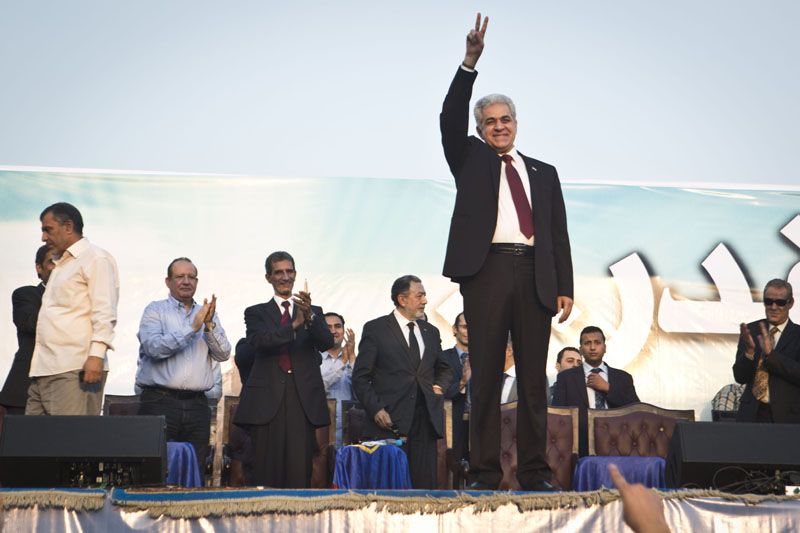
Between voting for Sabbahi and boycotting
With Field Marshal Abdel Fattah al-Sisi poised to win the presidential election, a minority of young voters are still opting to vote for his rival Hamdeen Sabbahi — or boycott the election altogether.
The Revolutionary Front — formed last September and comprising several secular youth groups, such the April 6 Youth Movement — and other political activists have announced that they are boycotting the elections. However, the Revolutionary Socialists, also members of the front, announced they are endorsing Sabbahi.
Other human rights advocates also chose to boycott the elections.
Wael Eskandar, an independent journalist and blogger, says he was originally planning to vote for Sabbahi, as the representative of a civilian secular coalition. He saw this as a first step to building an alternative political process in the future.
However, Eskandar then decided to boycott after seeing a poster on Qasr al-Aini Street in downtown Cairo allegedly sponsored by the Interior Ministry, urging Egyptians to vote and vowing to protect them.
Eskandar notes that the elections themselves may be “free but not fair,” due to what he calls an undemocratic context and the oppression of state institutions.
As a person who rejected both the military and the Muslim Brotherhood, he feels alienated in a country which is not his own, Eskandar says.
“We [revolutionaries] always were a minority in the past few years, but this time there is a limited momentum of support and many are no longer ashamed of their thirst for blood,” he explains. “It is a celebration of mediocrity.”
In Mansoura, Ahmed Hassan, 22, an engineering student at Mansoura University, says that he's not voting today. Hassan used to support the Nour Party, and was also active in the Kazeboon (Liars) campaign which condemned military brutality in 2011.
“It's just a game, and I don't want to participate,” Hassan says, adding that only one of his friends was planning to go out and vote today.
Others, meanwhile, opt to vote for Sabbahi.
Karim Medhat Ennarah, a human rights researcher, claims he was originally thinking of boycotting, but decided to vote for practical reasons.
“Although there is very little legitimacy in the elections, and although I strongly disagree with Sabbahi, I decided to vote for him because it will make this election less of a coronation process for Sisi and reduce the total votes for him,” Ennarah says. “Even a 10 percent vote for Sabbahi would be a victory.”
Ennarah also believes that a minor victory would boost the morale of a democratically minded community and assert its existence.
“While political space is closing and our range of options is decreasing, it is important that we engage in the political process in order to assert our existence and increase our political movement,” Ennarah argues.
He calls Sisi a criminal whose administration would fuel conflict, rather than bring stability, claiming that Sisi is shutting down the robust political participation that had been catalyzed by the January 25 revolution.
“His project aims to reinstate the old governance model where a minority security clique has control over the political process,” Ennarah says.
Mina Fayek, a software developer and blogger, was present at Sabbahi’s presidential rally in Abdeen Square in downtown Cairo on Saturday, and overall, views several positive traits in the presidential candidate.
“Most of those supporting him are young, and his campaign claims it will realize the goals of January 25,” says Fayek, “and if he doesn’t many will hold him accountable.”
The elections are happening in a repressive time, Fayek says, asserting that revolutionaries should take advantage of all political openings available, even if the system is flawed. He believes that reducing Sisi’s votes from 90 percent to 70 percent would be a victory.
Unlike Sisi, “Sabbahi has a well thought-out political campaign and street movement,” Fayek claims. “He also seems committed to the revolution’s goals, social and economic reforms, freeing political prisoners and removing the Protest Law.”
Fayek supports Sabbahi’s political experience, as he was a vocal dissident against the Sadat and Mubarak administrations.
Sabbahi “has a breadth of political experience. He was an activist in his youth, a journalist and a member of Parliament for 10 years,” he explains.
Whether opting to boycott or vote for Sabbahi, political activists note that now, more than ever, Egyptians’ choices are limited in an increasingly repressive environment.
“Since January 25 we have had limited choices, and it was always a lesser of two evils — the Muslim Brotherhood or the Supreme Council of the Armed Forces (SCAF). But now, the choice is even more limited, and popular support for a third alternative is waning,” warns Fayek.
Eskandar agrees, adding grimly, “These elections are taking place over piles of dead bodies, and we are paying a very high price.”
تقارير ذات صلة
Abdel Moneim Abouel Fotouh: A man apart
His political journey has been a winding one.

COVID-19 drive-thru testing rollout blurs lines between public, private sectors
The prime minister visited the company’s first drive-through site the day it opened, on June 15.
A presidential race, anyone?
Plans for Sisi’s campaign take shape as other political figures weigh up running in the 2018 presidential elections
Your support is the only way to ensure independent, progressive journalism survives.
You have a right to access accurate information, be stimulated by innovative and nuanced reporting, and be moved by compelling storytelling. Subscribe now to become part of the growing community of members who help us maintain our editorial independence.
Join us