
Band of the week: Maurice Louca
One day, while I was stressing out about a deadline, a peer attempted to console me with a thought regarding digital publishing.
“Deadlines are imaginary,” she said.
And suddenly there was the sound of glass shattering inside my brain. For all my years and thousands of deadlines, I never once thought them to be imaginary. On the contrary, deadlines are as serious as water, food and booze — perhaps this could have something to do with my print beginnings. But without deadlines, I’m lost not only in writing, but in lifestyle — days pass unaccounted for and assignments wither away in idealism. I’ve heard many journalists say that it’s usually during the hours closest to the deadline that our imagination turns into writing and our story is made.
My friend’s comment strikes me often, and has had me thinking about other spaces or producers of the imaginary in Egypt.
Good dance music plays heavily off an imaginary dialogue between the producer and the audience, played out in a vibrational language. The music is made to stealthily create collective action, often without words. Each person in the sonic sphere is left to imagine and carry out their own reactions to the sound. There’s a freedom to move to whatever sound they choose to syncopate with: a sinuous beat, knee-bending basslines, or any of those other electronic embellishments.
In Egypt, these moments are painfully infrequent, and certainly fleeting. On the production side, you have certain dance music creators that can shake and bake their audience on a whim: Fulltone, Soopar Lox, Wetrobots + Bosaina and many of the mahraganat musicians. But even they are still playing it safe in the sounds they are producing and how they are performing them. They are working within the realms of reality, though certain songs scratch the surface of the imaginary — Cellar Door’s “Blind Part 1,” for example, or Madfaageya’s “Fi Haga Mesh Mazboota” (Something’s not right). And there was that magic moment last month at D-CAF when Fayze Miyake laid down some wicked grime beats as Sadat and Alaa Fifty spit incredible rhythms into the mic.
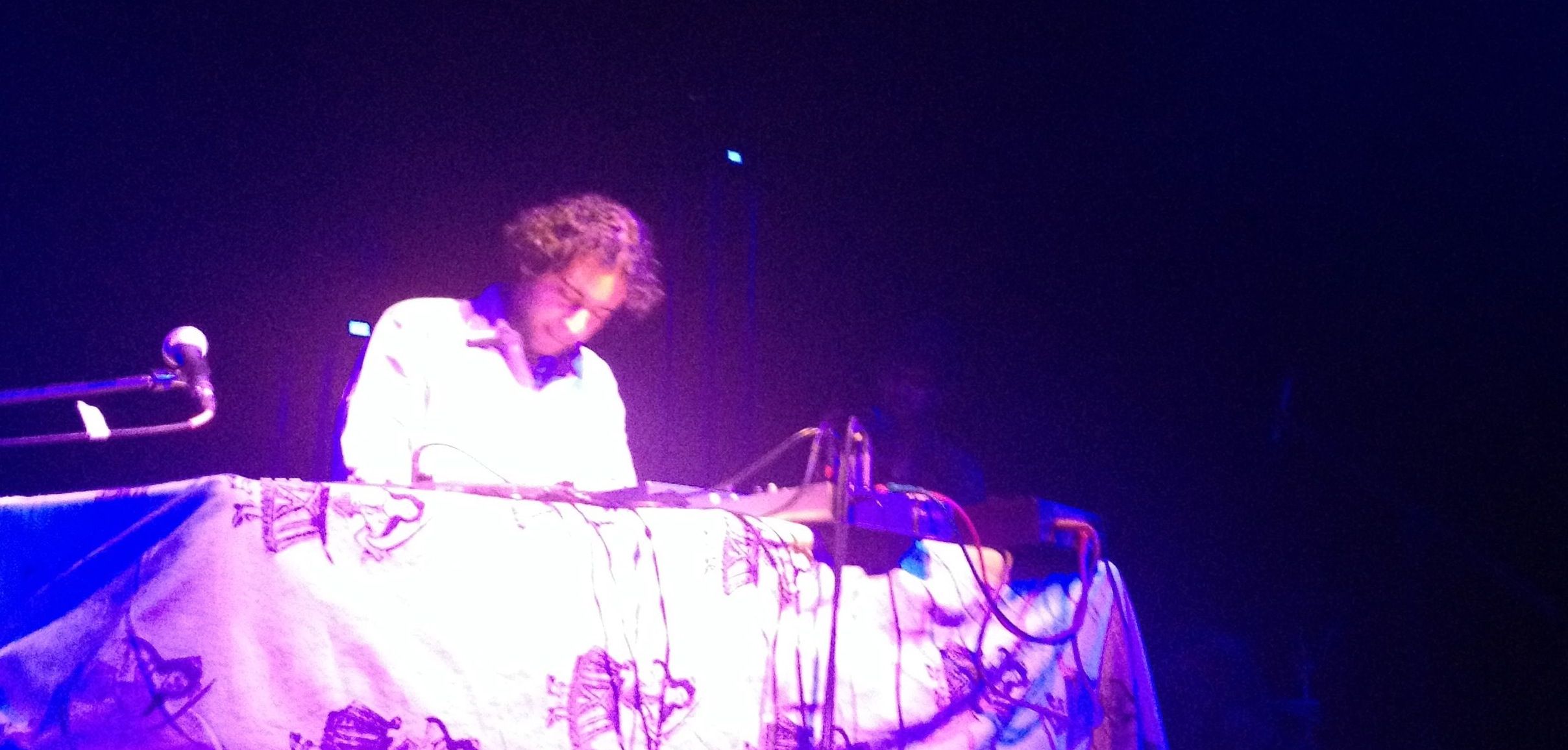
Another masterful display of musical imagination happened a couple weeks ago at the 3alGanoob festival in Marsa Alam. For one perfect hour, I had a great time of playing pretend within the sonic imagination of producer and live DJ Maurice Louca as he performed an epic set on the beach. He’s someone whose name I’ve been hearing for a while, but somehow I’ve usually missed his solo shows due to haphazard circumstance. At the festival, Louca was armed with his usual one man-show set-up: modulator, effect box, sampler and laptop. It was dynamite — it might have been one of my more exhilarating dance music moments in Egypt — with a perfect level of bass, rhythm and break beats as bare feet slammed and shuffled in the sand and arms thrust at the stars. Louca’s set was ambient and industrial, like some sort of galactic poetry, with noises that were folkloric and futuristic. But it never lost its rhythmic pulse. It seemed that even the moon couldn’t help but hang low and close to the music.
This experience explained for me why Louca has formed a cult following among Cairo’s independent-thinking culture-goers over the years. Prior to hearing his show at 3alGanoob, I was surprised to find that nearly everyone I spoke with at the festival had largely been motivated to book tickets as a result of Louca’s presence on the line up.
Having launched onto the scene in 2005, playing keys and a sampler in Bikya — a folktronica project with Mahmoud Waly on bass and Mahmoud Refat on drums and synth — 32-year-old Maurice Louca has years of performance experience under his belt.
Bikya came to be known for a special blend of drum 'n' bass rhythms, Detriot techno embellishments, funky bass lines and noise elements. The band is still together, performing sporadically, but now the three individuals work on their solo and side projects more regularly.
In 2011, Louca released his first solo album, “Garraya,” on the 100Copies label, and since then he has continued to work on a follow-up album based off the set he has been performing and recording over the past year. His solo work proves his wild imagination from start to finish — most of what we are hearing as the audience are separately recorded tracks of instrumental pieces by various musicians that Louca has worked with over the years.
Louca says most of the set is pre-recorded with various other musicians playing percussion — he then lays down the tracks horizontally, playing them live off his mixer, using the modulator and effect box to alter them while also adding break beat samples. For a live effect, he also adds embellishments on the keys to make polymorphous melodies from synthesized sounds like high pitched drone loops, and percussive sirens. The music is psychedelic, polyrhythmic, but driven home by its constructed and deconstructed shaabi tonalities. The tracks evolve and take new form in each set, giving even the most loyal of fans something new with every live show. The album is tentatively scheduled to release in October this year.
Meanwhile Louca is currently in the studio working on a side project called Alif Ensemble — a pan-Arab, multi-instrumental band due to release their album in the coming year. Founded by renowned Iraqi oud player Khyam Allami, and formed around Louca and Palestinian composer and producer Tamer Abu Ghazala, the project brings together various other musicians from Syria, Lebanon and Jordan, creating a contemporary take on oud-driven acoustic-electronic music.
Their sound is melancholic yet modern, with frequent vocal interventions by Ghazala, who recites a poem called “Hassan” by Iraqi poet Sargon Boulos against progressive rock riffs, electronic textures and some improvisation when performed live.
These projects help explain Louca’s dancing cult following.
At some point during his 3alGanoob set, as he was performing his track “Late,” I found myself marching across the dance floor, softly chanting, “dance monkey, dance” like a drunken authority incited by layers of wild percussion, drone sounds and synths. One moment I was a dancer in space, fighting off Martians with militant, albeit minimal movements, and the next I was belly dancing like Fifi Abdo at a rave. The transformation from Martian to Abdo was elongated in stretched Arabic percussions, the distorted “sik-sik” of the sagt (finger cymbals) and spacey nay samples.
Louca’s music plays off a make-believe conversation between east and west, past and present, earth and space. It feels simultaneously tribal and futuristic, and the music becomes an agency for the imagination. Your dance movements are your only means of expression between a folkloric past and funky, fidgety future.

Maha ElNabawi
After graduating from the American University in Washington, DC with a Bachelors degree in Business, Maha began her publishing career in NYC with indie pop culture magazines, the likes of…
تقارير ذات صلة
Music industry conversations: Sarah El Miniawy
In a new series, Maha ElNabawi speaks to music professionals about the term “industry”.
Creating a history mixtape: A conversation with Andrew Simon
Cassettes decentralized state-controlled Egyptian media long before the invention of the internet
Detox | The music in the background
I ended my journey among the ruins of the fallen Cassette Kingdom
Your support is the only way to ensure independent, progressive journalism survives.
You have a right to access accurate information, be stimulated by innovative and nuanced reporting, and be moved by compelling storytelling. Subscribe now to become part of the growing community of members who help us maintain our editorial independence.
Join us