
Baladi dogs: A case for animal welfare
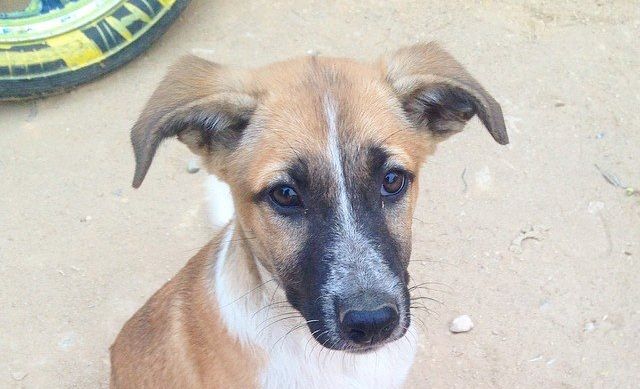
Walking down a Cairo street with an adopted stray dog can elicit a range of reactions, from surprise to rebuke. Their skittish behavior and curled-up tails make them easily distinguishable from the more preferred purebred pets.
Commonly known as baladi dogs, these animals are subject to name-calling while their owners are often pulled into a verbal frenzy that questions and belittles their consideration of adopting these canine friends.
“When you get a baladi dog, you can’t care what people think,” says Hadeer Halawa, who owns three. Her friends and family have ridiculed her for keeping the dogs, but she turns a blind eye to their criticisms.
“People usually come around after they interact with the dogs and see how playful they are,” she says.
Halawa found Mocha, her first rescue, as a two-month-old puppy lying in the street after being run over by a car.
“He was laying a certain way, trying hard to breathe,” she recounts. “I could tell he was waiting to die.” Mocha finally recovered after three different surgeries to fix two broken legs and a broken pelvis. Halawa decided to keep him, and then adopted two more.
If these dogs are not rescued, they are at risk of forced euthanasia through government or private initiatives, which are often encouraged by citizen complaints. They are systematically poisoned, evidence of which has emerged on social media in recent months. In August, for example, protesters condemned the Gezira Sporting Club for the massacre of hundreds of cats.
Many countries have yet to utilize street animals in a productive way, and in Egypt, the treatment of animals — particularly dogs — requires a paradigm shift.
In addition to a cultural and social stigma against them, these animals are often considered to be no more than pests, and are typically treated as such.
“Animal welfare is not part of our culture in Egypt,” claims Aya Shehata, a volunteer with the Maadi trap, neuter and release (TNR) initiative. “People think of animals as some kind of object instead of something that has a soul, like us.”
TNR programs are promoted by global animal welfare organizations, such as Humane Society International, as a euthanasia alternative to curb and control feral animal populations.
Maadi TNR is a grassroots volunteer group that started eight months ago. Its members work closely with local animal hospitals and vets, who provide vaccinations and spay-neuter operations before releasing the animals back to the streets. They also clip the ears of the animals in order to track which ones have been treated.
Shehata says the group was launched after several of its members met while working in the crowded Egyptian Society for Mercy to Animals (ESMA) shelter in Giza.
“Egyptian shelters can’t care for all the baladi dogs, so we started thinking how we can help the animals besides what they are already doing,” she explains.
The group has already covered 22 streets, catching 170 cats and 15 dogs.
Veterinarian Karim Hegazy is a strong proponent of TNR programs as a long-term solution.
“We want to decrease the population without any harm to the animals themselves,” he says.
Hegazy criticizes government-supported initiatives that kill thousands of stray dogs by spreading poisonous substances.
“When they come into contact with the poison, their respiratory muscles squeeze so tightly they can’t breathe,” the vet explains. “Ultimately, they die from asphyxiation.”
“It’s hard to catch the government poisoning them, because they do it late at night or early in the morning,” Shehata says. “What we will find is leftover scraps of meat, and we try and clean it up so no other animals die.”
The General Authority for Veterinary Services, a department of the Ministry of Agriculture, is thought to be responsible for these initiatives, which can kill up to thousands of animals at one time. In January, 2013, approximately 1,800 dogs were killed in Ismailia, with plans to extend the initiative into other cities, according to the Suez News Network.
Maadi TNR, which upholds a strict no-kill policy, continually tries to inform the government of their efforts, giving them an alternative to mass killings. Shehata cites TNR groups in Hurghada that have partnered with local officials as an example of the possibility of such partnerships.
“But they won’t talk to us,” she says.
Hegazy encourages adoption as another option. In his estimation, more Egyptians are starting to adopt stray animals. He currently caters to a clientele of approximately 25-30 baladi dog owners.
Fortunately, animals in Egypt do not just have to rely on the kindness of strangers.
For the first time in Egypt’s history, an article on animal welfare was approved in the January 2014 constitutional referendum. While the legislation will not come into effect until a new parliament is sworn in, Article 45 stipulates the “humane treatment of animals.”
“But this is just a start. To even mention animal welfare in the Constitution is a major achievement,” says Nour Diab, the general manager of the Society for the Protection of Animal Rights in Egypt (SPARE).
“’Baladi’ means local, it means Egyptian, but it has a degrading connotation,” Diab says. But “the dogs are beautiful, smart and alert. Egyptians must start adopting Egyptian dogs.”
Nadeem Maqsoud, 26, recently adopted a dog from SPARE after owning purebred Labrador retrievers and German shepherds while growing up.
“He’s much smarter, much more loving and much more compassionate,” Maqsoud says of his baladi dog Zaza. “I won’t ever regret adopting him compared to a purebred.”
Maqsoud explains that he isn’t really mocked while walking Zaza, but often is asked how much he paid for him.
“It’s ridiculous to think of pets, in general, as items you can buy. They are companions,” he says. This response elicits shock more than anything else.
With sentiments such as these, the growing number of animal activists and welfare organizations are slowly seeing the perception of street dogs change in Egyptian society.
“If you cannot be merciful toward a creature who is doing you no harm at all,” Diab points out, “then you will never be tolerant to someone who is different from you.”
تقارير ذات صلة
The never-ending nightmare of Giza Zoo’s animals
The public-private consortium renovating Giza zoo has shown little regard for animal welfare

Detox | In the company of four-legged friends
This is definitely not a call for replacing humans with animals
Creaturely empathy with desert animals: A Kuwaiti environmentalist’s social media experiment
Much of the appeal of hunting in the region is in the way that it invokes an idealized past.
Your support is the only way to ensure independent, progressive journalism survives.
You have a right to access accurate information, be stimulated by innovative and nuanced reporting, and be moved by compelling storytelling. Subscribe now to become part of the growing community of members who help us maintain our editorial independence.
Join us