
Asleep at the wheel
The line was here. No. Here. No. We crossed. We crossed. They crossed. We switched sides. That’s what happened. We switched sides and then we negotiated a deal with the Americans insisting on lines of ground gained, and the Americans maintained and negotiated grounds that were buffered and lost and gained and lost.
How is the 1973 October War presented as a victory — even though it wasn’t — well, not really. The Egyptian army’s feat in crossing the insurmountable Bar Lev line is fetishized in the concrete fabric of Cairo’s roads and bridges, commemorated in public art, bas reliefs, posters, displays and museum exhibits. The war is invoked in news reports about battles between Egyptian security forces and protesters. In fact, I can’t find anything that is not evidence of the army’s footprint and the war’s significance.
Every time I try to develop a clandestine position, it ends up being blared from the October bridge — through loudspeakers. When this project was first conceived, I can assure you that the military was doing a lot less flagrant exhibitionism.
I find an image online with a caption that reads: Breaking: The image of a young man walking as naked the day he was born on October 6 Bridge — democracy, freedom and secularism prevail. Clearly ElBaradei has succeeded in spreading American freedom in Egypt. If the situation continues without restraint, we will see masses of secularists, liberals and democrats walking around completely naked, and all under the banner of personal freedom!!
Prompted by Sherif El Azma’s lecture performance A Psychogeography of Loose Associations, I plan to conduct a psychogeography of Cairo’s October 6 Bridge.
I suffer from narcolepsy when driving. Eyes snap open once I feel the car swerving, and then seconds later I am drowsing off again. I have no memory of how I get home. Each time, I murmur a prayer and thank God I am still alive. In November 2012, a month before the research was meant to commence, I fall asleep and crash into a taxi outside Tora prison where deposed President Hosni Mubarak was being held. I spend the duration of the research taking the metro and taxis, visiting government buildings, military museums, public libraries. I am not permitted to write down the name of any military official on paper. Is it Ahmed, Fouad, Helmy? I can’t absorb their titles, or the significance of their ranks. I don’t remember. I took a picture of the lapels exhibited in the military museum to help me.

I identify a series of flashpoints, routes and locations, around which the October 6 War is celebrated. The Cairo-Suez highway extends from Revolution Road. The army has built a bridge to facilitate the flow of traffic through a bottleneck named simply Kilo 4.5, an informal low-income area where many Sudanese refugees have found housing in half-built apartment blocks. The road signs that flank the bridge read: “Egypt First.” “Egypt Above All.” “The Army and the People are One Hand.” Right after 4.5, heading toward Suez, a wall and watchtowers conceal a factory known to manufacture weapons and household appliances. Outside one of the gateways, a screen is put up. On one occasion, it displays images of rabbits hopping in a field.
All military compounds bear a sign — “no photo.” I take a picture out of defiance. A newspaper article points out that Google Earth features images of the very sites we are forbidden to photograph. My guide in the military museum tells me that what I don’t realize is that the information I would gather, such as the height of the wall, for example, would be useful for those with sinister intent.
At patriotic flashpoints, our experience of the war is not intensified but bypassed, driven past. There can be no occasion for stopping. Stopping is suspect.
Following the war, President Anwar al-Sadat arranged for those involved in its planning to dress up in their military uniforms and pose for pictures in the Operations Room. Sadat’s realization that the photographic image was part of the appeal of war — and crucial to manufactured victory — emerges in the extravagance of the commemorative events attached to it. Reenactments are conducted yearly. But Sadat’s fabrications proved deadly. In a military parade, he was assassinated by Khaled al-Islambouli, a member of the Islamic Jihad, discontented by Egypt’s peace with Israel. Islambouli stepped out of a truck and killed Sadat, along with 11 others, including his personal photographer. Sadat’s last words: “It’s not possible. It’s not possible.”
How is the bridge a manifestation as much as it is a commemoration of the event? What state of mind has the commemoration of the war produced?
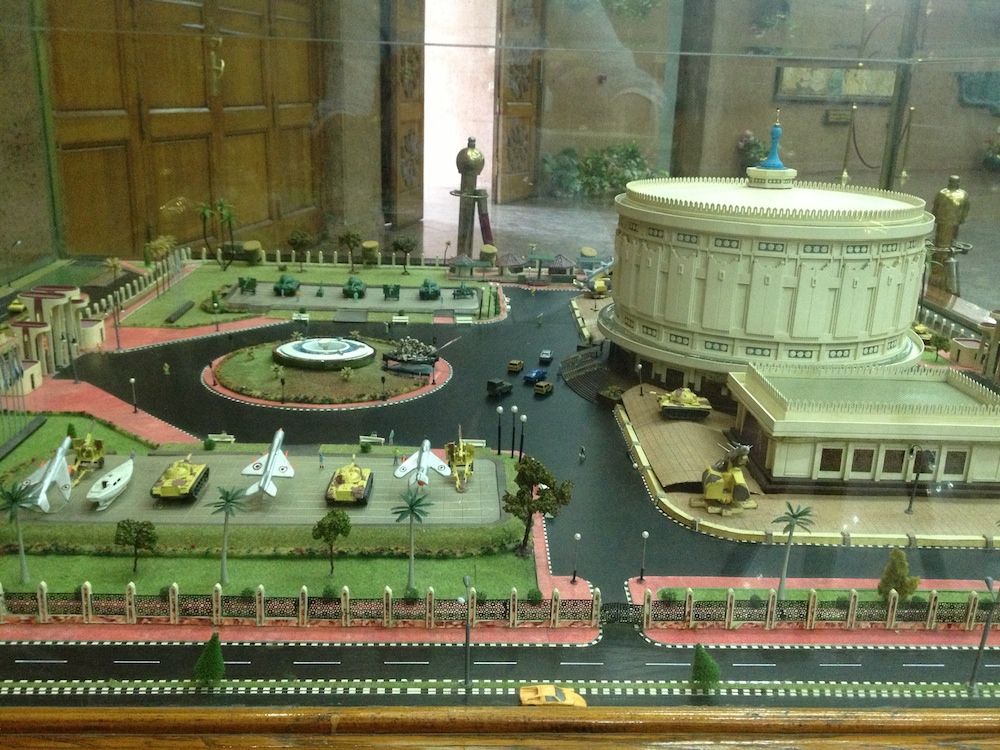
For Mubarak, October 6 was fraught with anxiety and excess. His role in the air force, even today, is used to grant him credit and heroic status. Mubarak famously got the idea to build a war panorama during a visit to North Korea, and in 1989, on October 5, it is opened to the public. Set back from the main road, across from tower blocks named the Oboor (Crossing) buildings, flanked by the Ministry of Information, and a park featuring a cafeteria and children’s fairground attractions, the panorama is a peculiar spot for the great victory — reduced to the moment when the Bar Lev line was crossed and re-enacted in a 35mm film, a diorama and a panorama. The exhibits retain the strategies that granted the military its victory — vantage point, technology and spectacle.
Vantage point
For the Egyptians, the Bar Lev line was a visual barrier. The dyke created an immediate limit to their observational field, making a blind zone that denied them a view of their occupied territories.
The October 6 Bridge grants access across, through and over places. Those vertically elevated in buses are given a privileged vantage point, as car drivers’ sight is obscured by barriers or blinders. In the so-called June 30 revolution of 2013, the most spectacular photographs belonged to the army, not the people. Cameramen filmed the crowds from helicopters.

We have a coherent narrative, albeit one that concentrates on the first few days of the war. There is no room for ambivalence. In a visit to the military museum, I am told I am forbidden from backtracking. Signs of a red finger pointing to indicate the correct direction hang on doorways and corridor walls. They are nestled between displays. My attempt to defy the pointing red hands causes distress. I pretend I have forgotten something. I demand an explanation. “If you don’t follow them, you’ll get us into trouble.”
Sadat’s October Paper, published in 1974, articulated his vision for post-victory Egypt. The building metaphors embedded in this document were taken literally. The army was involved in the construction of bridges that move traffic from greater Cairo to satellite cities, but also in the sale of land to businessmen. The panorama physically and metaphorically receded — and the significance of the war was disseminated into popular imagination in the form of the marks the military makes on the city through the construction industry and the production of civilian goods.
During my visit to the Arab Organization for Industrialization, aka the Sakr factory, I see prototypes of the military’s products on display. Television receivers, radios, TV antennas, personal computers, microwaves, blenders, electric irons, fans, chip fryers, vacuum cleaners. I read that their military products include Infrared guided missiles, artillery rockets, antitank weapons, CNC machines. In the boardroom where I am left waiting, a home entertainment system has been installed with leather chairs and a screen.
The fairground that was positioned in a semi-public military club near Kilo 4.5 has been demolished to make room for a bridge. Unable to arrange for anyone to accompany me, I become increasingly uneasy about conducting the mission alone. One accident-prone friend who doesn’t wear socks has wounded herself by stepping on broken glass. Another has experienced dramatic weight gain and, as an off shoot, is suffering from a leg injury. Is walking alone inevitable? Is paranoia part of psychogeography? Is being stopped a requirement? Lecherously, I contact a freelance journalist with 33,000 followers on Twitter and ask if he will accompany me. I am told that the walk would be acceptable to him so long as the weather is suitable, that anything above 30 degrees is intolerable. He cancels. I send him the 1955 Situationist Internationale essay defining psychogeography. He doesn’t read it.

Technology
In an outdated brochure, we are told that the diorama is operated using 39 switches.
I am encouraged to fetishize the equipment housed in the panorama. The diorama is inaccessible. But a 35mm film made in 1989 instructing audiences about the war’s main events is projected every half hour. The auditorium itself features an installation, but the second in command tells me that they will replace the 35mm with a data projector and create an “in the bunker” experience for future audiences. There is already a similar installation in the military museum, but I am not convinced he is aware of this. “We will take people back to 1973,” he says. I find out later that they will be installing a 3D film. On October 6, 2013, I wait for two hours in line to watch the panorama display. It is packed. I leave unimpressed and steal a book before approaching the director lieutenant of the museum. He remembers me, and says the diorama and film exhibitions will be closed for at least 10 months in order to carry out the changes.
There is no footage of the original event, only reenactments. In 1974, a flurry of documentaries featured the war. By the 1980s a number of feature films were made. In 1978 American filmmaker Fredric Wiseman came to Egypt to film his documentary Sinai Field Mission. The film covers the work of employees of Texan company ESystems, contracted by the US government to maintain the borders between Egypt and Israel and monitor the movement of vehicles and personnel from both sides across a buffer zone. Such a film would be impossible to make today. Commemoration of the war is everywhere and nowhere at the same time. Impossible to avoid and impossible to document. No one can tell me about the photographs, give me copies of the films, provide information about the photographers or filmmakers. Any request for information or mention of photography is met with suspicion. The Ministry of Morale Affairs releases promotional videos. The mirrored doors of its bowling alley, next to the panorama, are firmly shut.
In most accounts, the gains made by the Egyptians were due to advantages in technology and communication equipment, including networks, signaling, jamming and counter jamming devices. During the war, Ariel Sharon would apparently often refuse to respond to orders or pretend he could not understand them. His blatant acts of defiance were sometimes put down to faulty communication apparatuses. In his autobiography, Sadat recounts his arrest during the British occupation after he met with two Germans who elicited his help in fixing a transistor device. In the panorama park there is a litter bin shaped like a rabbit. I am convinced that it looks like Moshe Dayan, with the hole as his eye patch. I try to take a picture so that I can juxtapose them later, but am unsuccessful.

2012: The spokesperson of the Armed Forces, Colonel Mohamed Ali, has announced the release of a short video produced by the military Commander in Chief, General Abdel Fattah al-Sisi, minister of defense and military production and engineering authority of the Armed Forces. The video explains that according to the mandate of Sisi, on September 1, 2012, an access road will be built between the Ismailia Highway and the Ring Road, named after Saad Eddin al-Shazly, which will shorten the distance from Ismailia Highway in the direction through to Maadi to 5 km instead of 15 km. A second project will involve the expansion of the Joseph Tito route, which serves the military and civilians and will relieve traffic pressure from the Cairo-Ismailia gateway.
In a national newspaper a photo-essay comes with the following explanation: The White Knights have cut off the road at the top end of October 6 bridge in front of Ramses Central Station in protest against their colleague Sayed Ali, aka Master (Sayed) Naughty. Security forces arrested Mr. Naughty at dawn the day before yesterday from a cafeteria in the 10th District in Nasr City, citing his association with the group known as “Stand Firm.” His whereabouts and the reason for his arrest remain unknown. During their protest, members of the White Knights asked those in the buildings surrounding them, specifically the Al-Ahram Newspaper Foundation and the Telecommunications Exchange in Ramses, to throw down bottles of water.
Saad Eddin al-Shazly’s achievement was to cross the canal in a short amount of time using pontoons, and Mubarak’s celebration of it was expressed in the slow and laborious construction of October 6 Bridge. Forty years later, another form of commemoration occurs when the default setting of Egypt under military rule is rebooted. The October bridge functions as a live-action monument, screened on television. Through the bridge we can think about patriotism, the role of the military, transport networks, factory production and construction industries. This is the return of the repressed in concrete material form.
تقارير ذات صلة
Judges of tomorrow to be picked, trained by Military Academy, judicial sources say
Anchor Isaad Younis interviewed on Sunday a crew of newly hired government employees — judges, a diplomatic attaché, a school principal, a legal researcher at the Customs Authority, and an…
Egyptian officials: Sisi’s visit to Djibouti part of East Africa ‘charm offensive’
One of Egypt's chief aims is to counter Ethiopian regional influence
Al-Ahram’s coverage of the October 6 War
The archive of the state-owned Ahram newspaper, which Mada showcases on the anniversary of the October 6 War, shows how the war was a turning point after which the Palestinian…
Your support is the only way to ensure independent, progressive journalism survives.
You have a right to access accurate information, be stimulated by innovative and nuanced reporting, and be moved by compelling storytelling. Subscribe now to become part of the growing community of members who help us maintain our editorial independence.
Join us