
Art around us: 𝑆ℎ𝑎𝑚3𝑑𝑎𝑛 and the weight of fire
We were invited to the premiere of 𝑆ℎ𝑎𝑚3𝑑𝑎𝑛 by Nasa4nasa this summer. We have been closely following the collective’s work in the contemporary dance space, often foregrounding the body in its entirety, docility and uncontrollability, countering its reduction to a tool.
The two dancers making up the Nasa4nasa collective, Noura Seif Hassanain and Salma Abdel Salam, are known for their duo dancing in different settings and stages, ranging from Instagram reels to an emptied swimming pool and a squash court in a sports club. But this time, they go backstage and work with nine dancers to perform 𝑆ℎ𝑎𝑚3𝑑𝑎𝑛. We are curious as to what brought such a relic of traditional Egyptian belly dance to their practice. We had some guesses, but were still surprised.
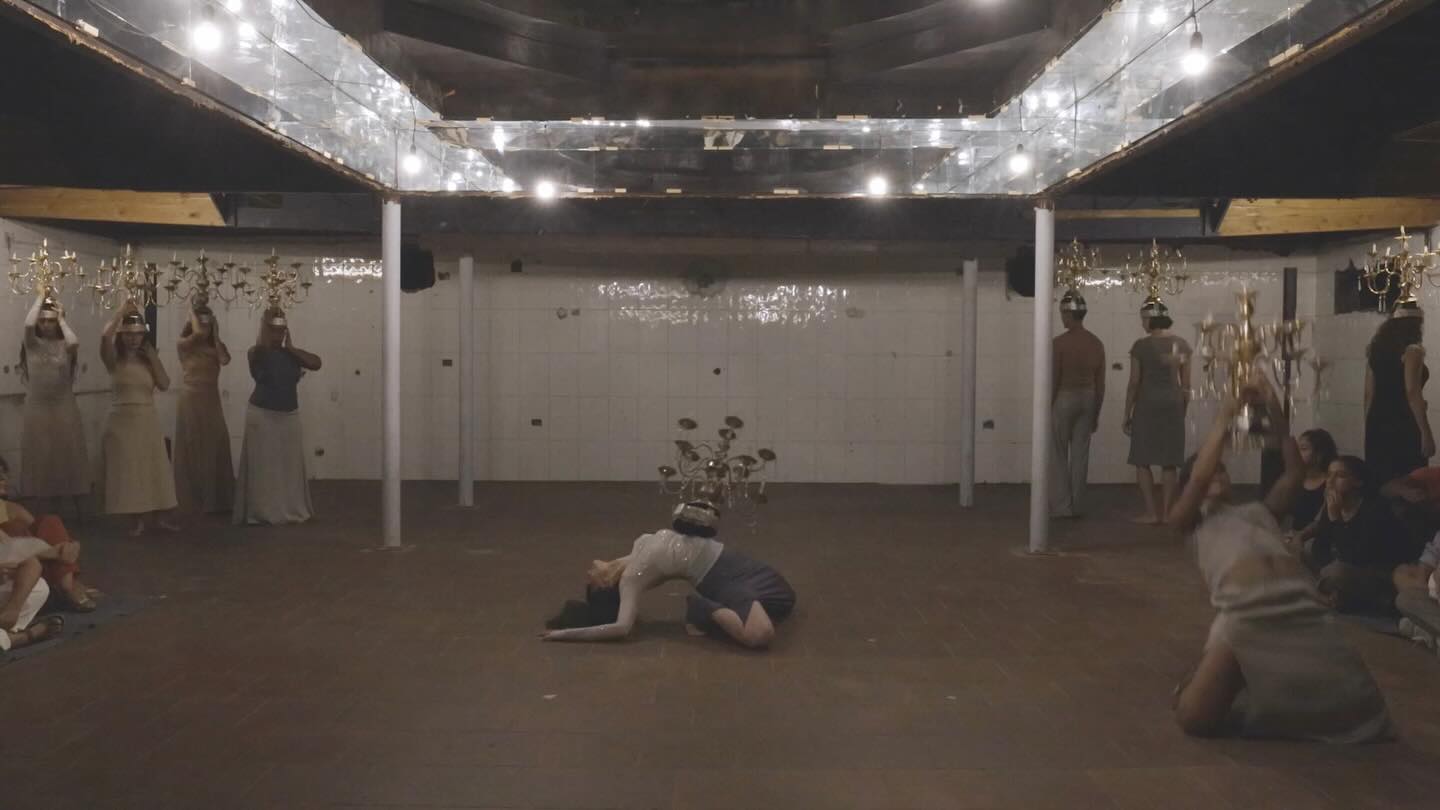
For 40 minutes, we are watching nine dancers carrying candelabras on their heads, moving slowly and subtly together in a ritual-like performance, danced to a somber score by sound artist Ismail Hosny. They arrive with an energy seemingly carried from before, the backstage, the rehearsal, the kitchen.
[Source: Nasa4nasa]
The dynamism and playfulness of the well-known candelabra dance is undone here, or perhaps, deconstructed to its bare elements, histories, bodies, movement and earth. There is something from the order of grief and mourning in the spectacle. There is also something solemn. The summoning that is asked of us deranges the classic relation to dance as entertainment in a barter deal — how belly dancing was a signifier for desire in the colonial gaze, a signifier that would persist in the national gaze despite the outgoing conditions of its existence. In Nasa4nasa’s 𝑆ℎ𝑎𝑚3𝑑𝑎𝑛, we are trading something else with the dancers and the show: a certain presence, a certain connection.
Do you remember who did the candelabra dance before?
This article gives us a functional history to the candelabra dance, pre-dating its adaptation to stage performance — the candelabra-bearing dancer would light the way through dark streets which at the time were not powered by state-provided electricity, announcing that a wedding had taken place. From there on, the candelabra dance would become a tradition in weddings, specifically dancing brides to their new wedded lives. This made us think of our difficult attempt to read Theodor Adorno’s Aesthetic Theory, and the idea of making an artwork possible by extracting and separating aesthetics from function. Something of this happens in the show: a declaration of art that ends just as the actual dance begins.

We move from function to stage, as popular history tells us that in the 1920s, belly dancer and singer Badiaa Masabni, often referred to as the godmother of belly dance, was among the first dancers to put a gas lamp on her head, boasting impeccable abilities for balance and muscular control. Shafiqa al-Qibtiyya is known to have placed a candelabra on her head while performing, complete with candles ablaze, literally dancing (with) her fire. But Masabni, Qibtiyya and their artistic descendants in modern belly dance would bring much more with their fame than sensual entertainment. They sway the politics of body formation by the colonizers and their successors. They shape women-led economies. They dance to instruct dance. They just dance.
We suspect that this is being captured in 𝑆ℎ𝑎𝑚3𝑑𝑎𝑛. Gathered from a local maker, the candelabras in the Nasa4nasa performance are foregrounded above the bodies carrying them. Rather than being seamlessly held overhead in a skillful dance, they index their weight, and perhaps all the weight carried by those who danced before. Carried in this way, and in a spectacle of collective movement dancing as one body, 𝑆ℎ𝑎𝑚3𝑑𝑎𝑛 speaks of dance as labor, an embodied labor that gives away possible transformations.
In their choreography, Nasa4nasa creates images out of bodies synching together. It’s not new, given their duo dances since 2016. But the grandeur of the nine dancers moving in sync together left us with a strong emotion. It catapulted the idea of laboring bodies, standing in the face of the divaesque solo performance common in traditional belly dance. It evoked various meanderings.
The burden of carrying the weight of the world on your shoulders.
To lead and to follow. To be present. To be an individual and part of a group. To feel the dimensions of your body as a group. To hold your gaze as a desire to allow you to move as many and then to hold a gaze of desire observing. To explore the patterns of gravity these different gazes form.
To work with the cosmos. To tune into scales and temporalities. To move in tune with a dimension outside of time, inside your head. To witness these movements of states of preparation before we avail ourselves back to the world.
There weren’t candles ablaze. Instead, there are light bulbs and they make us think of the technology that renders a reproduction possible. We are about to mourn the swallowing of craft by capitalism, but there is something else. Because 𝑆ℎ𝑎𝑚3𝑑𝑎𝑛 does not try to be a simulation, the absence of the lit candles, alongside that of the dance, leads us to feel that this performance was a deconstruction, an investigation, a wondering about this certain social history and a wandering.

تقارير ذات صلة
In Fustat, cultural center Darb 1718, pottery factories face demolition
“Old Cairo is one of the seven oldest cities in the world doing pottery art"
Systems of subtleties: Reflections on MASS Alexandria’s latest exhibition
The exhibition is MASS Alexandria's first since 2016.
Video | Stories in sign
Ahmed, Madonna and Yasser speak about what it is like to live in Egypt with hearing impairment
Your support is the only way to ensure independent, progressive journalism survives.
You have a right to access accurate information, be stimulated by innovative and nuanced reporting, and be moved by compelling storytelling. Subscribe now to become part of the growing community of members who help us maintain our editorial independence.
Join us