
Analysts: Egypt aids obstructionist efforts of Libyan legislatures to stall UN-led political process
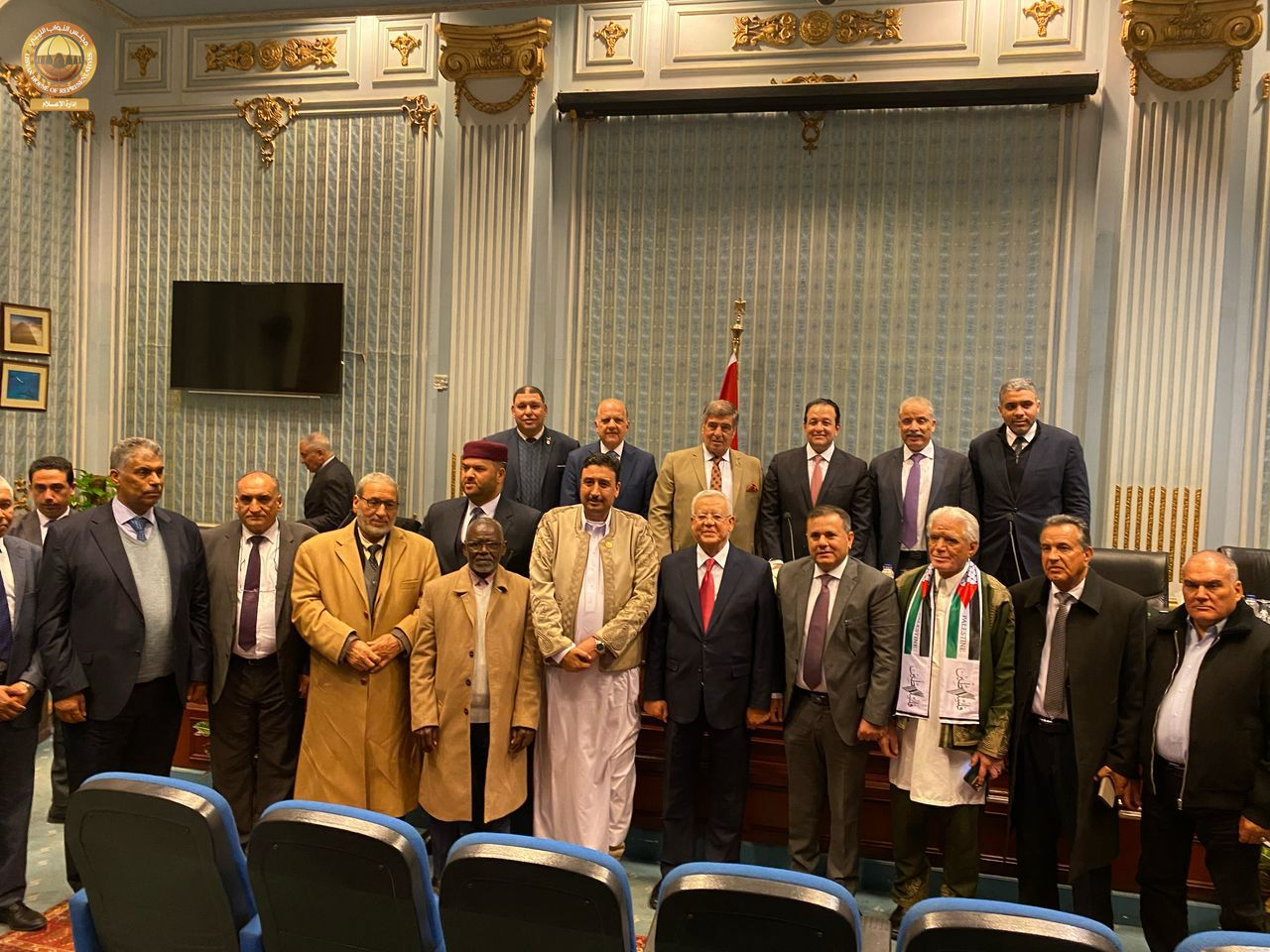
The political process to determine Libya’s future should be the “exclusive ownership” of Libyan official institutions, members of the country’s two legislative bodies declared Tuesday at the conclusion of two weeks of consultations in Cairo initiated by Egypt’s Parliament.
Speaking to the growing tension between the two legislative bodies and the United Nations, which kicked off a new advisory process to try to stabilize Libya’s fragment political and military landscape at the beginning of February, the delegations called on the UN Support Mission in Libya (UNSMIL) to adhere to its mandate as defined by the UN Security Council, which tasks it with supporting Libyan institutions in line with the political agreements.
The meetings, held from February 11 until the 25th, were attended by 171 members of Libya’s legislature — 96 from the House of Representatives and 75 from the High Council of State — marking the largest such gathering of members of the rival institutions.
The meetings came in response to an invitation by Egypt’s Parliament under the sponsorship of the Egyptian National Committee on Libya, which includes representatives from key sovereign bodies.
While the meetings did not bring about any tangible results, according to a source at an Egyptian state-affiliated research center, the closing statements served as a stern rebuke to UN-led efforts to put forward a roadmap for elections and to unify various state bodies that have been split by years of war and competition following the ouster of former Libyan President Muammar Qadhafi.
The post-Qadhafi period has been marked by the fracturing of state and military bodies. Successive UN, regional and European initiatives to bring about a solution have not led to sustainable resolutions, instead putting in place governments that cling to power and attempt to obstruct initiatives that would undermine their positions and influence.
The Government of National Unity, led by UN-appointed Prime Minister Abdul Hamid Dbaiba, was meant to steer the country toward elections in December 2021. When those elections — which many regional powers were set on preventing from the beginning — did not materialize, Dbaiba’s government has continued to rule Libya long past their mandate.
Libyan political analyst Faraj Farkash tells Mada Masr that the Cairo meetings follow this long path of obstruction.
“From the outset and before the meetings, we knew that the gathering of members from both bodies in Cairo was nothing more than a preemptive attempt to block the efforts of the UN-backed advisory committee, which might present proposals that do not serve the continued existence of these members or their sprawling influence over the political scene,” he said.
Libyan political analyst Mohamed Fouad sees things in much the same way, telling Mada Masr that whenever the House of Representatives and the High Council of State sense movement from the UN, they try to convince the world that they can reach a solution and try to play on nationalist sentiment as the two parties to the intra-Libyan dialogue.
In early February, following the Libyan legislatures’ failure to reach consensus, the UNSMIL established an advisory committee of 20 Libyan experts to draft proposals for the two bodies’ consideration. However, during its second meeting, the committee requested that its recommendations be binding, according to a source informed of the details of the committee meeting, contrary to the UNSMIL’s earlier statements on the committee’s role. This raised concerns among House of Representatives and High Council of State members, with both viewing such efforts as an attempt to curtail their disruptive influence over the political process.
The advisory committee and UNSMIL’s efforts have been met with explicit opposition from Russia and France, both of whom expressed their reservations about the committee during a UN Security Council meeting in New York on February 19. Meanwhile, the US and the UK have voiced their support for the committee and the mission’s efforts.
Farkash called Libyan lawmakers’ argument against foreign interference “ridiculous,” pointing to the fact that they are making these declarations at Egypt’s invitation.
“Unfortunately, this reflects poorly on Egypt and its role in Libya, as its position is now generally perceived as one that supports obstructionists seeking to maintain the status quo rather than progressing even a single step forward, such as by holding legislative elections,” Farkash said.
The core mandates of the UN-appointed advisory committee are to assess the constitutional and legal frameworks drafted by the 6+6 Joint Committee — established by the two legislative bodies in 2023 — which cover eligibility criteria for presidential candidates; the representation of cultural groups, particularly the Tubu and Tuareg communities; the concurrency of presidential and parliamentary elections; and the unification of the executive authority.
While both bodies initially announced their commitment to resolving these issues, the agenda for the Cairo meetings included competing political paths to move toward a comprehensive solution that could end institutional divisions and pave the way for presidential and parliamentary elections.
Statements from participating members of both delegations said that discussions focused on two main topics: the unification of sovereign positions and the formation of a committee to draft a new roadmap for the next phase. Some members argued that reaching an agreement on unifying sovereign positions would pave the way for a new roadmap, including efforts to unify the executive authority, which remains a point of contention between stakeholders in eastern and western Libya.
At the core of the dispute between the two legislatures and the UN-advisory committee are the laws issued by the 6+6 committee pertaining to the elections and decisions regarding unification.
Calling the laws issued by the 6+6 Joint Committee “flawed,” Farkash told Mada Masr that the legislatures “are well aware that holding presidential elections at the current time is impossible given the security and military divisions, as well as the insistence of controversial figures on running for office.”
“House Speaker Aguila Saleh placed a major obstacle in front of the advisory committee’s success by stating that the 6+6 Committee’s outcomes have now become constitutional amendments incorporated into the constitutional declaration,” Farkash added. “He said that changing them is challenging and would require another constitutional amendment. By stating that, Saleh is effectively signaling his rejection in advance of any outcomes from the advisory committee — which could propose holding legislative elections alone — that contradict the inapplicable and absurd laws he and his allies in the High Council of State introduced through the 6+6 Committee, which aim to obstruct any elections, particularly parliamentary ones. The result is a stalemate where both bodies would remain in place.”
By backing Saleh’s obstructionist move, Egypt is undermining the prospect of a better, more stable future for Libya, and by extension, given the country’s long, shared border, undermining its own interests.
When it comes to unification of fractured sovereign bodies, the two legislatures had previously reached agreements during earlier meetings in Rabat, Tunis and Cairo. These positions include the Public Prosecution, the Supreme Court, the Audit Bureau, the Administrative Control Authority, the High National Election Commission, the National Anti-Corruption Commission and the Central Bank of Libya (CBL).
However, when Libya’s Presidential Council dismissed former CBL Governor Sadiq al-Kabir, UNSMIL mediated between the House of Representatives and the High Council of State to appoint Nagy Issa as his replacement. However, the fact that Issa hails from western Libya contradicts the council’s previous statements at the conclusion of the Bouznika meetings that a new central bank governor should be from eastern Libya.
Speaking at the UN Security Council session on February 19, UN Under-Secretary-General for Political and Peacebuilding Affairs Rosemary DiCarlo said that the fragile stability in Libya is increasingly at risk, saying, “the country’s leaders and security actors are failing to put the national interest ahead of their competition for political and personal gain.”
تقارير ذات صلة
Greek migrant boat tragedy: What do we know so far?
Many of the passengers went through a hostage-like situation in Libya, their families told Mada Masr
Massive security campaign sends Egyptian migrants walking to Libya-Egypt border, as Haftars eye lucrative migration contracts
The migrant tragedy in Butnan has financial and political dimensions for LNA leader Khalifa Haftar
Erdogan, Sisi hold meeting in Qatar, reconciliation bolstered by Qatari financial incentives
Qatar is about to provide a generous aid package to Turkey’s flagging economy
Your support is the only way to ensure independent, progressive journalism survives.
You have a right to access accurate information, be stimulated by innovative and nuanced reporting, and be moved by compelling storytelling. Subscribe now to become part of the growing community of members who help us maintain our editorial independence.
Join us