
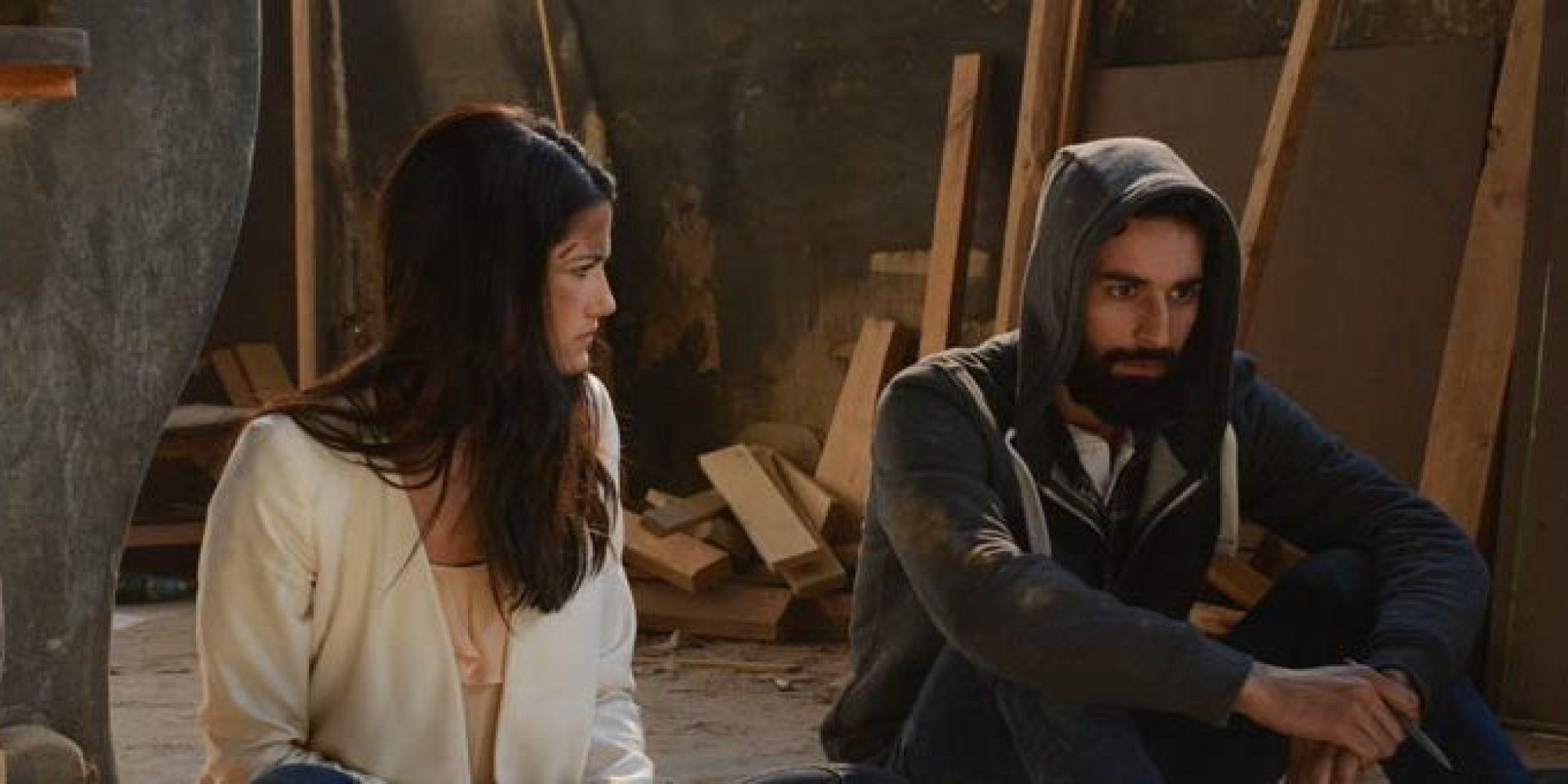
Al-Haram Al-Rabea: A fourth pyramid with wobbly foundations
What can I say about Al-Haram Al-Rabea (The Fourth Pyramid), screening on wide release in Egypt since last week? Like Peter Mimi's previous offerings as writer and director — comedy flops like Saeid Claquette and Hara Maznua (Narrow Lane, with a poster modelled on Reservoir Dogs) — it’s disappointing. Not nearly enough happens in terms of action, plot, acting or characterization. The story is both too contrived and too familiar. It takes itself too seriously and, to add insult to injury, it also seems to be a rip-off.
A mismatch made in heaven
First things first, the so-called story is about a hacker extraordinaire — Youssef (Ahmed Hatem) who calls himself the Fourth Pyramid — exposing the corrupt fat cats who are sapping the life out of the country. How does he end up doing this? He's originally a (white) taxi driver with a passion for computers — tracking perverts on the internet while at university to protect his female colleagues — but then his mother dies because he couldn't afford treatment at an investment hospital. Boo, hiss. That's the oldest one in the book, in Egyptian melodrama, and makes him very suddenly attuned to the plight of the needy. Now he's busy trying to evade both the (incompetent and out-of-date) authorities and the criminals chasing him, including some of the world's top drug dealers and arms traffickers. Makes you wonder when he has time to scratch together a living from cab fares and fall in a love with a spoiled rich kid to boot.

Secondly, the casting, while admittedly good, is a bit too good for its own good. Top-notch actors and actresses just show up for a scene or two but make no real contribution to the storyline. Youssef Shabaan plays a useless, hoarse-voiced observer of life's ups and downs; Mahmoud al-Gendy is a shady nightclub owner who inadvertently introduces Youssef to the people he’s beginning to take down; Yousra al-Lozy does a prissy, uptight, chain-smoking journalist to gorgeous perfection but only in one solitary scene. The most squandered talent by far is Reham Abdel Ghaffour, playing a prostitute Youssef delivers to the infamous Haram (Pyramids) Street. Although Reham never ceases to amaze, here she only pops up in one sequence and Youssef's promise to get her a decent job doesn’t come to fruition. So what's the point? Could it be that they're throwing in big names to cover up for lackluster content? Who could imagine such a thing?
28-year-old Ahmed Hatem is a really good actor and I'm happy to see him in a lead role so early on in his career, but honestly, I think he’s miscast here. He plays good guys and bad guys equally well, yet when he plays a nice person he's always the gentle intellectual type who’s being taken advantage of, as in TV series Hawari Bucharest (The Alleys of Bucharest, 2015). His soft, injured voice helps in this regard, while his crazy eyes and schooled, groomed looks help him play the white-collar psychopath (the minister's son in the series Ibn Halal, 2014) or political ideologue (the Zionist youth in Harat Al-Yahud (The Jewish Alley, 2015)) wonderfully. Here he's neither — a wounded guy who’s nonetheless proactively vindictive. The mix just doesn’t mix.
The bad guys — ultra-Egyptian Bayoumi Fouad (with the pot belly) and Tunisian Nejib Belhassen (you'd think he was a blond, athletic Mossad agent) — and flatfoots on his tail do a better job, but you don’t really care about them either way. Youssef's best bud, played by Mirhan Hussein, does a more convincing job, being brazenly attractive enough for her character, but doesn't amount to more than a symbol of how relaxed boys and girls have become nowadays, and how there aren’t that many real men out there anymore. Youssef's love interest, Nada (model Tara Emad), is very nice indeed as the sensitive, caring girl who has a distressing relationship with her wealthy, powerful father (read: Egypt), but her relationship with Youssef could have been more fully explored.

Muted messages from yonder
Third criticism: The politics are simultaneously confused, annoying and conventional. There's Haram Street, popularly associated with prostitution, which Youssef morphs inexplicably into his nom de guerre. This makes no sense. And the name Youssef I presume is in reference to the Prophet Youssef, the caretaker and guardian of Egypt, the person who didn’t take liberties with the wife of the big man despite the opportunities offered him. That might explain the scene where he's told by the sleazy nightclub owner that in this business, you have to be like a eunuch. But since he doesn’t work in that business, that doesn’t make much sense either.
There's also Belhassen's character. The police describe him as someone with no identity, working for the international mafia but of vague North African origins. He tries to speak with an Egyptian accent, but Bayoumi’s character insists he speaks in Tunisian, reminding him — it seems — of his forgotten origins. Why the rude aside toward the country that started the Arab Spring? If Youssef is a stand-in for Khaled Saeed or Wael Ghoneim, why is Mimi intent on pointing out that the bad guy is Tunisian?
Now to get to the final criticism — lack of originality. The structure of the movie, with its mix of flashbacks and present-day narrative, make it very hard to follow and not terribly entertaining. Ahmed Nader Galal’s 4G (2015) handles its timeline much better — an opening scene from the present, then everything from the past leading up to that moment, then the rest of the story from that point onward. In The Fourth Pyramid you feel they’re trying to imitate trendy thrillers. The heavy metal music in the background doesn’t help much either, especially when juxtaposed with the kind of Egyptian music microbus drivers are famous for listening to, deployed here to give the film a grimy, culturally "authentic" feel.
As for the inspiration for the story, it struck me as taken from an old, out-dated US film even I didn’t like that much: Turk 182! (1985). It’s about a boy who takes on city hall through pranks exposing corrupt officials to avenge his wronged fireman brother, who was denied medical benefits despite long years of service. The hero scrawls “Turk 182” everywhere (his brother's fireman nickname), making it a symbol of protest others take up in tandem. (Youssef's father was a taxi driver and got most of his fares on Haram Street, for some reason). There’s some hacking in Turk 182, but overall it was just as contrived as this pale imitation. If Mimi wanted to Egyptianize an American hacker movie, WarGames (1983) would have been a better bet.
The Fourth Pyramid is funny in places, and the ending isn’t half bad either. It’s too abrupt, however, and it's hard to believe that the authorities will somehow let Youssef off the hook. If it was a comedy like 4G, I could believe it, but alas, there are no football stars in this digital dead end.

Emad El-Din Aysha
Emad El-Din Aysha received his BA in economics and philosophy and his MA and PhD in international studies at the University of Sheffield in the UK. Most recently, from 2001…
تقارير ذات صلة
Unworkshoppable cinema: A visit to the 11th Cairo Video Festival
Recently, I finally got to see Payal Kapadia’s All We Imagine as Light (2024), winner of the Cannes Grand Prix. I was lucky to experience it in a theater and…
The thin thread between misogyny and emancipation
Faten Hamama gives a rare, realistic portrayal of the frustration experienced by women in Egypt
Detox | No drama
#31: Without the drama, though — both on-screen and in all our lives — what's left to explore?
Your support is the only way to ensure independent, progressive journalism survives.
You have a right to access accurate information, be stimulated by innovative and nuanced reporting, and be moved by compelling storytelling. Subscribe now to become part of the growing community of members who help us maintain our editorial independence.
Join us