
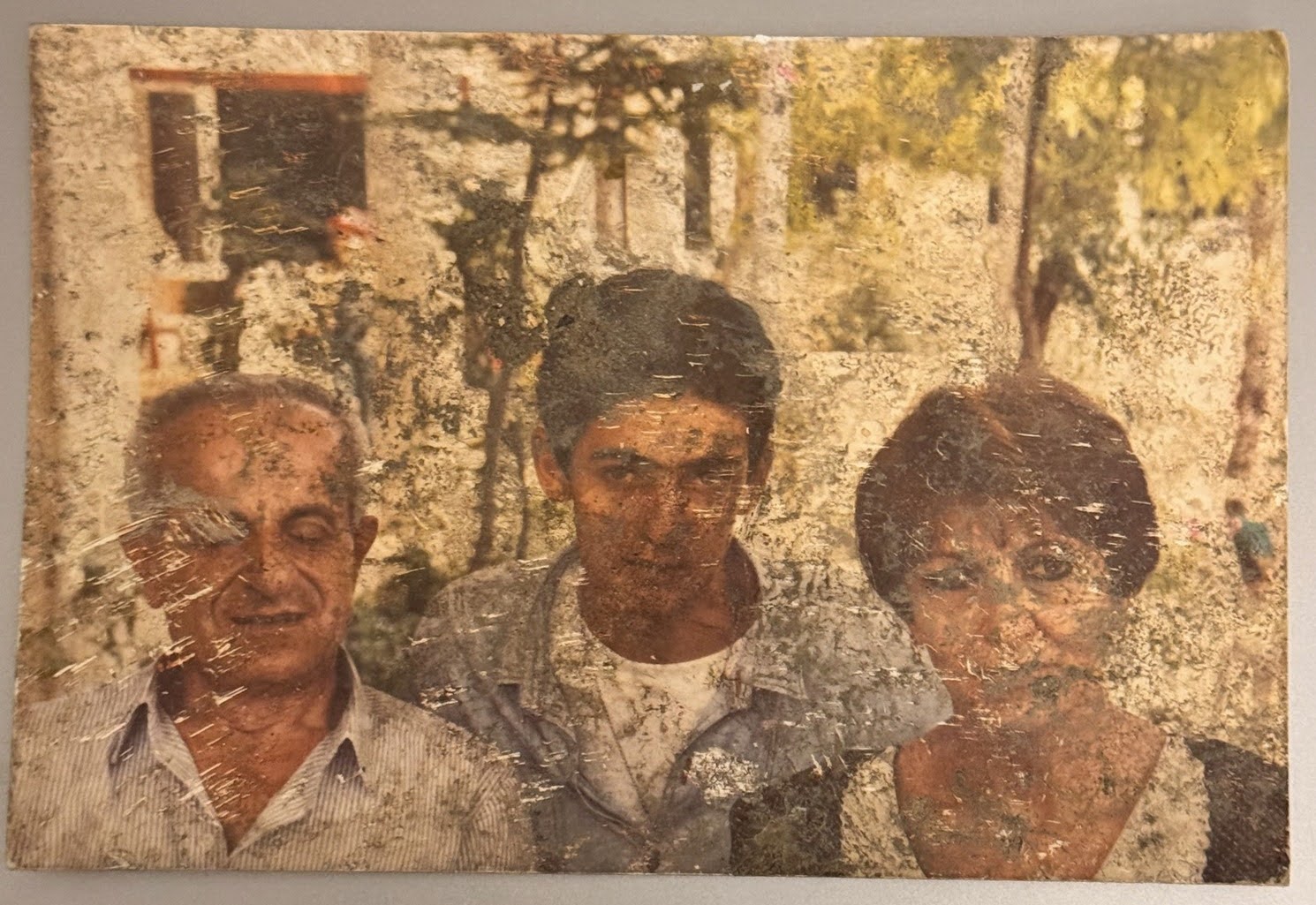
After the catastrophe: Ali Cherri takes Israel to court following the killing of his parents
On November 26, 2024, Paris-based artist Ali Cherri spoke to his mother Nadira Hayek living in Beirut on the phone right before boarding a plane to Vienna where he was to open an exhibition. By the time the plane landed, he received news that his parents’ neighborhood, Nouaire, was attacked by an Israeli strike and that they weren’t responding to calls. By the time he made his way to Beirut the following morning, his mother, his father Naim Cherri and their housekeeper Birki Negesa were killed, alongside four other people.
The strike was part of ongoing Israeli bombardments in Lebanon that started in October 2023 and intensified in September 2024, with the aim of deterring Hezbollah, the Lebanese paramilitary group. It took place hours before the enforcement of the 2024 ceasefire, a time whenLebanese people reported experiencing an intensification of the bombing. Targeting densely populated residential areas with the justification that they house military targets, Israel has killed thousands of Lebanese people.
A little over a year later, Cherri is taking the unknown perpetrators who killed his parents to a French court through a civil complaint with the French War Crimes Unit.
Using his privilege as a French national, represented by the International Federation for Human Rights (FIDH) and supported by investigative work undertaken by Amnesty International (AI) and Forensic Architecture (FA), Cherri decided to turn his catastrophe into action, the result of which is uncertain, but in its undertaking, as he sees it, there is some form of redemption.
“When you lose someone that close and [lose] the place where you were born and raised, something inside you dies. A big part of me died when my parents died. But what do you do with this faje’a (catastrophe)? What do you do once you surpass the zuhoul (stupor)? What do you do with this amount of hotam (debris)? There is something horrific when you face a landscape with so much violence, that is also so personal.”
A month after Cherri’s parents were killed, Akram Zaatari, a fellow artist and friend, shared with him the work of Clémence Bectarte, the coordinator of the FIDH litigation group. Bectarte had been working on accompanying victims of crimes against humanity, including international crimes, through litigation processes, using French jurisdictions, among others.
By February, Cherri and Bectarte had met and started working on the case.
The law takes innovation to expand it to seek justice. French courts only have jurisdiction over offenses committed on French soil or by a French citizen or against a French citizen. Cherri’s French nationality makes it possible for a French court to investigate the case because he owns the apartment that was bombed.
Speaking to Mada Masr, Bectarte says this will be a precedent for a French court, namely to hear a civil complaint involving war crimes — using French and international definitions of war crimes — where there was an attack targeting a civilian property owned by a French citizen.
Besides seeking justice for his own parents, Cherri is also acting out of a broader sense of responsibility. “I have a duty toward people who can’t do it, because they don’t have another citizenship. In Lebanon, there is no way to raise cases against Israel.” In his statement with FIDH, Cherri defined his move as one coming from “a son, a citizen and a victim.”
If the case makes it to the War Crimes Unit, it will land in a court with major expertise in international cases, according to Bectarte. This is the same court that issued three arrest warrants against former Syrian President Bashar al-Assad for war crimes and crimes against humanity.
In order to prepare the case file, Cherri and his legal representatives sought to document the event thoroughly, especially that the “Lebanese government doesn’t have the resources, and we don’t know if it has the will, to document such assaults. The police and army reports were very limited,” Cherri says, a claim confirmed by Amnesty International.
For this documentation to be provided, Forensic Architecture was commissioned to produce an expert report that documents the attack through a digital reconstruction of the site using 3D modeling. To build the model, FA used images and videos taken by Cherri and his family from their apartment in the immediate aftermath of the attack, as well as open-source material from that night, according to Samaneh Moafi, the lead investigator in the case, and FA’s assistant director of research. Drone photography was also commissioned to increase the reconstruction’s precision.
This reconstructive work was important, according to Cherri, because by the time a French court would investigate the case, there could be no traces of the crime site, as it may be restored.


Using the model, FA showed that the destruction of the building was highly localized across four floors, with Cherri’s family’s apartment particularly sustaining extensive damage, Moafi tells Mada Masr. Detailed analysis of perforations, together with the resulting structural deformation, allowed FA’s team to identify that multiple missiles were fired into the apartment.
Upon analyzing remnants of ammunition on the site, FA found that they are remnants of two GBU-39 bombs. “The GBU-39 is a precision-guided glide bomb developed by the United States and used extensively by the US and its allies, particularly Israel. According to the US military, the munition is engineered for precise targeting: once released, it relies on GPS/INS guidance to navigate to its intended impact point,” Moafi explains.
FA has been investigating Israeli attacks in different sites in Gaza, Lebanon and ,most recently, Iran, and this context provides patterns for their findings. Weapons designed for high-precision targeting have been found elsewhere, yet multiple lives are lost when these attacks are unleashed. “So-called precision-targeted strikes are being used as weapons of mass destruction. The use of such ‘precision’ is widespread, but it can only be challenged through the careful documentation of specific cases,” Moafi says.
“It was Ali’s invitation, and our close collaboration with him, that made this investigation possible.”
Amnesty International’s role in the case involved figuring out who the Israeli strikes were targeting. The organization produced a report in February 2026 documenting several attacks where no evacuation order was given prior, and no claim of assassination was made afterward from any party — the Lebanese state, Hezbollah or Israel.
For Cherri, AI’s work was important for the investigation. Representatives of the organization spoke to residents of the neighborhood — people who lived there and knew each other for decades, the local knowledge substance of evidence. According to AI’s report, interviewed neighbors predicted that the targets of the attack could have been two brothers of a Hezbollah member of parliament who lived in the building. The men had no political or military involvement and were also not in hiding. “They walked the streets every day,” the residents told AI, wondering why Israel would choose to attack them inside a residential building.
Sahar Mandour, AI’s Lebanon researcher, explains to Mada Masr that their interlocutors who survived the attack were trying hard to find a logic to who the target was, since there was no announcement. She also says that during that war, and previous ones, Israel has not usually targeted Hezbollah MPs or their relatives unless they were on the frontlines, which is not the case here.
Mandour is also a friend of Cherri’s. She recalls his mother throwing him spectacular birthday celebrations in Tyre, where she would serve fish on a long table by the sea even though Cherri did not eat fish. It was their annual joke. When Cherri learned about his parents’ killing, he called her saying, “My parents are gone. Flames are coming out of the house.”
“Whatever it is I was trying to avoid about this war became inside my body,” Mandour says. Cherri’s initiative opened a window for accountability and helped his friends and family “extend their hands beyond complete paralysis.”
“This helped us as a family to put our energy into a project. To do something,” Cherri says. “When you lose your parents, you are a victim. But we also try to have the capacity to do something and not just be on the receiving end.”
“I don’t have illusions where this will go and if it will change the reality. I am not naïve. But maybe the journey is more important than where the case will go — to demand justice as a basic human dignity.”
While working on this story, many interlocutors referred to Cherri’s courage in this journey, expressing gratitude toward him. Mada Masr shared the sentiment with him. “I don’t feel like a champion or a hero. I am just someone who could not save his family, but is trying to at least to honor their memory on a basic, human, personal level. In reality, I am speaking from a broken place.”

تقارير ذات صلة
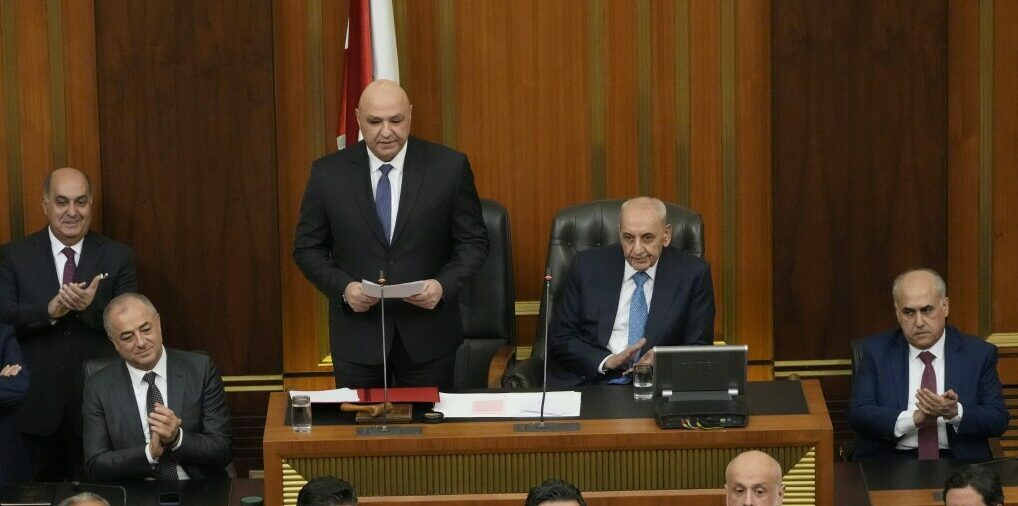
Hezbollah vote secures General Joseph Aoun’s election as new Lebanese president, underscoring party’s concessions to new regional reality
When the Lebanese military began to send the first of its soldiers to the south of the country on November 28, hours after a ceasefire was suddenly announced, it marked…
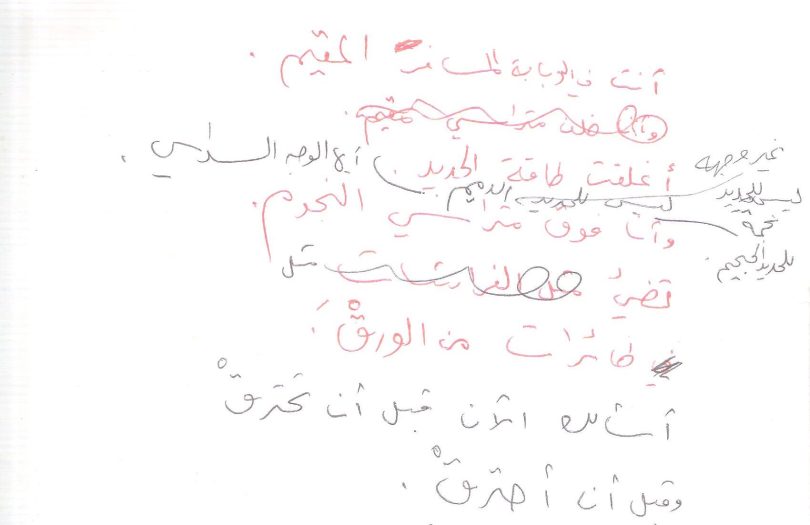
Poetry in the face of history: Letter to an Israeli soldier
Under what conditions could a confrontation between poetry and history yield to the defeat of history? And what is it in poetry that could defeat history? Is it the simple…

The long and costly wait for a new personal status law
Bassant Soliman’s suicide triggered renewed public backlash against personal status laws in Egypt
Your support is the only way to ensure independent, progressive journalism survives.
You have a right to access accurate information, be stimulated by innovative and nuanced reporting, and be moved by compelling storytelling. Subscribe now to become part of the growing community of members who help us maintain our editorial independence.
Join us