
A fleeting moment in the sun
After five weeks of disruption in October and November, Israeli gas flows to Egypt resumed, returning to 800 million cubic feet per day — their standard levels prior to Israel's aggression on Gaza. This marks a potential end to Egypt's natural gas shortage, which has negatively impacted the country's exports and domestic supplies.
Shortly after, power outages eased and the Idku gas liquefaction plant received the Adam gas carrier to export Liquified Natural Gas for the first time since June.
The economic and political reliance on Israeli natural gas is markedly different from the promise the government made just five years ago. At the time, Egyptian gas was supposed to enable the nation to become an energy hub, ensure a stable electricity supply and meet the needs of gas-based industries. The failure to meet these promises has raised doubts about the viability of the government’s strategy of using natural gas to leverage its geopolitical and economic influence in a perpetually turbulent Middle East.
This chapter of the story stretches back five years, during which Egypt moved from a theoretical energy glut to a deep shortage, weakening its regional political positions and economic sovereignty. But that wasn’t the country’s first brush with an energy crisis. Rather, it is a new round in a vicious cycle with no end in sight as long as the political decision-making has consistently taken measures to leverage fossil fuel as a socio-political influence tool instead of pursuing more sustainable alternatives that would ensure domestic energy sovereignty.
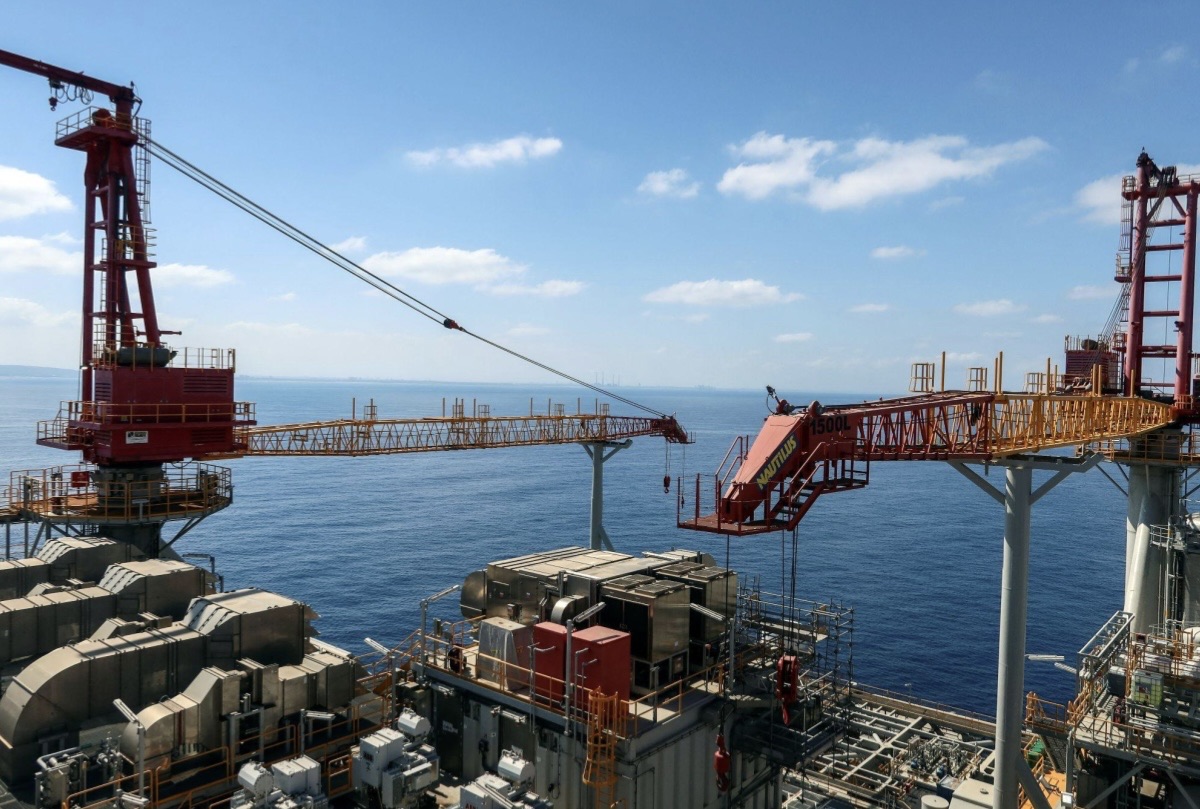
At the spot where the rising sun first touches Egypt’s maritime economic territories — Petroleum Minister Tarek al-Molla said during a lyrical portion of a 2018 speech — Egypt had opened a new natural gas megafield.
The field in the Shorouk Concession was called Zohr to represent the sun at its zenith since the field would “light up the whole of Egypt,” he said.
Molla highlighted in a literal sense, that the fuel from Zohr would supply electricity to homes and businesses across the country, but he was also referring to a moment of national determination. “A new story of success written by the petroleum sector,” he called it, one that would “fulfill the hopes and dreams of Egypt’s people.”
Fast forward to five years later after laying out this ambitious trajectory, Molla would find himself sitting beside Prime Minister Mostafa Madbuly as he announced nationwide electricity outages until the end of the summer – a promise that would since prove unattainable when share loading continued well into autumn.
Days before Madbuly's speech, citizens could already predict the looming energy crisis, when their households would plunge into darkness for an hour or more on a daily basis. Since then, highways have mostly been pitch black. Sports events would be held before sundown to lower electricity consumption and government buildings have taken measures to ration their electricity consumption, such as remote work days, and made similar calls to the private industrial sector to follow suit.
“Our plan for the actual consumption of electricity fell short and resource management in the summer months did not suffice. Together with the declining efficiency of those plants during the heatwave means that we are forced to cut the electricity feed for at least one month,” Madbuly said back in July.
In his speech, Madbuly blamed the situation on the unprecedented heat wave, while assuring millions of citizens that the electricity sector is more than capable of meeting the future needs of power. Analysts, officials and experts, however, told Mada Masr that while the heat definitely was a contributing factor, it is, in fact, the government’s poor planning, lack of appropriate strategy and seeking short-term economic and political gains that are the true culprits behind Egypt’s story of going from blackouts to surplus to blackouts again in less than a decade.
Madbuly reasoned in July that the "majority of our electricity is produced from fossil fuel-[powered] plants," which explains why Egypt is doomed to repeat cycles of glut and shortage.
“The production of fossil fuels, including the natural gas that fires the majority of power plants in Egypt, will always see surges and slumps,” former Petroleum Minister Osama Kamal tells Mada Masr. “Production will peak as exploration grows. But the wells decline naturally, so it requires further investments to keep production stable.”
Extractive industry: Rooting dependence on foreign companies
The problem with securing further funding is that the fossil fuel industry in Egypt has always been dominated by foreigners, Kamal said. The dynamic meant that the industry was created to put Egypt in a position of dependence and indebtedness to foreign financiers and oil majors setting up extractive projects.
European and American oil companies looking to make quick cash off oil in the early 20th Century eyed up sites in Egypt conveniently near the Suez Canal to allow for easy shipping back to Europe. If oil was discovered in the field, the oil companies got the title to the resource and the profits from its sale. On the other hand, the Egyptian government had a limited capacity to claim rent for leasing the fields, as the foreign financiers steering the oil companies were racing to win region-wide monopoly over oil, and were, therefore, more interested in buying up as many fields as possible to crowd out competitors than they were in actually drilling, piping and exporting the oil.
Vulnerability to the oil companies was inbuilt, with the precarity of the structure exposed to its full extent after Israel invaded Egypt in 1967, when the latter took three Sinai oil fields in the process — Sedr, Assal and Matarmah. Italy’s Eni, which had been operating the Sinai fields for Egypt, not only continued oil exploration and extraction on behalf of Israel, but also sped up production.
Export imperative
As Egypt’s economy grew over the 1980s and 1990s, oil exports were conceived of as playing a central role in the country’s economic development. “Ever since the first and second oil shocks, brought about by the War of 1973 and the Iranian Revolution of 1979,” says political economy historian Amr Adly, “oil and gas constituted a considerable bulk of direct foreign currency earnings — not only important for the economy but more importantly, as a vital direct flow into the state coffers.”
The appetite for oil at the time made the commodity take precedence over other energy sources, despite the fact that Egypt had huge reserves of natural gas trapped in seams of porous sandstone under its ground and deep sea.
Instead, gas was pictured as a commodity that could be used at home to facilitate the export of even greater volumes of oil. "The more natural gas is used for domestic needs, the more Egypt's petroleum in the form of crude or refined products can be used to earn or save foreign exchange," said a 1987 World Bank report.
State policy ran in parallel to the World Bank’s recommendation. As gas discoveries increased, “the Petroleum Ministry suggested to the Electricity Ministry that it convert the electricity stations which ran on fuel oil (mazut) at the time to run on gas instead,” says Kamal. This would allow the Petroleum Ministry to export the mazut, he explains, while the gas — simpler to pipe and consume — could be consumed at home.
As gas became more popular in global energy markets, the potential of still more export revenue proved an irresistible pull. Enter former Petroleum Minister Sameh Fahmy, who was in office from 1999-2011, saying, "as long as we have the opportunity to get a suitable price for gas at present, why don't we benefit from it like any other country in the world?"
Huge economic ambitions were latched onto the export potential of gas, says a renewable energy consultant speaking to Mada Masr on condition of anonymity, such that at the time, “people would say ‘Egypt will be one of the largest gas-exporting countries in the world.”
However, as Fahmy would say ruefully in a televised interview in 2009, “it’s a buyer’s market.” To boost gas exploration and export oil, the government tied itself into a set of precarious commitments that would come crashing down with the 2008 global financial crisis.
The next set of measures that Egypt took to persuade oil companies to stay and continue investing, put the country at a further disadvantage. "New investments required changes to the contracts, and if not, then the foreign companies would freeze investments," Kamal says.
Precarious partnerships
The next step was to boost exports, which required two main parts: infrastructure and buyers. Building out export infrastructure began with the creation of the Egyptian Natural Gas Holding Company (EGAS) in 2001, empowered to act as the sole authority over granting foreign companies access to fields.
As for buyers, the Petroleum Ministry under Fahmy opted for buyers nearest to Israel and Jordan. A contract to build a gas pipeline connecting Arish to Ashkelon to carry Egyptian gas to Israel was granted to the East Mediterranean Gas Company, a new entity which had been created shortly after EGAS with what a judge would later call “suspicious synchronicity.” Along with a few other partners, former General Intelligence Services member Hussein Salem, and Israeli investor Yossi Maiman were the main players in EMG, who had partnered together on a prior occasion to set up the Midor refinery.
Salem wasn’t the only one keen to get a foot in the architecture of the export deals. “Sovereign authorities’ interest in the energy sector began to be remarkable over these years,” says a former energy advisor to the government. “Most of their [sovereign authorities’] investments were injected into this sector with the justification of national security” he added. As a result, the gas export agreements, the consultant says, were granted by direct tender and without parliamentary approval in violation of the law and the constitution, which require such “agreements of a special nature” regarding the export of a public resource to be approved by Parliament.
Gas would be piped via overland infrastructure to neighboring Jordan and Israel, and to secure access to overseas markets, liquefaction facilities were also constructed at Damietta and Idku to ship cargoes of liquid natural gas to European and Asian markets. Petronas and British Gas were contracted to build the Idku plants, while Spain’s Union Fenosa partnered with Eni to construct facilities at Damietta. “Egypt demanded a share of the ownership” in the facilities, says Kamal. Instead of providing part of the investment required for the LNG plants, the government opted “for a share of the profits it would ultimately derive from owning part of the stations.”
But the export deals — again made without parliamentary oversight — had locked the government into delivering volumes of gas for years at a fraction of the price other countries were getting for gas spot markets. For Egypt, at the time, gas was not as important as oil and it feared prices could drop, so it negotiated an agreement to tie the price point of gas to the global price-per-barrel of Brent crude. Egypt had stipulated that it would take an upper limit of US$3.5 per British thermal unit from Union Fenosa, for example, if Brent rose to $43 per barrel or more.
Egypt is estimated to have lost somewhere between $824 million and $3.8 billion for the billions of cubic meters of gas it delivered to Jordan under export agreements with Jordan made in 2003 and 2007, former Petroleum Authority head told the attorney general, during a 2011 investigation into the export contracts. Another $6 billion was lost to the export deal with Union Fenosa, and at least $714 million to the export deal with Israel.
The government had committed to deals that entailed significant obligations to export in order to pay the oil companies, whether in oil or at dollar rates, in exchange for their extracting natural gas. It needed to sell its natural gas to pay back the companies that had invested in its gas export infrastructure. Gas had to leave the ports, but domestic energy demand was rising. Fuel oil had to be used to generate power domestically, says the former government advisor, meaning more spending
Guaranteeing domestic supply became a low priority given the new economic context. Lights began to flicker in 2009 and go out in residential areas outside of major cities, says the former government advisor, extending to Cairo and Alexandria in 2010, and forming just one in a plethora of catalysts that led to revolution in 2011.
Upon the revolution, Egypt stopped delivering the volumes it had promised to export, and now, alongside the debts owed and the value lost, it would be pursued in the international courts of arbitration for having failed to fulfill its obligations in supplying gas to Spain, Jordan and Israel. Moreover, the country had to secure natural gas to generate electricity for the domestic demand.
The reliance on natural gas for electricity was not a problem when Egypt was producing a surplus in the early 2000s but it became a serious issue later. Domestic production of natural gas peaked at 6.06 billion cubic feet (bcf) of gas per day in 2009, when consumption averaged only 4.11 bcf/day, which meant it had huge reserves for exports. This continued for almost a decade - despite some disruptions in exports, according to the 2015 BP Statistical Review of World Energy.
The reliance on natural gas for generating electricity continued. By 2013, natural gas accounted for 51.5% of the total primary energy supply in Egypt and produced 76.8% of the electricity generated. Around the same time, domestic gas production had fallen by 22.3% to 4.71 bcf/day when the rapidly growing population as well as the appetite for electricity consumption, pushed demand to a peak of 5.09 bcf/day, which created a shortage in 2013 and 2014 when it coincided with a slowdown in natural gas production and the halting of new exploration contracts from the government following the popular uprising in 2011 and the 2013 coup.
Things took a turn for the worse in 2015 when Egypt became a net gas importer after being a key North African gas exporter for about ten years.
According to the think tank Oxford Energy, this was unfortunate, but not unexpected, since Egypt’s natural gas production declined while the domestic gas demand was growing fueled by large energy price subsidies.
Nothing shows how severe the issue was like the power cuts in 2013 through 2015. At that time, Egypt had stopped awarding new concessions to foreign partners who also suffered from their inability to repatriate their profits abroad due to the economic conditions at that time and the uncertainty around the future, Kamal said.
Worse, in a bid to ensure political stability during a chaotic period in Egypt’s modern history, the government chose to withdraw energy from private sector factories to keep houses lit until the end of 2015 when demand eased due to moderate weather and slower production from heavy industry, according to a research paper by the Carnegie Endowment.
Instead of looking for a sustainable solution, it was around that time that the government announced its strategy to, once again, stimulate gas import and production to increase electricity production and export the surplus.
On the one hand, Egypt commissioned a Siemens-led consortium to build three combined cycle power gas-fired power plants that would produce a whopping 14 GW of electricity at full capacity - of course, if provided with enough natural gas.
To secure the needed gas, Egypt began receiving shipments of liquefied natural gas from abroad through two floating storage and regasification units (FSRUs), which enabled it to import an additional 0.70 bcf/day through each.
In parallel, Egypt also decided to fast-track exploring gas in what seemed to be a political decision.
But natural gas was, in fact, far from being the only option for electricity generation. Around the same time, Egypt started looking into renewable energy as a potential and more sustainable source in the long run to substitute for natural gas but, nevertheless, decided to raise its reliance on natural gas.
The simple reason as to why Egypt did not pursue renewable energy at the time was cost, Welligence Energy Analytics, the energy intelligence firm, explained in an email to Mada Masr. “10-15 years ago, gas power was more cost-effective vs solar/wind.”
But this will not remain the case in less than a decade from now.
Cairo University Engineering Professor and New and Renewable Energy Authority (NREA) chair Mohamed al-Sobky told Mada Masr that with natural gas, the government sells concessions to foreign companies that carry out all exploration, drilling, and production of fossil fuels whether from the deep waters or inland. Better yet, any surplus in the production of gas or even electricity could potentially be a source of export revenue. But renewable energy, on the other hand, was new to the market, which meant it required a government stimulus.
This stimulus was introduced in the form of the feed-in-tariff program in 2014. When the program was launched, the government set a rate of 14 cents/kw - a price at which it committed itself to buying the energy produced from solar power plants in Upper Egypt. In the second phase, the tariff was cut to almost half at 7.88-8.4 cents/kw.
Construction costs were covered by multinational organizations that saw this model as ideal: green projects, phasing out fossil fuel, and servicing a developing nation’s development needs. “However, Egypt had to commit to paying a fixed rate for the produced electricity,” Sobky said, adding that this very high price was developed based on the current status of the new renewable energy industry in Egypt at the time. Now, I believe that the government could negotiate a tariff of just 2 cents/kw,” he added.
Factoring in all the costs involved in both cases; relying on natural gas or investing more in renewables, would have only resulted in a 13.8% increase in costs, according to a 2017 research paper assessing water-energy-food nexus challenges in the region with German funding.
The paper used sophisticated methods to assess how the energy sector has a significant potential to generate electricity from alternative renewable resources. The research showed that by enduring a 13.8% increase in cost, Egypt can significantly reduce its reliance on natural gas, thus, improving the country’s energy security and progressing toward a low-carbon society. The research also noted that these costs are highly expected to decline in the future as the renewable energy industry becomes more localized, prompted by breakthroughs in technology abroad.
However, the authors noted, easing reliance on natural gas will have an impact on both exporters of energy to Egypt and importers of Egyptian energy, as natural gas has been serving as a key geopolitical tool for the Egyptian government.
“These types of decisions are only made at the very top of the regime,” Sobky told Mada Masr.
Following 2011, says the former government advisor, “the government was forced to grant concessions to some companies affiliated with some countries,” just as it had done previously. “The political legitimacy of the regime and the need for economic and financial support were the two windows that allowed foreign penetration.”
To sweeten the deal, Egypt had to restart its export facilities, which had been compromised by its failure to deliver on its export contracts, both to Union Fenosa and Israel, for which Egypt was to pay compensations of about $4 billion.
However, Egypt leveraged its LNG plants to circumvent the rulings. With Israel, Egypt negotiated to pay only $500 million, but sold a 39% stake in the Ashkelon-North Sinai pipeline to a US-Israeli consortium, which would then be used to send transport natural gas from the Tamar and Leviathan reservoirs to Egypt for re-export through Idku and Damietta LNG plants. Egypt settled the dispute with Union Fenosa through an agreement to restart the Damietta LNG plant, but Eni would acquire an additional 10% stake in the plant from the Egyptian Natural Gas Holding Company (EGAS).
It was around that same time that Eni – the former government advisor points out – was also awarded the Shorouk Concession. The government also exempted the Italian company from royalties and taxes. By 2015, Eni had announced the discovery of the Zohr field — trumpeted as the biggest gas find in the East Mediterranean to date.
Turning through the same cycle
The discovery of Zohr and solvent export deals were the cake. The cherry on top was an agreement with Saudi Arabia, which enabled Egypt to import cheaper oil financed by the kingdom for five years at an optimal two percent interest rate. In exchange, Egypt ceded sovereignty over the Red Sea islands of Tiran and Sanafir to Saudi Arabia, as part of the $22 billion package deal.
The series of concessions turned sour again, leaving Egypt similarly dependent on exports to generate the revenues it needed to pay high outgoing commitments when another set of global economic shocks hit in 2020, with the COVID-19 pandemic, followed by Russia’s invasion of Ukraine in 2022.
Many of the sources providing their read on the power cuts in July describe the crisis as a repetition of the 2000s, revising the sequence of events since 2013 that have reproduced the same dynamic.
Kamal points out that the Saudi-financed mazut, used to keep power stations running last year and facilitate the export of as much gas as possible, had run out by the summer of 2023, with the five-year agreement signed in April 2016 expiring in 2021.
Since the expiry of the contract with the Saudis, Egypt had to rely on its own resources to secure its needs for fuel. When the price of natural gas skyrocketed in 2022 following Russia’s invasion of Ukraine, Egypt was able to raise its exports, while using part of the proceeds to import mazut and keep the power running. But when the European winter demand for gas eased, the price of natural gas gradually dropped. Oil prices, on the other hand, have picked up since June 2023, when Saudi Arabia cut its production.
So when temperatures peaked over 40C in July and the load on the national grid spiked to 35.5 gigawatts — a scenario that nearly all the sources who spoke to Mada Masr said was totally predictable — the government opted to switch the lights off.
Speaking to Mada Masr on condition of anonymity, a member of the House of Representatives energy committee said that “the lack of foreign currency” likely contributed to the decision to have the public endure daily power cuts. During a Hekayet Watan press conference, President Abdel Fattah al-Sisi openly stated that the government opted for the power outages as a way to save $300 million per month.
The Petroleum Ministry has embarked upon an expansion plan that will see new oil and gas fields opened for the first time in the Red Sea, though there is little to suggest the move will alter the status quo whereby domestic supply comes low on the list of priorities, at a time when, once again, reports emerged again earlier this year of receivables to oil companies amounting to $3 billion.
In the government’s calculus, as Ambassador Mohamed Nasr who leads the climate diplomacy team at the Foreign Ministry tells Mada Masr, “it’s better to rationalize and have scheduled power cuts to keep the energy needs at the levels you planned for. Many countries are doing this.”
True, some other developing nations have power cuts. Yet, Egypt’s situation now is arguably worse. By investing heavily in natural gas exploration and development and leveraging its natural gas resources at home and for political influence abroad, Egypt was simultaneously forced to let go of its renewable energy ambitions, before recycling old targets once again.
Likewise, the political goal Egypt had hoped to achieve by becoming a dominant natural gas player in the global market could not be less attainable. Although the plan was momentarily successful in the past few years, the widely expected production problems forced the government to take a U-turn and, becoming a natural gas importer, instead of exerting influence as an energy exporter.
Following Hamas' attack on Israeli settlers around Gaza last month, the Israeli Energy Ministry requested that Chevron shut down its operations in the offshore Tamar field, which produced 47% per cent of Israel’s output. Subsequently, gas exports to Egypt through the offshore EMG pipeline were suspended. Almost immediately after, daily power outages doubled in duration, reaching over two hours, in some cases. Worse, Egypt is now entirely reliant on Israel to supply its gas. Since the discovery of Zohr, Egypt has gradually let go of its floating storage and regasification units, which were used to import gas away from the EGM pipeline.
With growing demand and production down 9 percent in the first half of 2023 due to water penetration in the Zohr reservoir, the Oxford Energy think tank has dubbed the situation in Egypt "a perfect storm."
تقارير ذات صلة

Israel finally approves Egypt’s gas deal after nail-biting battle
In an unexpected move, Israeli Prime Minister Benjamin Netanyahu announced on Wednesday Israel’s final approval of a controversial gas export deal with Egypt, months after Israeli hesitation following the initial…
How will the Israel-Iran war affect the Egyptian economy?
The Egyptian economy continues to tremble with uncertainty in the face of the widening regional war escalated when Israel attacked Iran on Friday night. By the end of Sunday’s trading…

Proposed formulas for new US military Red Sea foothold not acceptable to Egypt
Since March 15, the US has carried out nearly daily strikes on targets in Yemen
Your support is the only way to ensure independent, progressive journalism survives.
You have a right to access accurate information, be stimulated by innovative and nuanced reporting, and be moved by compelling storytelling. Subscribe now to become part of the growing community of members who help us maintain our editorial independence.
Join us