
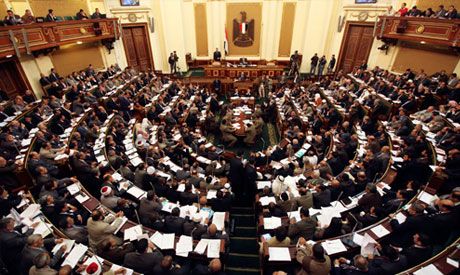
A divided parliament
A contentious draft law governing parliamentary elections is expected to be one of the first major challenges for newly elected President Abdel Fattah al-Sisi to overcome.
A major bone of contention in the draft law is the mixed parliamentary system, whereby 80 percent of the seats are elected for single candidates and 20 percent are reserved for party lists. This represents a major shift from the last Parliament, in which two-thirds of the seats were reserved for lists and one third for individuals. Critics say the new configuration weakens the power of the political parties.
They warn that this system would once again empower individuals with traditional bases of support, such as money, power networks and tribal connections, which they would use to mobilize voters and thus turn the elections into a contest between people, not political ideas.
Outgoing President Adly Mansour appointed a group of legal experts to formulate the draft law, but political rifts delayed the writing process and the bill wasn’t approved before he left office. It’s now Sisi’s problem, after he took the reins from Mansour earlier this month.
Headed by former Minister of Transitional Justice Amin al-Mahdy, the committee is comprised of legal experts, many of whom were part of the committee that wrote an early draft of the 2014 Constitution.
These experts include Ali Awad, Mansour’s advisor for constitutional affairs; Omar al-Sherif, assistant to the minister of justice for legislative affairs; Ali Abdel Al, a constitutional law professor and legal advisor to the former minister of interior; and Ali al-Sawy, a political science professor and legal advisor to the former minister of local development.
The committee only had 15 days to draft the bill before putting it up for national dialog with representatives of various political parties.
The liberal Wafd Party was heavily involved in the negotiations. But Ahmed Ezz al-Arab, the party’s vice president, says the only response they were able to get out of the committee was a “big no.”
“We explained the dire conditions that political parties went through. We explained the atmosphere of political exclusion we experienced under both the Mubarak and Morsi regimes. We said that we cannot function without a strong electoral law that gives wider powers to political parties. But the only answer we got was no,” he says.
Sherif Taha, spokesperson for the Salafi Nour Party, reiterated Arab’s remarks, adding that none of the party’s suggestions were ever taken into consideration.
Farid al-Baiady, a member of the Egyptian Social Democratic Party’s political bureau, worries that the new configuration will further weaken the country’s political life.
“Political parties are weak, so we either strengthen them or destroy them,” he said in a press conference.
The 80 percent allocation to individual candidates would also lead to a divided parliament with no clear political alliances, argues Rania Zada, a researcher at the Arab Forum for Alternatives. For example, critical alignments for the approval on the formation of government as per the 2014 Constitution will be difficult to attain.
If the parliament disapproves of the government formation, its biggest bloc would have the opportunity to form a different one. But if it also fails to form the government, the president would dissolve the parliament altogether and call for parliamentary elections within 60 days.
“In such a divided parliament, who can form the government? The parliament will resort to forming a divided minority government, an experience that has utterly failed in countries witnessing democratic transitions. This will produce all the catastrophes of the mixed parliamentary system,” Zada contends.
Baiady agrees, accusing the bill of “killing political party life in Egypt.” He believes that the committee’s intention is to prevent any political party from forming the government, because the “independent individuals will most probably approve the president’s suggestion of the government.”
But Mahmoud Fawzy, the legal committee’s spokesperson, told the Saudi-owned satellite channel Al Arabiya that the committee’s true intention was to “enable the voter to know his candidate.”
Party lists weaken the relationship between the voter and the candidate, Fawzy argued, adding that when this link is weak, two major issues arise.
“Monetary bribing and religious mobilization will both prevail. Would this ensure the free will of the people? Our experience with the party lists system is immature and often reflects unreal representation of society,” he claimed.
Fawzy warned that the old regimes of former President Hosni Mubarak and the Muslim Brotherhood could return to power if a party system dominated the parliamentary elections.
However, Zada disagrees, arguing that Brotherhood and Mubarak-era figures traditionally infiltrate the individual candidates system to field candidates with whom they have discreet affiliations. The party system forces political groups to reveal their people, ideas and plans, she contends.
Responding to the argument that political parties have failed to organize and grow over the past three years, Zada asserts, “Yes, this is true. But would be the solution to further weaken them? If party life in Egypt is weak, it is the state’s responsibility to strengthen it by opening the space for political parties to function.”
The geographical division of the party lists’ constituencies has also drawn serious criticism from political parties.
While only four constituencies are allocated for the party lists, the draft law does not specify the number of constituencies allocated for the individual seats, leaving the battle over the geographical distribution of these constituencies postponed for a separate law still in the making.
According to Fawzy, the four constituencies allocated for the party lists system are organized as follows: The East Delta constituency with 15 seats, including Sharqiya, Damietta, Port Said, Ismailia, Suez, South Sinai and North Sinai; the West Delta constituency, also with 15 seats, which comprises Beheira, Alexandria and Matrouh; the Greater Cairo constituency with 45 seats, including Cairo, Qalyubiya, Monufiya, Gharbiya, Daqahlia and Kafr al-Shiekh; and the Upper Egypt constituency with 45 seats, including Giza, Upper Egypt and the the Red Sea and South Valley governorates.
For Baiady, this distribution presents serious challenges for parties’ organizational abilities.
“How does a party cover a wide constituency like this? Who has the money and the organization to mobilize in such huge constituencies?” he asks.
Islamist players are equally angered by the draft law, chief among them the Nour Party, which intends to contest all seats in the parliamentary election.
According to Taha, his party hopes that the committee would amend the percentages to give party lists 50 percent of the seats.
There are also disputes regarding the formation of the meager quota of seats allocated to parties. For the Nour Party, which wishes to see a stricter implementation of Sharia law through their presence in Parliament, some quota regulations within party lists are limiting.
As per the Constitution, the bill lays out specific quotas for women and Copts in each list.
“Our stance on the principle of quotas has been clear since the beginning. We are against it. The question on how we will handle this will be left for future arrangements,” Taha explains.
An earlier draft of the law suggested raising the number of parliamentary seats to 630, but Fawzy says Mansour instructed the committee to lower the number after various political parties objected. The final draft reduces the number to 567 seats, including 420 for individuals, 120 for party lists and 30 members appointed by the president. The 2012 Parliament had only 502 members, of whom 10 were appointed MPs.
According to Fawzy, Mansour decided to reduce the number of seats to save money on salaries, while also increasing the parliament’s efficiency — a bloated parliament could hinder the legislative process.
Most of the parties are now putting high hopes on Sisi to resolve their issues under the law. While they wait for his final decision, leaders of most political parties have put off their plans for forming electoral alliances until the bill is officially passed.
“We are coordinating with other political parties to change the draft law before it is passed,” Taha says.
Arab says that the Wafd Party also presented a list of its suggestions to Sisi, “but it remains completely unclear what will happen. There have been no signs of any decision yet.”

Mai Shams El-Din
Mai graduated from the American University in Cairo with a degree in journalism. She worked mostly for local English-language news outlets but has also been writing in Arabic, particularly when…
تقارير ذات صلة
Fragmented politics
As political forces brace for parliamentary elections in Egypt, which were once scheduled to take place before the end of the year, a web of political coalitions reveals fragmentation within…

Socialist Popular Alliance’s Haitham al-Hariry becomes latest candidate disqualified from 2025 House election
The list of nominees disqualified from the 2025 ballot is growing
Presidential elections: An opportunity for the opposition to come out of the margins?
Now, there are three members of the Civil Democratic Movement who have stated their intention to run
Your support is the only way to ensure independent, progressive journalism survives.
You have a right to access accurate information, be stimulated by innovative and nuanced reporting, and be moved by compelling storytelling. Subscribe now to become part of the growing community of members who help us maintain our editorial independence.
Join us