
‘7 years of abundance’ — The unusual media campaign celebrating Sisi’s anniversary
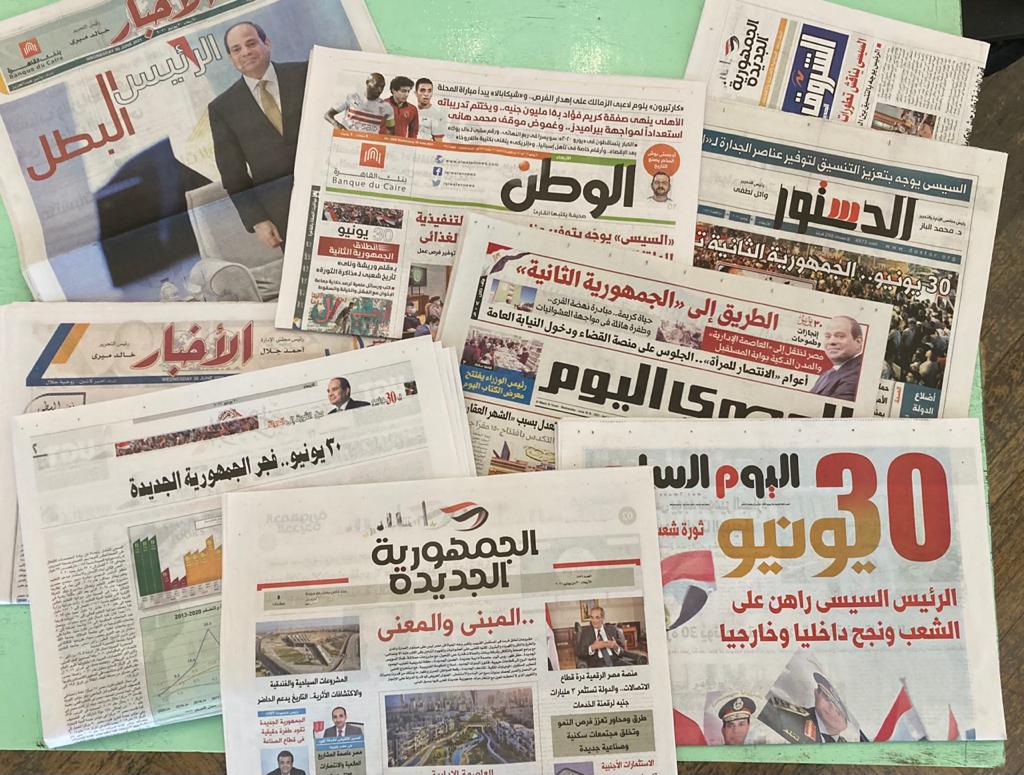
The headlines emblazoned across nearly all state and private newspapers in Egypt today, June 30, are gushing with praise for President Abdel Fattah al-Sisi and laud the “new republic,” a term Sisi himself used in a speech several months ago to describe the scope of his ambition to transform Egypt.
The wave of celebratory coverage has been continuous since the second week of June, with newspapers and television channels rolling out a particularly laudatory media campaign that has been notable even within Egypt’s tightly controlled and sycophantic media landscape.
Sisi was sworn into office on June 8, 2014, less than a year after Egypt’s first elected, non-military president, Mohamed Morsi, was ousted. This year marked the seventh anniversary of his inauguration. The presidential anniversary has been commemorated around the same time every year, with celebratory coverage typically stretching to June 30, the date of the mass demonstrations that preceded Morsi’s ouster.
This year, however, the coverage was unusual both in terms of quality and quantity. A number of newspapers have published four to eight-page special sections that feature adulatory reviews of the president’s achievements over his seven years in office, and several TV shows have dedicated entire episodes to the same.
According to several newspaper sources, clear instructions have been issued to newsrooms to highlight Sisi’s achievements and to avoid referring to negative news of any kind, even stories of building collapses and train crashes.
Mada Masr interviewed a number of newspaper, media and political sources — who spoke on condition of anonymity — to understand the context and motives for this year’s particularly laudatory media campaign. According to a number of the sources, it may be setting the stage for a significant political move in the eighth year of Sisi’s reign.
***
According to one senior editor at a state-owned newspaper, directives were issued to media outlets that were unmistakably clear: focus on the president’s achievements over the past seven years. The instructions came with a comprehensive list of achievements to be highlighted, arranged in the order they were to be featured along with specific elements to be covered under each achievement, the editor says.
This senior editor says the orders came from government press bodies. But another editor, who works at an independent newspaper, says the orders came from a “sovereign entity” which communicated to a group of chief and senior editors that the objective was to “remind people of [the president’s] achievements in a direct way.”
According to a member of the editorial board of a privately owned newspaper, these differing accounts can be attributed to the multiplicity of authorities that usually issue instructions to newspapers and other media outlets. However, he says, the most important instructions are always delivered directly to editors in chief by the press guidance taskforce, a team attached directly to the office of the president that is a small, trusted working group within the innermost circle of power.
The media “celebration” plan may have come from several different authorities, but the content, down to the minor details, is the same.
The main theme is to call attention to the “development achievements” and the “economic and social breakthrough on various fronts — including education, services, roads, new cities, public services, and the New Administrative Capital,” according to the editorial board member. Another editor of a state newspaper spoke of detailed lists of achievements issued to media outlets to “make use of in reports and special features.”
Compliance with these instructions has been apparent in various newspapers over the past few weeks. Al-Gomhuria’s June 11 issue was published with a special section titled “Egypt, Sisi, the road to the new republic: Years of building, development and progress.”
While state-owned newspapers were more packed with celebratory content, even newspapers viewed as “independent” took part in the coordinated media rollout. The day after Al-Gomhuria’s special section, the front page headline of the Wafd Party newspaper was “Egypt builds the new republic.”
Hailing the “new republic” wasn’t the only repeated theme. A good portion of the coverage invoked the Quranic version of the prophet Joseph’s story, particularly drawing on the significance of the number seven in the parable, where Joseph interprets a dream of a former fellow prisoner about seven years of abundance.
In their coverage, various state and private newspapers described Sisi’s time in office as “seven years of abundance.” Meanwhile, in a June 7 column titled “a new republic,” the editor in chief of Al-Akhbar, Khaled Miri, referenced Joseph. “Nobody has the same ability as Our Revered Prophet Youssef had to foresee the future and interpret dreams,” he wrote. “But his story teaches us that patience, hard work and faith are the key to prosperity and reaping the fruits of success.” And in Sawt al-Azhar, the official weekly of the preeminent religious institution, the main headline of its second June issue read: “The new republic: 7 green years.”

But Joseph’s seven prosperous years were followed by seven hard years, noted columnist Mohamed Saad Abdel Hafez on Facebook — calling on the officials who devised this public messaging to carefully consider the Quranic text and not quote it haphazardly. Another columnist, Galal Hamam, made the same connection in his June 11 column in Dostor. Hamam, however, resolves the tension by saying that after seven years of prosperity “ the year will arrive during which people will be given rain and in which they will press olives and grapes,” instead of seven hard years.
Citing the Joseph story was not part of the mandate to media outlets, according to sources, but it was referenced in multiple outlets nevertheless in what seemed to be a coordinated way. One political figure, who had met Sisi several times when he was defense minister, says that the Quranic verse on Joseph has a special place in Sisi’s heart and that he loves to recite it.
Perhaps the most balanced piece was a column penned by Emad Eddin Hussein, a member of the Senate and the editor in chief of Al-Shorouk newspaper. In the June 6 issue, he lists the achievements of the past several years but also points out the challenges lying ahead. Hussein writes that TV personality Lamis al-Hadidi asked him on her talk show, ‘Would you have thought all these accomplishments were possible during seven years under Sisi?’ He responds by telling her that while people were primarily hoping for security and stability at the time Sisi took office, what has in fact been achieved —whether in the economy, infrastructure or public services — is far greater. But he adds that, with these seven years of achievements, there are seven challenges must be overcome: the Great Ethiopian Renaissance Dam, the development of the education system, combating corruption, agricultural land reclamation, agricultural and industrial development, foreign debt and the need for more political freedoms.
Along with listing Sisi’s achievements, the other half of the directive issued to media outlets was to refrain from covering negative stories as much as possible. Sources from both state-owned and independent newspapers describe exceptionally thorough review efforts within newsrooms in recent weeks, resulting in many stories perceived as negative being cut.
This was the case with an op-ed penned by writer and researcher Amr al-Shobaky for Al-Masry al-Youm. The article appeared in the print edition, but was later taken off the newspaper’s website. Shobaky criticized current media trends and questioned “the motive behind imitating unsuccessful experiments.” According to a well-informed press source, one official concerned with media coverage told the editor in chief that “this is not the time” for such articles and instead that this is “the time to underscore the positives.” At the same time, Shobaky was subject to a defamation campaign by Egypt’s largest state-run newspaper, Al-Ahram, and its affiliates — of which he is a member in his capacity as a researcher for the Ahram Center for Political and Strategic Studies — accusing him of supporting the Muslim Brotherhood.
According to workers in several state-owned newspapers, the special feature sections that were published presented a rare opportunity for companies to purchase advertising space to praise all of Sisi’s achievements over his seven-year tenure. One particularly striking example was a full-page ad signed in the name of “all workers at Al-Tawhid w al-Nour franchise.” Ragab al-Sweirki, the owner and founder of the department store franchise, is in remand detention on terrorism funding charges.
The editors who spoke to Mada Masr of a coordinated coverage “plan” for the seventh anniversary of the president’s inauguration did not mention any specific reason for the unusual level of coordinated media hype this year around, offering different interpretations. Some believe that Sisi is “disappointed in the media and feels that people need a reminder of just how much has been accomplished,” while others maintain that “it is not arbitrary,” but rather think of it as “a prelude to something to come” during Sisi’s eighth year as president.
The “something to come” could potentially be a move toward a second constitutional amendment that would, in some fashion, lift presidential term limits of two terms, according to parliamentary sources, who reference talk of the issue in political and legislative circles. A two-term limit was outlined in the Constitution before Sisi took office, while a constitutional amendment in 2019 allowed him to stay in office until 2030.
Then there is a simpler explanation presented by one media professional: this media campaign may be nothing more than a proactive effort by the press guidance taskforce to demonstrate its ability to properly promote the president’s accomplishments, thus earning itself greater prestige and trust. “More than anything, such initiatives come from people who want to assert their position more than anything else,” the source says.
تقارير ذات صلة
Shakeup to state-dominated media landscape underway
Management of Egypt’s state-dominated media is in the midst of a shakeup, 10 sources working in media institutions tell Mada Masr. Nearly all media outlets in the country are either…
Legal limbo: Media council again extends deadline for outlets to legalize status
For the time being, we remain in legal limbo.
This justice is not blind: New amendments to terror laws
Under one amendment, individuals on the terror list may see their syndicate memberships frozen.
Your support is the only way to ensure independent, progressive journalism survives.
You have a right to access accurate information, be stimulated by innovative and nuanced reporting, and be moved by compelling storytelling. Subscribe now to become part of the growing community of members who help us maintain our editorial independence.
Join us