
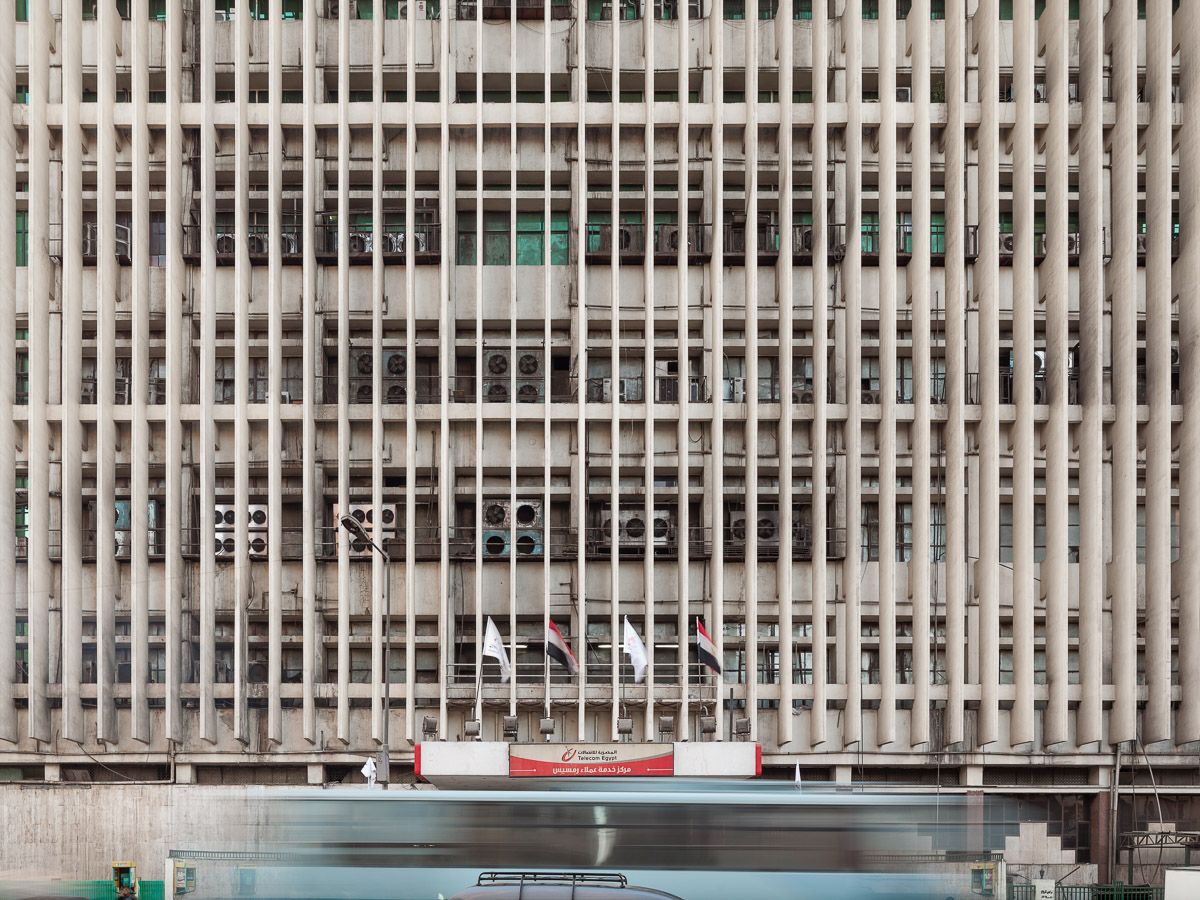
The Internet As A Place
In the summer of 2012, Heinrich Holtgreve happened upon a blog post — BLDG BLOG — in which its author, Andrew Blum, outlines the potential dangers of the centralization of information. It was this discovery that sparked Holtgreve’s fascination with the physicality of the internet. The internet is a place one can visit: Buildings of varying importance that are related to its facilitation and management are scattered all over the world, and are situated contrary to typical notions of a connected world. The internet connects cities, countries and continents via fiber-optic cables that follow the shortest path between two points. Egypt is a significant location for international data traffic and the cables carrying data follow the same path that international trade lines do, passing through the Suez Canal. Downtown Cairo hosts the largest internet exchange — the Cairo Internet Exchange or CAIX — and cable systems like SEA-ME-WE-3 and 4 or FLAG are routed ashore in Alexandria. Egypt’s geographical location has benefitted the state in a number of ways. Just as the Suez Canal has annually brought in billions of dollars, there is money to be made from selling licenses to cable laying companies, and the Egyptian government is well aware of this. Yet, while he is fascinated by the tangibility of the internet, Holtgreve is also aware that it’s “not all sparks & romance,” and that Egyptians don’t enjoy many of the same freedoms as others with the same infrastructure. For example, the internet was shut down nationwide from the CAIX directly on January 28, 2011, in an unprecedented move by the Egyptian government. It might not sound advantageous that the informational infrastructure for most countries is in the hands of private companies with their thirst for profit, but it’s frightening that governments also maintain such a tight grip on networks, broadcasting the voices of some and silencing others. Indeed, in its brief history, the architecture of the internet has managed to withstand a number of threats. Despite these pertinent issues, Holtgreve hopes to show that Egypt is in a critical location for international data flow, and that Egyptians can proudly say that the magic of the internet, both tangible and intangible, flows from a handful of buildings in Cairo and Alexandria.


Your support is the only way to ensure independent, progressive journalism survives.
You have a right to access accurate information, be stimulated by innovative and nuanced reporting, and be moved by compelling storytelling. Subscribe now to become part of the growing community of members who help us maintain our editorial independence.
Join us