
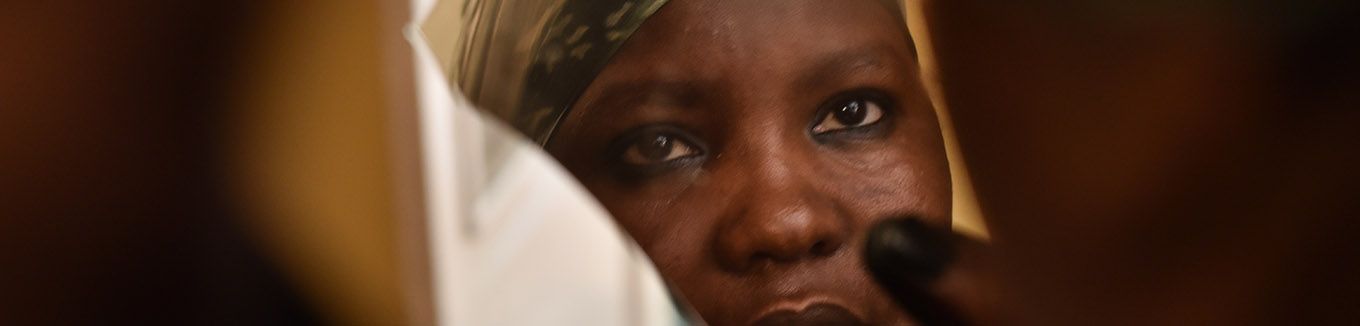
Life in a garden across from the UNHCR
In 6th of October City’s Hay al-Sabea (7th district) neighborhood, where a number of Iraqi and Syrian restaurants and markets have flourished, one can also find the United Nations High Commissioner for Refugees building. Dozens of people wait in line for hours outside its gates on weekday mornings.
Across the street, in a small garden, men and women spread out various products on sheets to sell to the waiting crowds. The goods vary, ranging from pouches for UN refugee cards, to honey, incense and hair products from Sudan.
There are also often police cars parked nearby. “They are here to make sure no one stays too long,” Saeeda explains. These days, after 5 pm, the garden is empty. However, up until mid-February, Saeeda and her five children were among a group of people that had made the garden across from the UNHCR their temporary home, for lack of access to better housing. For over four months, she and her children shared the space with other women, men and children, who slept, cooked, ate, spent time together and went about their daily lives. Most of them were Sudanese, although some were Somali or Eritrean, and have been in Egypt for different periods of time, each with their own experiences.
When talking about their treatment in Egypt, several people outside the UNHCR building made references to the killing of at least 20 Sudanese protesters by security forces in Mohandiseen’s Mostafa Mahmoud Square in 2005. Two of the men in the garden were there on that day. A resident who was annoyed by the refugees staying in the garden also referred to 2005, but by a narrative that has been frequently espoused by Egypt’s authorities and some Mohandiseen residents, who see the presence of those in the garden as destroying its “public image.”
On February 13, 2017, police dispersed many of those in the garden, confiscating their belongings and arresting anyone who objected, as one of the refugees in the garden, Magdy, explains. The next day, Saeeda left her children at a friend’s house and spent the entire day at the police station, located near the UNHCR, pleading with officers to give her back her belongings. They refused.
Since then, Saeeda has been moving between apartments, often staying with friends. For now, she has settled in Ard al-Lewa. To provide for her children she goes to Hussein Mosque every evening, where she works as a Henna artist. Some days are better than others, especially given that police do not always allow Sudanese henna artists to work in the area.
Saeeda left Khartoum three years ago because she and her family opposed Omar al-Bashir’s regime. As a single mother to five children, living in Egypt hasn’t been easy for her. She faces economic insecurity, police violence and racism daily. “I feel like I fled Sudan, only to come to another Sudan,” she says. “We left the fire in our country, and came to Egypt to find the fire here too.”


Your support is the only way to ensure independent, progressive journalism survives.
You have a right to access accurate information, be stimulated by innovative and nuanced reporting, and be moved by compelling storytelling. Subscribe now to become part of the growing community of members who help us maintain our editorial independence.
Join us