The owners of small furniture workshops in Damietta are suffering from a combination of factors, including: the high cost of materials, imported furniture invading the local market, low-quality and low-priced Chinese goods, a lack of adequate social security, control over workshop owners by tycoon merchants and their capital and the deteriorating health of workers. The industry has been neglected and doesn’t receive enough support, given that it is the main source of income for Damietta governorate, with exports in the first quarter of 2014 reaching LE207 million, according to the Exports Council. Approximately 70 percent of Damietta’s residents work in the furniture industry, in addition to workers from Gharbiya, Daqahliya and Port Said, among other areas — for Damietta is the “Kuwait” of Egypt. According to official statistics, there are around 11,000 workers registered in the syndicate of furniture workers. The numbers in reality, however, are quite different. There are no accurate records of the number of small workshops, and the most recent statistics, from 2010, show 37,000 registered workshops that pay taxes. But there are thousands of unregistered workshops in Damietta, the city that seems like a huge factory without walls. On both sides of the street, warehouses stocking imported wood can be found, and furniture showrooms are everywhere. Owners stand at the entrances to their shops to greet potential customers. The small workshops are usually found at the back, tucked inside apartment buildings, and customers rarely know of their existence, except for perhaps a stray saw, paint sprayers, or some upholstery materials lying around. After the 2011 revolution, the city and its workers witnessed several changes: local designs regressed, the cost of materials soared, and merchants evaded payments, which increased their debts. Many small workshop owners left their business to find alternative sources of income that were more stable, even if they were earning less than from their workshops. This is one of the largest blows to the industry, since most of the youth in Damietta prefer artisanship to government employment. Many carpenters and wood polishers suffer from bronchial asthma, caused by constant exposure to sawdust and polyester paint. Most artisans don’t receive medical care for vocational diseases, which can mean they only live until 50 years old, or so. Carpenters risk injury on a daily basis, and in some cases require the amputation of a finger or limb. The nearest hospital is Damietta General Hospital, which has a shortage of services and trained staff. The Workers Syndicate, established 30 years ago, does not offer any other services to workers, so they and their families do not receive any social or medical insurance.
Usta Mohamed has been working as a wood engraver for 30 years, much of it without insurance or a fixed wage. He only started to enjoy such benefits 10 years ago, when he commenced employment at Said Eissa’s integrated workshop in the Shatt al-Malh area.
Most of the workshops that offer supplementary work for the furniture industry in Damietta are in Shatt al-Malh.
Despite the hazards, children and young people work as wood polishers. The wood polisher adds final touches to the furniture before it is ready for sale.
A wooden door separates wood polisher Mahmoud al-Esseily’s workshop from that of his brother, Samy al-Esseily. There are four workers in Mahmoud’s workshop, the youngest is 11 years old. Mohamed al-Rifay, an 11-year-old student, has been working at the wood polisher’s workshop since he was eight years old. He lives in Gamaliya village, one hour away from his workplace. When one of his fingers was injured, he went to the public hospital, where the doctor advised him to go to a private clinic, because the only thing they could do was amputate it. When asked why he has to work, even though his father is alive, he said: “This is a dangerous job, and it has ruined my chest. I won’t go to the doctor, I just drink a glass of milk every day and that makes the pain go away. The craft is more important, if we don’t practice, it’ll disappear.”
Hamada Allam takes a break to eat in his workshop in Shuara village in Damietta, while watching one of his workers, despite the surrounding sawdust and paint residue.
Mohamed Saad, a carpenter in Shuara village, works daily from 8 am to 10 pm in a small workshop. His finger was cut off by a wood cutting machine. Saad is exposed daily to many hazards from the machines, and doesn’t have medical or social insurance.
Usta Sayed taught the carpentry craft to his three sons, who work with him in his workshop in Shatt al-Malh area. Damietta is the only region in Egypt that has defeated unemployment, since all family members traditionally work in the furniture industry, regardless of age.
When the carpenter is done with the main body of the furniture, Haj Atif the upholsterer steps in. He owns a small workshop in the downtown area of Damietta.
The front of a major furniture showroom on one of Damietta’s main streets, displaying products at high prices from the small workshop behind.
One of the workers at Said Eissa’s integrated workshop moving from one floor to another, as each floor is responsible for different stages of the industry.
After painting the furniture pieces, the workers leave them to dry in a room away from dust.
At the end of a long working day, the workers leave their paintbrushes to dry after washing them, so they are ready to use the next day.
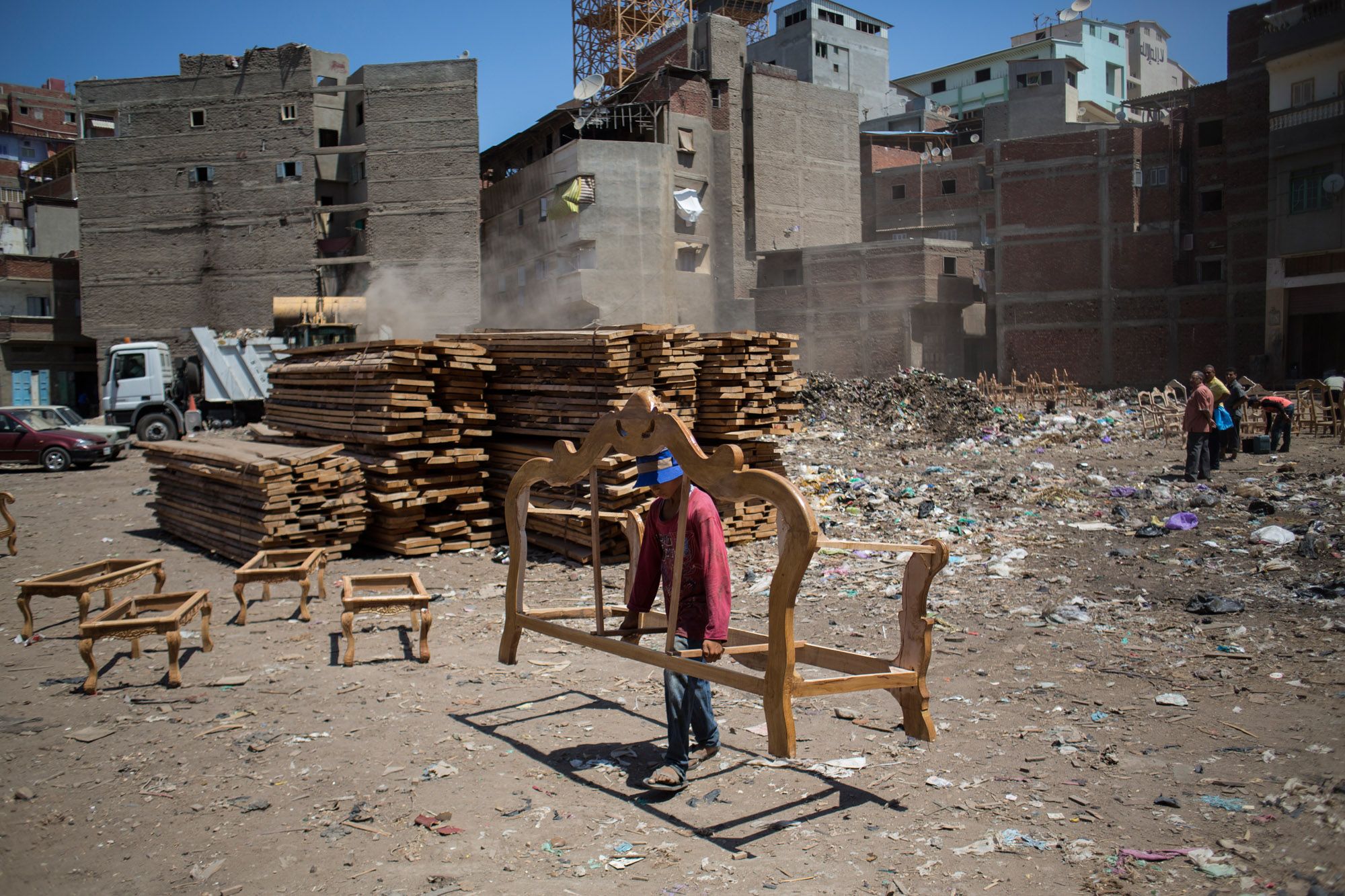
Due to cramped conditions, some work outdoors on empty land next to their workshops.
“Under each house there’s a workshop,” the locals say. Nearly all of Damietta’s residents work in the furniture industry and in small workshops.
Before the January revolution, this used to be one of the largest parks in Shatt al-Malh, open to local residents. It has turned into a deserted area, a garbage dump, and an extension for the surrounding workshops, like all other agricultural or empty land in Damietta.
Damietta needs large energy resources for its thousands of furniture workshops. However, due to the energy crisis, power outages often exceed six hours a day, which negatively affects workers and workshop owners.
A workshop in Gereeba, a residential area teeming with workshops. The area is marked by narrow streets, which make it seem like a huge factory.
Mohamed Awad, 38 years old, also known as Abu Ziad (Ziad’s father). He has been a wood polisher in Damietta since the age of eight, but with increasing debts, the high prices of materials, and his asthma condition, he was forced to close his workshop, quit the trade of his ancestors, and start working as a taxi driver. “I used to make LE4,000 per week, that’s the profit of working six days a week, 12 hours a day. It was enough to cover the costs of the workshop and the workers. I had 12 workers, mostly from the surrounding rural areas. All I cared about was to add up the profit on Thursdays, pay the workers, and take my children for a trip in Ras al-Bar or Port Said. I was carefree.” Due to debt and slow business, he started to lay off his workers one by one. After four months of working alone in his workshop, the debts increased and Awad decided to close. He started working as a taxi driver to pay his debts, which accumulated to the extent that he was unable to pay the instalments on his private car and had to sell it.
Sami al-Esseily, 40 years old, owns a carpentry workshop in Shuara village. Like all workshop owners, Sami worries about his debts and workers’ wages. Sami al-Esseily, a 38-year-old married man with four children, chose to work and live in Shuara village in Damietta. He has been a carpenter since the age of six and takes pride in his craft, which he says is under threat from businessmen and their capital. “Carpentry is the foundation of the industry, for the carpenter is the artist that materializes the designs and tastes of consumers. We hand down this craft to our children and the next generation. Regardless of their level of education, they must learn the furniture craft.”
Mahir Gumaa, a 35-year-old married man, who used to work as a carpenter. He doesn’t have a university degree, and is the eldest of five siblings. He used to provide for them, but after a serious injury, they became the providers. His right hand was cut off by a wood cutting machine at the age of 12, and he hasn’t been able to work as a carpenter since. The only compensation he receives is a LE250 disability pension from the Ministry of Social Affairs. He and his children have no social or medical insurance. He now works as a janitor.
After a long working day, Sami al-Esseily sits in his workshop, checking the furniture before delivering it to the merchant’s showroom.
Sami al-Esseily has his own designs, which he shows customers with a low budget. “Carpentry is the foundation of the industry, for the carpenter is the artist that materializes the designs and tastes of consumers. We hand the craft down to our children and the next generation. Regardless of their level of education, they must learn the furniture craft,” he says.
The wood polisher works for over nine hours in workshops full of spray paint fumes, which often cause asthma and respiratory diseases.
Kafr al-Batikh
Due to money shortage and high rent, Haj Mahfouz, “the master of wood polishers” as his peers call him, is forced to work on empty land next to his workshop in Gereeba. While the residents use it as a place to dump and burn garbage, he uses it to make the finest furniture.
Although he quit his job as a wood polisher five months ago, he makes sure to teach Ziad, his nine-year-old son, the furniture craft and wood engraving. “Each craft in this industry has its own problems, the wood polisher suffers from his chest, the carpenter’s fingers get cut off, and the wood engraver gets varicose veins caused by prolonged standing. I chose the least harmful craft for him. But the kid has to learn a craft, and know the value of money, and I have to look after this myself.” Despite the vocational hazards of the furniture industry, Ziad’s father makes sure to follow the suit of his fathers, teaching his eight-year-old son, Ziad, wood engraving, which he thinks is the least dangerous craft.
In every building on the Nile Corniche in Damietta are the largest furniture showrooms in the country, selling products from the small workshops behind at much higher prices.
Sabry Khaled is a Cairo-based independent photojournalist, Co-Founder and project manager of Shouf photographers collective, Contributor to The Associated Press photos, and Panorama Mada Masr. Sabry was a dentist who…
Your support is the only way to ensure independent,
progressive journalism
survives.
You have a right to access accurate information, be stimulated by innovative and nuanced reporting, and be moved by compelling storytelling. Subscribe now to become part of the growing community of members who help us maintain our editorial independence.