
Challenging visual stereotypes of the Middle East
The Instagram feed "Everyday Middle East" (@everydaymiddleeast) is a collection of images taken on mobile phones and contributed by 23 photographers based in the Middle East and North Africa. We posed some questions to Lindsay Mackenzie, founder and curator of the feed, about the motivations behind the project and the process of challenging visual stereotypes of the Middle East that prevail in much of the mainstream media. Lindsay Mackenzie: The purpose of the feed is to show images of day-to-day life from across the Middle East and North Africa. The mainstream media is often only interested in publishing photos of the extremes — this feed is a place to establish the norm. It’s a place to show photos whose subjects aren’t predetermined — just what we see when we are out in our “everyday.” In publishing these kinds of images, we hope that the feed can help to work against the stereotypes and visual tropes that are so prevalent about the Middle East. I'm not saying we are going to revolutionize the way the rest of the world sees the region. But I do think that the platform provides an interesting opportunity to reach a new audience with a new narrative. What visual stereotypes do you hope to challenge? LM: In September 2012 there was a Newsweek cover story that ran with a photo of shouting bearded Egyptian men with the headline "MUSLIM RAGE." Remember that one? I think that about sums it up. That being said, we are not trying to counter one specific stereotype with one specific alternate narrative. I hope that the account shows the diversity within and among all of these countries that are often lumped together under the “Middle East” label. We would like to be able to illustrate the context within which the extreme images that we always see in the mainstream media exist. Contrast the “Muslim Rage” Newsweek cover with, for example, Alex Kay Potter’s photo of a Yemeni father relaxing with his kids after lunch. We’d like to interrupt the predicable Western visual narratives of a place like Saudi Arabia with Iman Al-Dabbagh’s photo of a woman riding her bike along the Jeddah boardwalk. We’d like to show common human experiences, like Hanif Shoaei’s elegant photo from behind the scenes at a wedding in Tehran. Your contributors are a mixture of locals and ex-pats. Is this important? If so, why? Have you noticed that their vision of the 'everyday' varies and if so, how? LM: It's important to have a range of perspectives from across the region — local or expat or dual citizen — which is why we are a fairly large group of contributors. What was important in putting the contributor group together was to find photographers who are active on Instagram, who take 'everyday' images using mobile phone cameras, and who are on board with the idea of the project. Of course each photographer's vision of their everyday is different, but I don't think we've posted enough photos yet to be able to make broad generalizations. Are there any challenges you've faced or imagine having to deal with regarding the grouping of a diverse set of countries under the umbrella term “Middle East”. LM: We've intentionally gone with a very broad definition of "Middle East" (we include North Africa, Iran, and Turkey, for example) because these places seem to be subject to a similar set of stereotypes in the mainstream media. Perhaps this sounds odd, but we've grouped together a diverse set of places in order to be able to show that they are diverse. Regarding challenges, of course we've had and will continue to face some challenges. It is a complicated place and we are a large group of people, so there are always going to be differences of opinion. Whether or not to include Turkey was a discussion that we had. How to describe images from different parts of Israel/Palestine — that is an ongoing discussion. We still have geographic gaps in where the images are coming from — for example we don't yet have any images from Libya and only have a handful from Iraq, Syria, Oman and Bahrain. We are probably biased toward urban images because most of our contributors spend most of their time in cities. But overall I've been impressed by how much everyone understands the idea of the project. When I started up the feed every person that I asked to join said yes — it showed me how tired everyone is of these stereotypes and how much we would like to show something different. Riding on the success of the Everyday Middle East and Every Africa feeds, Belgian/American photographer Tinne Van Loon created "Everyday Egypt" (@everydayegypt) feed. Tinne Van Loon: [Everyday Middle East's] mission to break through the stereotypes by showing daily life scenes really resonated with me as that’s often the goal behind my own work. The idea to start Everyday Egypt actually came after a photo of mine was featured on Everyday Middle East. What does the Everyday Egypt feed contribute that Everyday Middle East or Every Day Africa do not? TVL: Obviously if one is interested specifically in life in Egypt, the most populated country in the Middle East, Everyday Egypt provides a much greater focus, and with 15 contributors right now (and our base is still growing) we provide 15 individual perspectives on the country. About half of our contributors are Egyptians, and half are foreign photographers living in the country, often for years. I also find that with so many photographers working on representing our country, we are often inspired by each other’s work and feed off of that, either by posting complimentary images as the ones who posted before us, or by posting contrasting images, showing that there are multiple realities that are happening at the same time. Everyday Middle East tries to deal with broader visual stereotypes of the Arab world. What do you think are the visual stereotypes from Egypt that prevail? TVL: Egypt specifically is stereotyped of course by Tahrir Square, the recent revolution and political unrest, as well as the ancient trifecta of pyramids, camels and the desert. Being able to really flesh out the range in diversity and differences both inside Middle Eastern countries and between countries is one of the strongest additions that country-specific everyday feeds such as our Everyday Egypt, as well as Everyday Iran and Everyday Bahrain can bring. Instagram is often regarded as a crude version of a photojournalists’ work. With Egypt arguably experiencing the greatest crackdown on journalists and freedom of expression, is using mobile phone photography going to become a more accepted professional tool? TVL: While many photographers are still unsure about the issue, mobile photography is definitely becoming more accepted. There’s Ben Lowy who has covered the revolution in Libya with his mobile phone, and his iPhone image of the waves in Hurricane Sandy in the United States was published as the cover of Time Magazine. With the image quality of mobile phones improving over time, I think the stigma behind it will disappear and the images will be judged based on the content and composition, instead of the tool it’s made with. I have recently found a greater freedom in photographing street life in Cairo with my iPhone versus my actual camera, as it is so much easier to blend in and not draw attention to yourself. This is especially a strong point in a country like Egypt where photographers are continually accused of being spies or having bad intentions. How can local photographers get involved? TVL: We are still looking for a few more talented photographers to add to our list of contributors, especially photographers who are based in cities besides Cairo. You can get in contact with us by emailing [email protected] or by hashtagging your work on Instagram with #everydayegypt. Each friday we feature a photographer who tagged their work with #everydayegypt on our Follow Friday. This way we’re also hoping to provide a greater platform for photographers to participate in the movement. I know countless people who often check the #everydayegypt hashtag on Instagram and befriend others who are part of this greater movement.
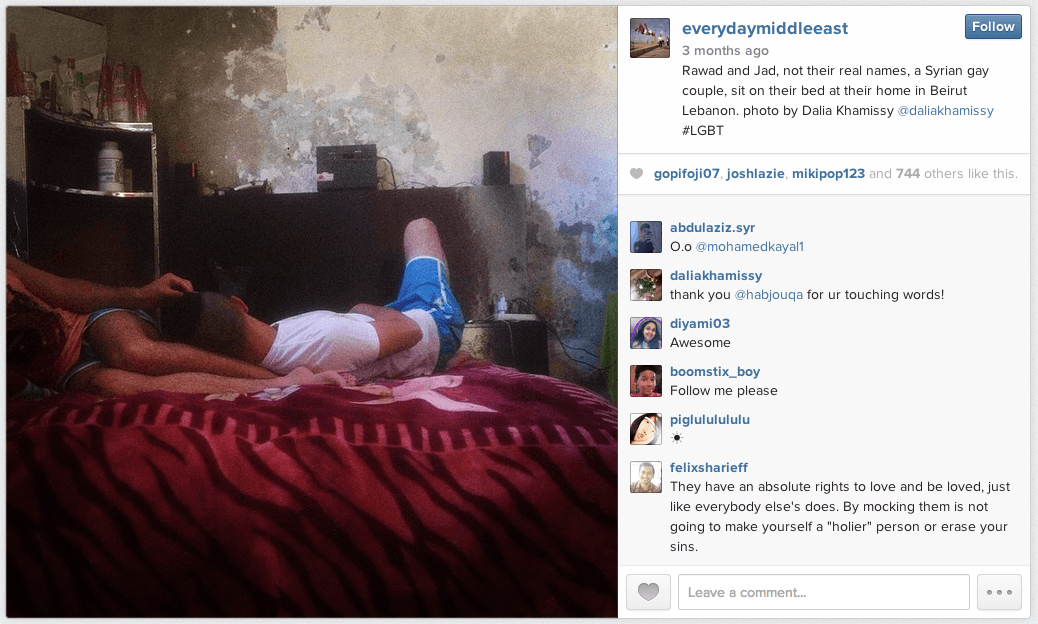
Dalia, what do you think about the reactions to this photograph you took? Dalia Khamissy: The day I took that photo, I posted it on my Instagram feed, on the 'Everyday Middle East' feed and on my Facebook (with more information included on the Facebook post) and so the reactions were different on each platform. The photograph was taken during an assignment for a publication so I shot the real thing that I saw in front of me, the love I felt between those two men who have been together for over three or four years, who fled Syria together for fear of being killed and who were still in love and only had each other as they had lost their country, their families, their house and belongings and everything they had in life. Obviously we had to collaborate the three of us with each other during the whole shoot since I could not show their faces, their tattoos etc and so we had to adjust the way they were sitting all the time. Their lives are in danger if anyone recognizes them, and the last thing I wanted is to put any of them in danger. On the “Everyday Middle East” Instagram feed the reactions varied a lot as there are different types of followers there obviously than on my own Instagram feed or on my Facebook ... I know that this day, after I posted this specific photo there were at least 70 people who followed me on my personal Instagram, I guess they were touched by it. People react differently to the LGBT subject and I guess the same happened on the photo I posted on everydaymiddleeast. Sadly often LGBT photos are represented with a lot of sex, exoticism and sparkles that when people see photos of LGBT all they think of is that. The comments varied, some were defending the couple and subject, others were offended by the photo, but this is what the discussions about that subject are usually in real life, some are very supportive and some are against. Everydaymiddleeast followers are very representative of the world we live in.
Why did you decide to photograph a bed? DK: This was also on assignment for an NGO where we were visiting Lebanese host communities in towns bordering Syria. The NGO wanted to stress the fact that NGOs should not only be helping Syrian refugees but their Lebanese hosts who live in similar difficult situations. That day we were interviewing this family whose situation is pretty bad. I did not want to disturb my colleague who was shooting the documentary with the sound of the click on my camera so I asked the owner of the house if I could photograph the inside of the two-room apartment that was furnished in the most modest way. When I got to the second room that was the parents' bedroom, there it was ... This majestic bed! With the light coming from the window, it was too surreal and extremely beautiful and haunting and it looked like a painting (these are the images that usually attract me, the ones that look like a painting!) and so I just took few pictures of it with my DSLR and a few others with my iPhone. I had posted before on my personal Instagram feed some three or four beds taken in different places: one at the tent of the 17,000 Missing of Lebanon, in downtown Beirut — an ongoing project I have been working on for the past four years — and another bed that was used by wounded fighters from the Free Syrian Army who were brought to be treated in Ersal in the Lebanese Bekaa. All of those beds look so beautiful and romantic but each one of them has a very sad story behind it. I usually give a lot of importance in my work to the personal spaces that people occupy and to the furniture they use to decorate them, I find it extremely important and for me they already tell a lot of stories on their own.
Bryan, what do you think or feel when you see big heavy clouds in the Middle East? Bryan Denton: To be honest, I typically love seeing clouds in the Middle East because of the rain they bring during the winter and spring months. This year was an incredibly dry year in Lebanon, and the wider region. The driest in the eight years I've lived there. The implications for farmers and the Lebanese population in general are going to be serious this summer as Lebanon relies on its winter snowfall to meet virtually all of its water needs.
Sarah, what is the history of this house? Sarah Dea: Lidia al-Qattan, the widow of Khalifa al-Qattan, a renowned Kuwaiti artist, began piecing together her House of Mirrors in the 1960s. While her husband was away at an exhibition abroad, she began to redecorate a cabinet in their living room with broken mirror pieces. When Khalifa returned, he was impressed with the result and he encouraged her to continue. Their villa was slowly covered in mirrored mosaics over the years, inside and out.
Tara, why did you choose to post this particular photograph to the Instagram feed? Tara Todras-Whitehill: I loved that this Moroccan man was wearing traditional Berber dress and was talking on his cell phone while wearing sunglasses. To me if he was wearing a different outfit he could have just as well been sitting in Brooklyn, NY. So I loved that that the new (cell phone) and the old (Berber dress) were crossing paths in that picture. I like taking photos which surprise people and put something foreign and familiar together. That and he had a terrific smile.
Alex, why did you take this photo of a repaired chair in Yemen? Alex Potter: The photo I took of the chair in the cafe was taken in small northern city in Yemen, a relatively poor area. All the chairs in the roadside cafe were stitched up like this. At the time I just thought it was an interesting pattern, but it also illustrates just how innovative Yemenis are — making do with what they have, and making something out of what others might see as junk. It's also a nice metaphor for Yemeni society; they're divided in so many ways, but in the end, they're all proud of being Yemeni.
Nadia, does this photograph illustrate resilience in extraordinary times or represent the norm in Cairo? Nadia Mounier: This photograph illustrates the extraordinary ability of people to adapt to what comes up suddenly on their way — life in Cairo doesn't stop whatever happens. Sometimes the small details add to the reading of the photograph; the two towers on both sides of the image can illustrate Cairo at certain times, framed within the current context of military rule.


Your support is the only way to ensure independent, progressive journalism survives.
You have a right to access accurate information, be stimulated by innovative and nuanced reporting, and be moved by compelling storytelling. Subscribe now to become part of the growing community of members who help us maintain our editorial independence.
Join us