
What’s Wrong with Peace?

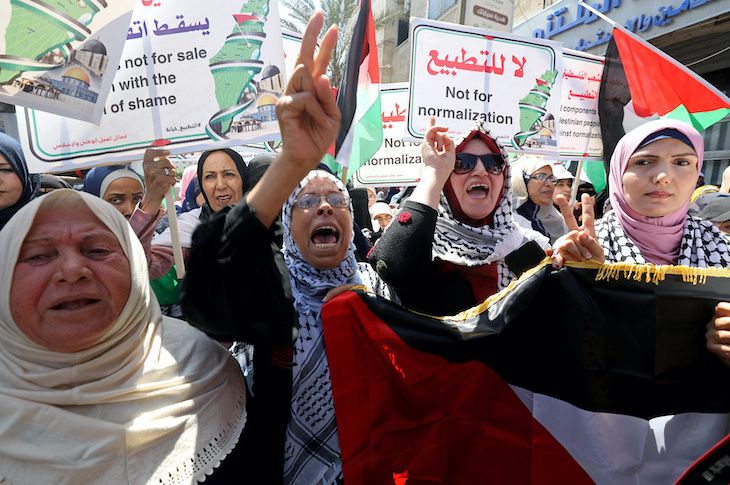
Since the announcement of the Israel-UAE accord, the hearty self-congratulation of the Trump and Netanyahu regimes has been uncritically echoed by most of the American political class and the pundits who reprise their views. The entire Democratic Party establishment has praised the accord, after recently refusing to allow even an anodyne mention of Israel’s occupation of Palestinian lands into the party platform. Meanwhile, the harsh reaction of the Palestinians and the Arab world as a whole has, not surprisingly, been ignored or dismissed.
Why should anyone be against normalization and peace? Why should former adversaries not hash out their differences and reach an understanding? Were the main protagonists in the Arab-Israeli conflict the United Arab Emirates and Israel, these might be reasonable questions. But these two countries, which are 1,200 miles apart and do not share a border, have never been adversaries, and have never been at war. In fact, they have long surreptitiously been close allies, with the Emirates’ missile defenses provided by Israeli companies like Rafael Advanced Defense Systems (under cover of the U.S. company Raytheon).
Most American politicians, Republicans and Democrats, together with media commentators, deliberately overlook these facts, and many others. One is that this agreement between Israel and the UAE, which is intended primarily to threaten their shared adversary Iran, is also meant — at least by Israel and the U.S. — to weaken the Palestinians, the people who are actually in conflict with the Israeli state that enjoys absolute control over them. The deal is an extension of a longstanding U.S. policy to use individual deals between Israel and the Arab countries and the “economic peace” model long touted by Netanyahu in order to further weaken and isolate the Palestinians and dampen pan-Arabism. Far from helping to create peace, this agreement exacerbates the real battle between Arabs and Israelis, the original one, the one over Palestine, by strengthening the oppressor, while enabling Netanyahu to continue to evade real peace while expanding colonization and further entrenching military occupation.
Another overlooked fact is that this is not an agreement between Israel and “the Arabs.” It is an agreement between Israel, a settler colonial apartheid state, and the absolute ruler of a monarchy that enjoys neither popular legitimacy nor the consent of the governed. The rulers of the UAE and their fellow Arab Gulf autocrats in Saudi Arabia, Bahrain and Oman are sovereigns so absolute that they make Henry VIII and Louis XIV look like Tom Paine and Robespierre. Arab public opinion, brutally repressed by these and other undemocratic regimes across the region (many of them propped up by massive infusions of Saudi and Emirati cash), is in fact supportive of the Palestinian liberation struggle, and highly critical of Israel, as is shown by regular public opinion surveys.
Thirdly, both parties to this agreement and its midwife, the Trump administration, are staunch opponents of democracy in the Arab world, since the spread of democratic governance would not only bring down these absolute monarchies from which U.S. arms and oil corporations benefit so much, but also bring Arab governments into line with their peoples’ support for the Palestinians. Out of their desire to preserve their untrammeled power and their ill-gotten gains stolen from their own peoples, the kleptocracies of the Gulf naturally fight democratic trends and support dictatorships all over the Arab world. They did this in confronting the Arab Spring of 2011, and continue to do so, notably in Sudan, where they support the same military forces that were responsible for unspeakable atrocities in Darfur and elsewhere. Indeed Riyad and Abu Dhabi are perfectly reminiscent of St. Petersburg and Vienna when they confronted the great revolutionary upheavals of 1848: twin capitals of absolutism and reaction.
Finally, it is the height of hypocrisy to use the word “peace” to describe this deal between and arranged by warmongers. One party to this “peace” agreement besieges and bombards Gaza ceaselessly, has kept millions of Palestinians under the jackboot of military occupation and a segregationist regime for over 70 years, and has bombed eight Arab capitals over the same period. The other, the UAE, has long been waging pitiless war in Yemen and Libya, whose peoples have suffered enormously from its interventions and those of both its allies and adversaries. Yemen, materially one of the poorest countries in the Arab world but culturally one of the richest, has been brutally bombed with American supplied weaponry and driven to the point of widespread starvation and collapse as a result. Meanwhile the godfather of this accord, the US, in Afghanistan is still waging the longest war in American history, maintains troops in combat roles in Syria and Iraq (the latter having already been largely destroyed by two bloody U.S. invasions and a criminal sanctions regime), and under Trump has ceaselessly pushed Iran in the direction of war.
There is nothing to celebrate in this agreement. Quite the contrary. Celebrations will only be in order when a peace based on justice and complete equality of rights is in sight between Palestinians and Israelis. This will only become possible when the Arab world ceases to be a global outlier and comes into line with much of the rest of the world in terms of democracy and human rights, ending the dark, oil-fueled night of autocracy, police-state repression and deprivation of rights under which it has groaned for far too long. The U.S., for all its talk of democracy and peace, has all along been the handmaiden to this most undemocratic and warlike regional system, of which Israel is a central part.

Rashid Khalidi
Rashid Khalidi is Edward Said Professor of Modern Arab Studies at Columbia University and author of The Hundred Years War on Palestine.
آراء أخرى

What Trump does when he speaks of emptying Gaza
«The notion of displacing Palestinians from Gaza is deeply rooted in Zionist policy»
Beyond Jabalia: Netanyahu’s ‘escaping forward’ strategy
«The killing of Hamas leader Yahya Sinwar, whom Israel considers the mastermind behind the October 7, 2023 operation, has further fueled a growing sense of frustration…»

Palestine: Unity of land, people and struggle
«This unifying statement was drafted by committed Palestinians in Palestine and in exile who, like many others, see the attempts to further fragment Palestinians and ensnare…»
Your support is the only way to ensure independent, progressive journalism survives.
You have a right to access accurate information, be stimulated by innovative and nuanced reporting, and be moved by compelling storytelling. Subscribe now to become part of the growing community of members who help us maintain our editorial independence.
Join us
لا توجد تعليقات بعد