
Beyond Jabalia: Netanyahu’s ‘escaping forward’ strategy

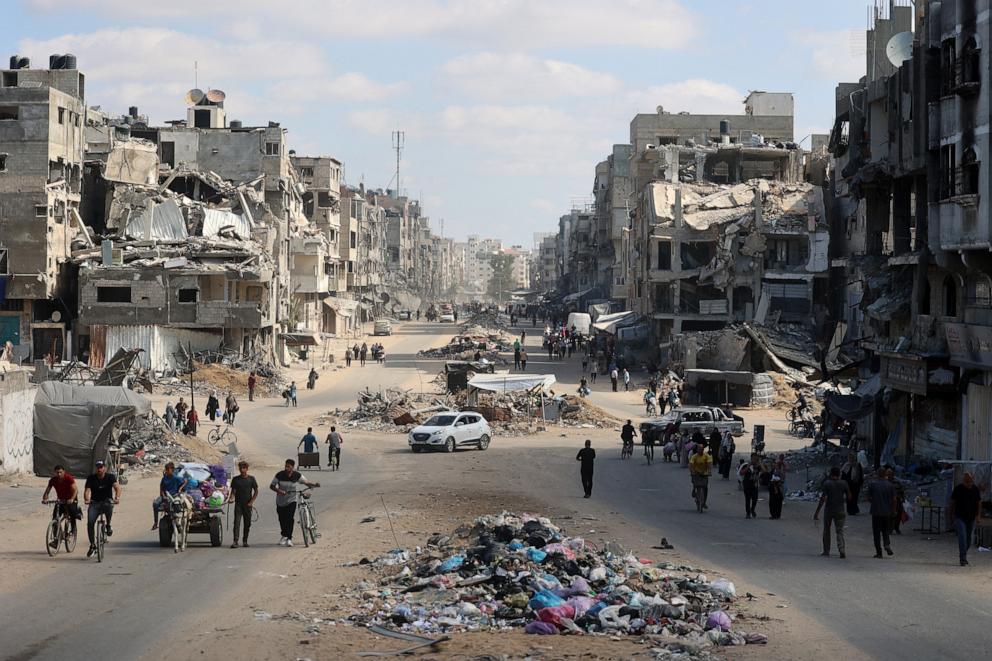
The killing of Hamas leader Yahya Sinwar, whom Israel considers the mastermind behind the October 7, 2023 operation, has further fueled a growing sense of frustration from the political impasse in negotiations to end the war on Gaza and Israel's military campaign in Lebanon. Against this backdrop, more than a year into the war, there is a pressing need for a panoramic view of Israel's evolving strategy in the ongoing war on Gaza and its conflict with Iran and its allies.
In trying to build a coherent context for Israel's successive moves during the war, we find that, at certain stages of the battle, the Israeli military preferred to defer “the day after” questions until after a ceasefire, when Israel can rebuild its security doctrine. And then we have the Israeli government, led by Prime Minister Benjamin Netanyahu, which we assume follows an exploratory, moving forward strategy. This strategy aims for interim practical solutions in hopes of securing a dramatic, decisive victory that would save the future of this government.
Today, this exploratory Israeli strategy seeks to establish Israeli military governance in Gaza to set the political groundwork for a post-Hamas era in the embattled strip. Decisions about such a future are deferred until Hamas is dismantled both politically and militarily — a goal increasingly seen by Israeli leaders as impossible without military rule over Gaza. This strategy, which includes moving through previously unconsidered options as influenced by the objectives of political actors within the state itself and the shifting political context and military capabilities.
October 7: The shock and absence of strategy
Following October 7, Israel found itself grappling with a strategic dilemma that required an urgent tactical solution: to secure a definitive resolution in Gaza without Hamas, while having to respond swiftly without yet establishing clear plans for Gaza’s future. These plans were embodied in the so-called “day after” term coined by the United States in its talks with Israel.
Israel's immediate objective at the time was dismantling Hamas’s military wing, the Qassam Brigades, which the Israeli military sought to accomplish through an operational plan beginning with a three-week preliminary carpet-bombing campaign, specifically on Gaza’s north. Ground operations then followed in late October 2023, unfolding in two campaigns: the first lasted until mid-January, saw Israel declare it had dismantled Hamas’s military organization in northern Gaza, including Gaza City and the North Gaza Governorate (Beit Hanoun and Beit Lahia). The second one, overlapping with the first, began in early December, targeting Khan Younis, and continued for around five months, concluding in late April.
By that point, the stance in Israel was clear: the Israeli military had exhausted its role in pursuing targets identified by various intelligence agencies, as well as combing and surveilling to uncover Hamas’s tunnels and facilities. This set the stage for negotiations aimed at a ceasefire and a prisoners’ exchange deal. Negotiations culminated in the Egyptian proposal presented to Hamas on May 6 under CIA Director William Burns’ supervision. Hamas accepted the proposal, which included adding “cessation of hostilities” between brackets after the phrase “restoring sustained calm” to clarify that the intended sustained calm entails a full ceasefire rather than selective strikes on Gaza.
Hamas’s acceptance and the conclusion of military operations placed Netanyahu in a tight spot. From the outset, he understood that ending the conflict without a decisive Israeli victory could spell the end of his political career, driven by the fragmentation of his alliance with religious Zionism. This coalition, uniting the nationalist religious current — comprising the Religious Zionist Party, led by Bezalel Smotrich, and the far-right Otzma Yehudit Party, led by Itamar Ben-Gvir — with Netanyahu’s secular Likud Party, had been the key to stabilizing four years of Israel’s volatile Knesset. Likud’s previous failure to form a stable government had forced its opponents — Blue and White alliance led by Benny Gantz, Yesh Atid Party led by Yair Lapid, and Naftali Bennett’s New Right — to partner with the Arab Joint List Party led by Mansour Abbas, in order to establish a government without Likud. Netanyahu thus views his alliance with religious Zionism as strategically vital — without it, his political future hangs in the balance.
Netanyahu also fears the fallout from Israel’s security failure on October 7, his divisive judicial reforms, and corruption charges. Furthermore, an Israeli withdrawal from Gaza conflicts with his ideological commitment to settlement expansion as a socio-political necessity for Israel.
This is how Netanyahu doubled down on his strategy of “escaping forward,” persistently pushing limits through military action. This led to a fourth phase of the war, culminating in the Rafah operation, which continued through May and resulted in Israeli control over the Philadelphi corridor between Gaza and Egypt.
By late May, conditions were ripe for another Israeli-Hamas agreement to end the war and negotiate a prisoner exchange. This prompted US President Joe Biden to issue a call, this time explicitly, for an end to the war on Gaza, with marathon negotiations beginning in June under US mediation. These talks aimed to secure Hamas’s agreement to the Israeli proposal for a limited prisoner exchange phase, with continued talks intended to build toward a sustained calm (ceasefire). In early July, following a series of US-led adjustments to reassure the group that Israel would not resume hostilities after the first phase, Hamas agreed.
At this point, the Israeli military seemed ready for a deal. By mid-June, Israeli Defense Forces spokesperson Daniel Hagari publicly stated that eradicating Hamas as an idea was unrealistic, signaling that the military had exhausted its efforts to dismantle Hamas as an armed entity in Gaza and that further steps require political action. Hagari’s remarks subtly conveyed the military’s dissatisfaction with the government’s political stance, saying that “this business of destroying Hamas, making Hamas disappear — it’s simply throwing sand in the eyes of the public,” insisting Israel must find a viable alternative to Hamas, or the group would persist.
Under pressure again, Netanyahu had to “escape forward” once more. With the Gaza military campaign reaching its practical limits, he threw a wrench in the works by introducing four demands for an agreement with Hamas: resuming hostilities after the truce, restricting displaced residents’ return to northern Gaza, retaining control of the Philadelphi corridor, and securing the release of as many Israeli prisoners as possible in the initial phase. These conditions had not been part of Israel’s proposal a month earlier, which had included a full withdrawal from the strip and no restrictions on the return of residents to the north.
July: falling forward to the north
Netanyahu has been aware of his predicament after exhausting his options in Gaza. In search of a new target — a new front that he can ignite to allow for a space to escape forward to, he turned to a reliable ally — the Israeli lobby in Washington. On July 25, he visited the US, securing support to pivot from negotiations in Gaza to escalation — a stance largely driven by the Biden administration’s desire to avoid direct confrontation with Israel and its supporting lobby in Washington that might bolster Donald Trump’s Republican campaign. The Biden administration has shown no inclination to oppose escalation thus far.
The second tool Netanyahu leaned on was the Mossad, Israel's intelligence agency.
Despite Netanyahu’s long tenure as prime minister, his relationship with military leaders had been tenuous. Figures like Benny Gantz and Gadi Eisenkot formed an opposition party, while Defense Minister Yoav Gallant frequently clashed with him over judicial reforms, with rumors of Gallant’s removal circulating throughout the conflict as their clashes became public. Reports during the war highlighted fundamental strategic differences between Netanyahu and his military commanders regarding Gaza’s future and the battle with Hamas. Meanwhile, his relationship with the Shin Bet soured, as the agency perceived his ties to religious Zionist factions as conflicting with its national security views. Tensions mounted between Shin Bet chief Ronen Bar and Netanyahu during the war.
In contrast, Netanyahu managed to strengthen his relationship with Mossad by appointing his close advisor Yossi Cohen as its head in 2016. At the time, it was said that Netanyahu regarded Cohen as the ideal successor for Israel’s prime ministerial role, and Cohen himself stated that the trust between them greatly advanced Mossad’s work.
From this point on, Mossad provided Netanyahu with various services aimed at securing both an escalation and a swift achievement that could grant the legitimacy and momentum necessary for further military action. Central to Mossad’s contribution was its capacity to infiltrate Hezbollah, whether through the agency's exclusive capabilities or in collaboration with other intelligence agencies, notably the CIA.
The missile attack on Majdal Shams on July 27 provided Netanyahu with the pretext to launch an attack on the north. Majdal Shams is originally an Arab village, not a Jewish one, inhabited by Golan Druze who, unlike the Druze of Galilee and Haifa, has historically resisted integration into the Israeli state. Hezbollah, from the outset of the war, had clearly avoided targeting civilians, which raised questions about the Majdal Shams incident. Nevertheless, this incident served as the justification for the assassination operation that shook Beirut on the last night of July, targeting Hezbollah military commander Fouad Shukr in Dahiyeh, Beirut’s southern suburbs. Simultaneously, Mossad assassinated Hamas leader Ismail Haniyeh while he was on an official visit to Tehran.
In August, escalation was anticipated from Iran, which had repeatedly vowed retaliation for the violation of its sovereignty in Israel’s assassination of Haniyeh on its soil. Escalation was also anticipated from Hezbollah, which had not seen such a high-profile assassination since the 2009 killing of its military leader Imad Mughniyeh. Yet, the response was delayed, likely due to European mediations that convinced the Iranians that the assassinations could present an opportunity to reach a settlement that preserved Israel's image — specifically Netanyahu's — as having achieved a reasonable victory compared to the gains that would be made by Iran, Hezbollah, and Hamas. This led to indirect talks in Muscat, where Oman mediated negotiations between Iran and the US to reach a regional settlement that would contain the conflict in Gaza as well as extend to defuse regional tensions and revive US-Iran discussions on the nuclear program. Ultimately, these talks proved to be practically a trap, buying Israel time to prepare a decisive strike against Hezbollah in September.
Since October 7, 2023, it was apparent that Israel would have to deal a blow to Hezbollah. Gallant had proposed this, as moving southward while fearing a strike from the north was unsustainable. However, the events of September went beyond a mere preemptive strike against Hezbollah — it became a dramatic assault aimed at creating a media spectacle and opening up an indefinite conflict in Lebanon. Here, again, the influence of Mossad and Netanyahu was evident.
The assaults began with the pager attack on September 17, followed by a major blow to Hezbollah that, without exaggeration, shook the region. This was the assassination of Hassan Nasrallah, the Secretary-General of Hezbollah and the Lebanese leader with profound influence in Lebanon and many other Arab countries.
This form of assault on Hezbollah doesn’t seem to represent a unified strategy between Israeli institutions and Netanyahu. The Israeli military, for instance, certainly aimed to diminish Hezbollah’s capabilities, as it poses a significant threat to Israel's security from the north, but it did not necessarily intend to open a protracted northern front and engage in a large-scale war. Netanyahu, on the other hand, sought a dramatic victory and the transformation of the conflict with Hezbollah into an open-ended front similar to Gaza. This explains his rejection of the US-proposed ceasefire known as the Hochstein proposal (after US special envoy Amos Hochstein), despite Israeli reports indicating a ceasefire was just hours away.
The Jabalia campaign: What does Israel want?
As Israel’s wide-ranging military campaigns in Gaza concluded in late June, Gallant announced readiness to enter what he called the third phase of the war. The first phase involved airstrikes, and the second was a ground offensive. According to the Israeli statement, this phase was set to involve targeted, limited operations to eliminate key figures in Gaza. However, Israel’s vision for Gaza's future remained absent from the strategic landscape until it began to take shape with the appointment of an Israeli military official to oversee the humanitarian situation in Gaza in early September.
Politically, this decision likely indicated that a military rule over the Gaza Strip, even temporarily, was the strategic choice for Israel. Yet, in the weeks following this decision, Israel did not take concrete actions on the field that could practically lay the groundwork for establishing this military rule until the campaign on Jabalia camp began.
Israel appears to be attempting to impose military rule through a strategy of controlling key axes. By stationing forces in pivotal axes and separating areas within Gaza, Israel can impose security and military control over the strip and establish military strongholds. These key routes include the Nitzarim axis separating Gaza City from Central Gaza Governorate (Deir al-Balah and the camps), the Kissufim axis separating central Gaza from Khan Younis, the Gush Katif axis between Khan Younis and Rafah, and the Philadelphi axis along the border with Egypt.
The North Gaza Governorate, including Beit Hanoun, Beit Lahia, and Jabalia, and the Gaza Governorate, unlike other governorates, share urban connectivity, with Jabalia camp and the Jabalia al-Nazla area forming an unbroken urban link between them.
When the attack on Jabalia camp began, many analyses, including Hamas’s official stance, believed the offensive was aimed at forcing northern Gaza residents to displace, preparing to establish a buffer zone and dismantle active resistance cells. Israel estimated these cells to comprise around 5,000 fighters led by Ezz Eddin Haddad, commander of the Gaza Brigade within Hamas’s Qassam Brigades and one of the top field commanders who have eluded Israeli forces. This analysis gained traction due to two factors: first, reports of a new, vaguely defined plan for controlling northern Gaza, which Israeli media called the "Generals’ Plan;" second, the Israeli military urging northern Gaza residents to evacuate southward to avoid military operations in the area.
Yet several indicators suggest an alternative interpretation of this offensive. Foremost is Israel’s awareness of the challenges of displacing northern Gaza’s estimated 500,000 residents without proper administrative arrangements for such large-scale forced displacement. Additionally, rather than pushing residents southward, the nature of Israel’s assault on Jabalia camp took the form of a strict siege, targeting anyone moving in the streets, which makes residents unable to displace. Moreover, Israel has not eased its airstrikes on southern Gaza, particularly in the camps in the central region, which would presumably serve as initial destinations for northern displaced people, thus reducing the feasibility for voluntary migration.
Rather than forced displacement, the offensive on Jabalia along the boundary between North Gaza Governorate and Gaza City may be an effort to establish an axis where Israeli forces could be stationed, effectively separating these areas. This could pave the way for military rule by transitioning from military tactics like shelling, clashes, and combing operations to combat armed resistance to a security approach focused on surveillance and pursuit. This pursuit approach treats Hamas as a network of insurgent cells, allowing for more comprehensive and accurate intelligence gathering, more precise targeting, and a greater scope for stifling the agile maneuvering capabilities that Hamas has displayed since the onset of war.
آراء أخرى

How the horrible month of March for Meloni might change the path of Italy
«Italian Prime Minister Giorgia Meloni will not forget March 2026.»

Trump’s Palestine is worse than mandate Palestine
«In September 2025, United States President Donald Trump unveiled a 20-point “peace plan” for Gaza, calling for a ceasefire, the release of Israeli captives and the…»
Anas, my neighbor
«The loss here is not personal, but a profound collective fracture»
Your support is the only way to ensure independent, progressive journalism survives.
You have a right to access accurate information, be stimulated by innovative and nuanced reporting, and be moved by compelling storytelling. Subscribe now to become part of the growing community of members who help us maintain our editorial independence.
Join us
لا توجد تعليقات بعد