
Oxygen and death

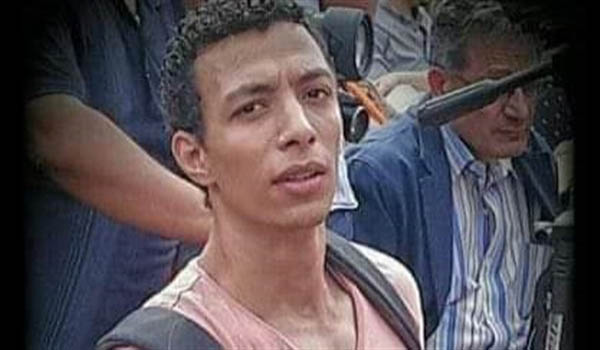
The initial hearing in the trial against Mohamed “Oxygen” Ibrahim, Alaa Abd El Fattah and Mohammed al-Baqer marked the first time in months the three men had stepped foot outside the tomb that is Aqrab Prison, where their detention conditions had been in steady decline. Just before the hearing, Alaa had declared he was contemplating ending his life, and two months earlier Oxygen had attempted suicide. As soon as they entered the defendants’ cage, Baqer and Alaa went toward their friends while Oxygen walked slowly into the cage, hugging his body with his arms as if trying to distance himself from the people and reality he’d been forcefully deprived of. He watched us all in silence with a wary, half-smile.
His family did not attend that hearing. No one knew what would happen during the proceedings, which were overseen by a phalanx of jittery security guards, But after the day passed without incident, they realized that our attempt to maintain human contact with the prisoners was not a threat to national security. After the hearing, we spoke with the defense attorneys about Oxygen’s family and they said they would notify them of the next hearing so they could try to attend.
At the second session, Oxygen’s mother, younger sister and older brother arrived, escorted by the attorneys after they had negotiated to allow the family to enter the courtroom. This was the first time Oxygen had seen his family in 21 months after being denied any visitations. I was there with others and we witnessed a scene that these anguished and angry words cannot fully capture, though I will try. It was an extremely fraught situation. Oxygen’s mother, sister and brother looked at him, and he at them. It was a singular opportunity, an opportunity that was nothing more than the span of a courtroom. His family stood some distance from the cage, waiting to snatch a moment away from the eyes of the officers, intelligence personnel, policemen and soldiers.
He looked to us like a different person than the one we’d seen at the first hearing. The color had returned to his face and he gripped the bars like his fellow prisoners, his eyes searching in the direction of his mother and family, and he smiled. They were within arms’ reach of an embrace that could not happen. Eyes welled up with tears. Whispers and sighs mixed with guarded smiles, wary of showing their unbounded joy, for how could anyone truly rejoice when enveloped by a cloud of soldiers and weapons and choked by a fog of injustice?
The officers barked at his family to move away from the cage and get back to the wooden benches, putting an end to the brief moment of chaotic joy. His family stepped back but they kept talking to him from afar. That fleeting moment of happiness had redrawn the features of Oxygen’s face, his countenance no longer walled-off and suspicious. His family came to every hearing after that, even for the pronouncement of the verdict, which neither the defendants nor the judge attended. It was the last time we met with his mother and family. His mother wept silently without end, unable to comprehend another four years of the unbearable hell that had already led her son to try to take his own life months earlier.

Oxygen refused to attend his mother’s funeral. He refused the show of magnanimity by the regime after five years of manifold abuse. He refused to place a rose on a heap of shit. He refused to let that be their last meeting — to see his mother’s shrouded corpse, now finally without tears and confusion, no longer worried about his fate or pleading with officers and soldiers to be allowed a word with her son. Oxygen utterly rejected this empty gesture, throwing it in our faces and in the face of anyone who would try to make such thuggery appear less ugly. The leave granted to him for the funeral only put the full horror of the crime under the microscope: victims saying goodbye, from the prison to the grave. He could not bear it and had no desire to recognize that moment. He wanted to pass over it as if it hadn’t happened at all. How can a person stripped of everything have hope?
This regime denied Oxygen’s mother the chance to visit her son for two full years, only to grant her wish after her death. Finally, they would allow her to see her son, as they stood there at the funeral with guns at the ready. And they consider this a noble, patriotic act.
In another winter like this one — a cruel winter without sun — we went to the Bab al-Nasr cemetery. We were there to attend a burial under heavy guard. Security officers and their subordinates insisted that the detainee attend his father’s funeral. They surrounded the area from all three entrances, and officers bearing stars and swords on their shoulders came personally to secure the premises. We waited for the detainee with the family of the deceased — even the deceased himself was made to wait. He finally arrived under the escort of an inexplicably heavy guard given his alleged crime. He was not charged in connection with any violence, only for his satire and biting criticism, and because he made the public laugh. He was a comedian, and he was detained for years only to have his father die during that dark period of his life.
The security detail transporting the young man from Tora Prison Complex — no more than 20 kilometers from the Bab al-Nasr cemetery — was hours late without explanation. The sky darkened and night overtook us. The detainee’s father’s body was left at the entrance to the burial ground, his mother and brother sitting beside him, relatives standing at the grave’s open mouth, and the undertaker and gravediggers sitting next to their hatches and equipment. The detainees’ friends and others who had come in solidarity were scattered around the cemetery, like ants looking for rescue from a pit. We stayed like that for hours, a mass cordon around the deceased and the family — they were not granted even a moment of humanity to properly say goodbye. The wind gusted through the cemetery and we felt the dust in our throats. We waited so long we started talking with the residents of the cemetery, who were baffled by the unprecedented security presence. One woman who lives in the City of the Dead commented cynically, “If this is showing respect for the dead, I’d hate to see disrespect.”
The young detainee finally arrived surrounded by a security escort and flanked by two hulking men who never left his side. The undertaker fetched some spotlights whose glow lent the site a ghostly air. We could see only the shadows of the detainee and his dead father and hear cries of “God is great” and the recitation of verses about mercy and forgiveness. After the burial, the young man stood under the glow of cell phones, pressed against a wall of police bodies, to receive condolences — bodies, in that moment, that were closer to him than his family and friends.
This was the terrible scene that awaited Oxygen and his family. The family and residents of Queisna, in Menoufiya, would be thrown into disarray, and the mourners would be held under siege so Oxygen could come and say a final goodbye to his mother in the darkness and cold. Astonishingly, security forces attended the funeral even though Oxygen did not, as if they were watching his shadow that accompanied his mother to her grave.
Do the founders of this institution that murders our mothers realize what their actions bring every day? The mother of lawyer Mohammed Ramadan died while he was imprisoned (he remains behind bars still). He wasn’t allowed out to say goodbye, so the residents of Alexandria's Sidi Bishr came out instead to say farewell to the mother of the renowned lawyer who had stood by every wronged person in the neighborhood.
Amira Tawfiq, the mother of detained comrade Hassan Mustafa, died two years ago while attempting to visit her son. Prison visitations had been suspended on the pretext of the pandemic, so she traveled from Alexandria only to die on the way back home having failed to see him. She died having lost hope of ever seeing him again, of living a life she never imagined. Hassan’s hoarse voice and zeal for life had long filled their home in Moharram Bek, and his friends often came over to talk and dream about freedom and justice. She died from an overdose of “justice.”
I hadn’t met Oxygen before he slipped into this nightmare. I knew his blog and his work in the independent press and citizen journalism that emerged before the revolution. He was full of vigor, like the rest of his generation that poured out from houses and alleyways and into the streets, carrying millions to the palaces and seats of corrupt power in this country. He was one of what they called “the pure youth of January 25.” His experience was shaped in the deluge of voices bellowing out earth-shaking demands. He wandered around with his camera recording stories and news and opinions. He dove into it with euphoria only to come up into a nightmare after his first arrest in 2017. He was detained for several months and then released into the precarious life of probation. Then he was arbitrarily arrested again. What government body will investigate the disappearance of a young man from a police station and his reappearance days later at the prosecutor’s office? No one grasps the true breadth of the pipelines that connect places of detention with prosecutors’ offices in our country.
I met him in one of the hearings during this latest trial. He had sat in prison for two years without trial and then was added the same case as Alaa and Baqer. We spoke for a while. He was passionate about knowing the missing part of every story and strove to piece together all the threads of various events. He had very little information about what was going on in the outside world. He asked me about various things: the Renaissance Dam, what Ethiopia was really doing and what Egypt was preparing for; price hikes and if prices were still rising and how people lived in such circumstances. He asked me about newly released books and who we were reading these days. I told him I was about to publish a novel and I felt embarrassed when he expressed admiration for the title. We spoke about the very few novels available for him to read — denied books from the outside, he’s forced to read whatever is in the prison library, if he's permitted access at all.
He was hungry for information about developments on the outside, how people were accepting them, and what I thought of it all. He told me about Baqer’s recent entry to his life and how he helped him pass the time. He said he would sometimes be gripped by enthusiasm and resolve to use his time to teach English; other days he only spoke when necessary, withdrawing into some distant spot. He talked to me about Nelson Mandela’s prison experience, but such inspirational stories are extinguished with the lack of sunlight and exercise, the dearth of information, and sight of the same faces every day. Oxygen knows the lesson every prisoner must learn, he knows that the prisoner must preserve his nerves, heart, and head with as little damage as possible. But that lesson has been slowly fading for reasons he cannot understand. He’s on edge and unsettled and is unable to find meaning. The experience is too much for him to bear or is more severe than he expected. Every time he rearranges his life to accommodate a bad situation, the worse things get.
He asked me whether anyone on the outside talks about him. I told him we remember him and that our memory never betrays the names and fates of those inside. Everyone knows why you’re here, I told him, because you’re a courageous, independent journalist.
No reasons are given for the detainee being held in a particular prison, for there are many prisons, as we all know. Habib al-Adly and Gamal Mubarak were not in the same kind of prison as Alaa Abd El Fattah or Mohammed al-Baqer or Mohammed Oxygen are. They do not dream of ping-pong tables or modern electrical appliances, or food from seven-star hotels brought daily to the prison gates. They simply want to step outside into the sun.
Was it a political or security decision? A decision by a prison officer? It doesn’t matter to the authorities that this punishment is not prescribed by any part of the Penal Code. On what grounds and by whose decision can a young man in his 20s be denied a visit from his family? How can hundreds of people detained in Egypt pass their days without seeing their family even once in all these years? How can they be ignorant of the simplest developments in the lives of their families and loved ones? The regime breaks the bridge between prisoners and their lives until the prisoner is tossed aside like a forgotten idea. They punish them with isolation and alienation so no thought can take shape in their minds and no meaning can grow in their hearts. They set them loose to wander aimlessly in the deserts of the self and return to bottomless darkness.
Forgiveness is incomprehensible in cases like this. We will not ask forgiveness for Oxygen, who deserves his life. He deserved his mother’s life and she deserved his without all the injustice, grief, and suffering.
Oxygen: if there were more of the likes of you in this country, this regime would ask forgiveness from you and the thousands more of the innocent and wronged who search for the sun every morning.

آراء أخرى

Letter to Alaa, to our Egyptian Comrades
«We have a steep fight ahead of us, Alaa, for your life, for our lives»

Dressed with intention: On Ahmed Douma
«Keeping one in the room even when they aren’t is never only about the person you're trying to hold»
Thinking with Alaa: Nothing but love
«We have much more from Alaa than his absent condition and possible disappearance to grapple with»
Your support is the only way to ensure independent, progressive journalism survives.
You have a right to access accurate information, be stimulated by innovative and nuanced reporting, and be moved by compelling storytelling. Subscribe now to become part of the growing community of members who help us maintain our editorial independence.
Join us
لا توجد تعليقات بعد