
Knowing Etel Adnan (1925–2021)

At the outset of every obituary is a retelling of the first encounter between the deceased and the person tasked with eulogizing them. Etel Adnan breathed her last on a somber Sunday in November at the age of 96. I did not know her, and she did not know me. I once stood outside her Paris apartment on Rue Madame for a brief hour, unsociable and a bit reticent; a visiting friend about to complete an art history thesis had dragged me along to an informal meeting with her and Simone Fattal, but I ultimately failed to mark presence. It’s important to precede what is to follow with that initial failed contact. For one, it appeases expectations that, by scouring through this text, one might come to know plentiful anecdotes that allow a view to Etel’s internal world. It also concedes to those that have nurtured a correspondence and an alliance with Etel at the center and in the margins of the serendipitous existence she led: how I wish it could have been each and every one of us.
“Mayakovsky, wherefrom the wind that will carry my thoughts to you? / They’re gone: Imam Ali, the Che, Ghassan Kanafani and you … . the hard ones remain.”
But, then again, Etel has ensured we come to that knowledge of self and psyche on our own, and without having to sit alongside her as she narrates wanderings and we jot down illegible markings. To “know” Etel is a democratic act; everyone can have at it, provided they make time for the rather demanding task of stitching together the scraps and fragments exquisitely tucked into her multitudinous oeuvre. Unfettered by the indelible, quick-witted protagonist in Sitt Marie Rose regarding herself as a “closed system” that goes along “with my head always to the ground,” Etel instead sought radical sincerity, and insured traces and motifs of her lived experience aren’t only preserved within the thick pages of her accordion-shaped leporellos, but also able to unfold ad infinitum and dispense immortality. Perhaps that is why those of us who accepted her bountiful invitation to be taught by and make inroads into life with her are today finding ourselves grappling with an “impossible loss,” as Maya Mikdashi informally termed it; Etel had tricked us not only into believing that we could line up in front of her shambolic Parisian desk at any time to find a warm light radiating from it, but that the clue to thumbing one’s nose at death is to perform wisdom against finitude.

Come to think of it, I know Etel, and a lot of you knew her, too. My first contact with Etel manifested during my first encounter with communism. If I find myself summoning the communist imaginary, it is not through its melancholic excesses and authoritarian cooptations, but as a salvational antonym to the modes of relation and exchange we’ve given credence to since time immemorial, and as a yet-to-emerge horizon of potential fulfillments. One can speculate that Etel was, in more ways than one, a resolutely defiant and unorthodox communist. Hers was of the kind that instructed us to partake in repeated, varied attempts at worldmaking instead of locating prevailing infrastructures of power to capture and hold. In The Cost for Love We Are Not Willing to Pay, commissioned for Documenta 13’s 100 Notes, 100 Thoughts, she writes: “Political activism is a way of love, and it’s explosive, and it can lead to great upheavals. But what if we do not take those risks, what if we’re determined to maintain the present state of affairs, playing it (only apparently) safe? The answer is simple: by not paying the price for what it takes to change the world, the world will change in its own way, will change anyway, will escape the possibility we possess to direct it along roads we deem beneficial.”
Though it can appear banal, and even impersonal, to remember someone for the love they had for and distributed among people and things, those that knew her most only know how to speak of her through her sensuous conjugations of the verb.
The landscapes Etel painted often staged natural reflections, and through what was being reflected one would always point toward a distant, auspicious horizon rather than what would immediately appear in one’s field of vision. For some, this could signal a paucity of political resoluteness — and Etel was perhaps never one to ascribe ideological or programmatic clarity to her convictions. But the field of vision from which she set off would frequently fail to provide the adequate tools for her to take hold of; her heroes had either all been slain by forces of evil, or, per the Gramscian adage, were struggling to be born. Every so often, she had to invent them herself, as she did Sitt Marie Rose, who would fatally delink herself from the exterminatory impulse of her sectarian clan in 1970s Lebanon, then on the brink of a sanguinary civil war, to join the Palestinian call to arms; or the many outlandish characters — among them self-governing sex workers, disobedient nuns and soldiers, and militant women of letters — that populate Master of the Eclipse, her opus on everyday formations of violence. But she too would succumb to that structure of feeling we credulously call communal longing. Her messianic quest for lucidity had her once addressing Soviet playwright Vladimir Mayakovsky as she grappled to find a guiding light in the night: “Mayakovsky, wherefrom the wind that will carry my thoughts to you? / They’re gone: Imam Ali, the Che, Ghassan Kanafani and you … . the hard ones remain.”

My capitulation to utopian craving was also marked by confusion and lament, as were those of peers across our apocalyptic region, from the corners of the bloodstained cybercafé in Alexandria where Khaled Saeed was executed by police officers, to the Jerusalem neighborhood of Sheikh Jarrah resisting, at the time of writing, Israeli settler-colonial barbarity. The “hard ones” we inherited, and whom Etel had warned against, would indeed come to seize the means of speech production. But it would be unsound to reduce that lot to the high-ranking military officers and bureaucrats ruling over barren lands. They are often people we find ourselves breaking bread with or conceding legitimacy to; writers, poets, and thinkers who hijack the domain of militancy with their commands and pontifications, and who step over the corpses of muted martyrs with indifference, if not disdain, to kiss the rings of warlords and serve as their court poets. Time also teaches that, beyond their unwavering commitment to treachery, these “hard ones” have also never known when to keep quiet. Etel, on the other hand, understood the potential for language and speech to refigure and do away with dominant orders, having originally taken up poetry in California to protest against the Vietnam War, but also their propensity for harm in times of political transformation, having later abandoned writing in French to extend solidarity with the Algerian struggle for decolonization. “The conquered will always have the last word,” she said. To sit with, and also vitalize, the specters of emancipation is to know when to seize political agency, and when to recede into the folds of “strategic time,” that is, to know when to loudly speak with conviction, and when to patiently sit with one’s own silence and listen; that, we continue to learn through Etel.

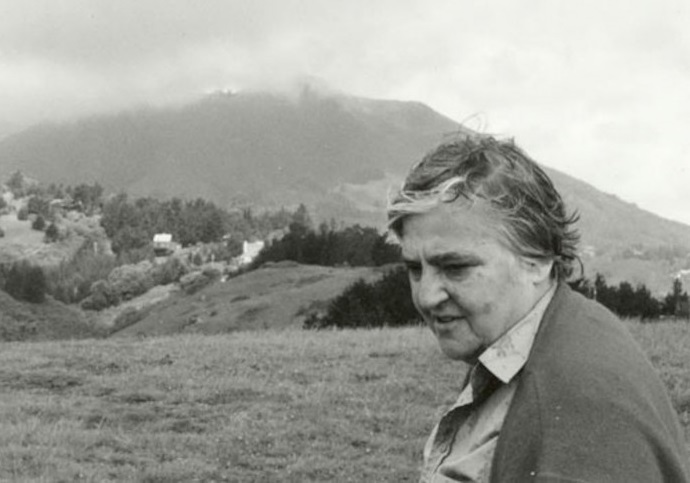
Love foregrounded Etel’s practice of the everyday. Though it can appear banal, and even impersonal, to remember someone for the love they had for and distributed among people and things, those that knew her most only know how to speak of her through her sensuous conjugations of the verb. Negar Azimi, when asked to write a profile in Frieze, could only envision tending to that task through a sprawling enumeration of all that Etel loved — Om Kalthoum, Marguerite Yourcenar, Luchino Visconti’s Death in Venice, a pizza restaurant in Paris, the mountain springs of Mount Sassine in Lebanon. Omar Berrada, another one of her longtime interlocutors, also structures his profile of Etel around her enduring attachment to, and fascination with, Mount Tamalpais in California — which she captured through paint, poetry, and prose for decades — but also tenaciously reminds us of a quote from her book dedicated to the peak, in which she describes tuning in for a radio broadcast of a tape recording by Black Panthers member George Jackson that had been smuggled out of prison: “Then his voice slides between his lips, and his longest word, his most important one, the one pronounced with a long, burning, agonizing, pleading and ever-sure voice, is the word love.” Etel’s dedication to, and belief in, honoring love as a concept can be understood as a lifelong endeavor of “cultivating orientations that admit into the same space comfort, aggression, delight, and surprise,” as signified by the late Lauren Berlant, and of acknowledging the intricate web of relationalities that draw the contours of individual lifeworlds and narrate one’s artistic or writing practice as a story of being-with.
On that fateful day standing outside Etel and Simone’s apartment and peeking in, I also unknowingly established contact with her. By then I’d experienced countless boy crushes and sexual encounters, but had yet to realize how one could radiate the kind of affect that could establish a form of queer kinship with those whom they desire and yearn for. I spotted and acquired skill in that radiance through the soft-spoken hand gestures and unposed gazes Etel and Simone would gift one another as they reminisced, in harmony and in counterpoint, about the cities they set sail in, people they shared ragouts with, and sculptures they spectated at. Though their love would remain unbound by matrimonial regimes and property agreements, it was all the more engrossed in the safeguarding of legacies and the building of sanctuaries with and for each other. I grounded my own aspirations to boylove on that lesbian romance, and know many who have as well; I engage it as a blueprint to navigate not how to act out an exemplary partnership, but to think of myself and of present and future “partners” — be they friends or lovers — as custodians of the traces we each leave in our wake as we turbulently move through different stages of life. Etel and Simone also held space for difference and agency throughout their shared time in the world; they did not produce jointly nor did their collaborations exhibit the kind of authorial transparency that would allow an archive to frame it as such. When asked by Anna Tome of the Brooklyn Rail whether they would ever come together for a work, Etel could only assert equivocacy: “You know, you can’t really know your influences, but you cannot live with a person 40 years and have no give and take.”

Besides, what we are left to ponder on now is the extent to which, should we want to encounter Etel again and again, this could, above all, be made possible through Simone’s fortuitous canonization of her artmaking. With much fanfare, Etel’s paintings have been shown over and again within the past decade in some of the cultural sphere’s most prestigious venues and formations, from the Guggenheim in New York to Documenta in Kassel. And however one looks to and addresses this “belated” exposure shouldn’t, in and of itself, impede on the sheer joy conjured when witnessing the global circulation of her art — though, more often than not, that engagement has surfaced at the behest of the art market’s recent appraisal of artworks packaged within reductive sales categories like “non-Western abstraction” and “older women artists.” The rumble will grow louder, at least for a while, and with it will proliferate unimaginative write-ups that recognize the constructions and perspectival cues of Etel’s paintings, leaving unnoticed the urge they contain, the desire to glide past tightly-bordered enclosures. But where we’ll meet Etel’s painterly mark again and, by extension, the specters of emancipation her brushes and pencils helped cast on the world, is through Simone’s distinctive, close to hagiographic essay, “On Perception: Etel Adnan’s Visual Art,” delineating Etel’s dynamic relationship to painting with careful, and equal, attention to the infinitesimal and major events that shaped it, from Project Apollo and the Lebanese civil wars to her moving to California and lamenting the Arab apocalypse some more. She writes: “Adnan's paintings play the role the old icons used to play for people who believed. They exude energy and give energy. They grow on you like talismans. They help in living everyday life... They reflect the praise of the universe, the experience of it, immersion in it, participation in its formation. No lamentation, no elegy. Love.”
I now know not to decisively count contacts I’ve made with Etel during her living years because I know more encounters will surface as our time in the world will continue to sway to the rhythm of historical transformations.
آراء أخرى

To try and take a picture of Hassan Eslaih
«The other side of Hassan I saw, alongside the complete surrender of himself to the moment, was that»

This is a rebel song
«Just when history, we were told, had allegedly ended in the 1990s, Sinéad O'Connor, icon and iconoclast, insisted on making it. By singing or swearing, shouting…»

Farewell, hero: On this land, we carry on
«Her work remained focused on the street, among the people and about them, among us and about us.»
Your support is the only way to ensure independent, progressive journalism survives.
You have a right to access accurate information, be stimulated by innovative and nuanced reporting, and be moved by compelling storytelling. Subscribe now to become part of the growing community of members who help us maintain our editorial independence.
Join us
لا توجد تعليقات بعد