
Kafka on the shore

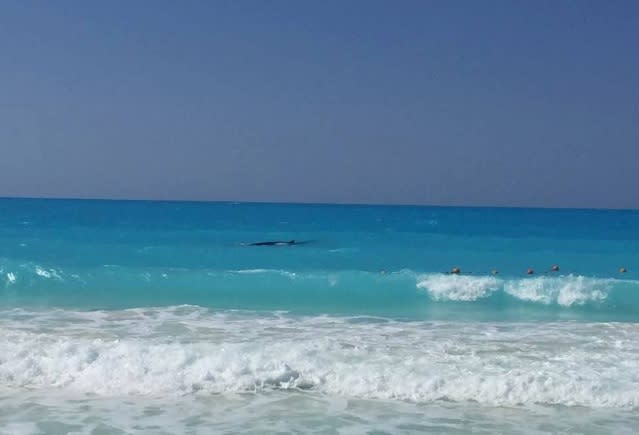
I always remind myself that my persecution falls on the milder end of the spectrum of persecution that the average politically-engaged person is exposed to in Egypt. I’ve never spent more than what my colleague jokingly refers to as “five minutes” in prison, measured in Egyptian prison time. And though living in the shadow of terrorism charges inevitably exposes you to misfortunes like the one that dropped on me at the end of August, at least I have the networks and connections that can intervene on my behalf and secure my release. But after recognising my political and social privileges and thanking God for his many blessings — I can claim with some confidence that I may be the one person in Egypt, perhaps in history, holding the record for the number of times of being arrested on the beach, or by the seaside to be precise: — (for the first time was literally on the beach, the second time a bit further on the coastal highway).
Two days before my latest arrest, I was chatting with friends about something I can’t remember now, when the conversation wandered to Kafka. There is a maxim that maintains that any discussion of Kafka always ends with at least one participant insisting that our contemporary reality/their own life is more Kafkaesque than Kafka’s fiction. This time I was the one committing the sin of abusing the term “Kafkaesque.” But I defended my case by citing a few examples from the Kafkaesque world of anti-terror cases.
For five years now I’ve been trying to challenge a decision by one of Cairo Criminal Court’s terrorism circuits to freeze my bank accounts and assets. Egypt’s criminal procedure law actually allows me to appeal such measures every three months. But every time my lawyers submit a petition it gets stonewalled because the court requests a memo from the Supreme State Security Prosecution, possibly to confirm that the preventive measures are still in place (even though it was a terrorism circuit within the same court that had granted the prosecution’s request for the asset freeze in the first place). We submitted the first petition just a few months after the court’s original decision to freeze my assets, issued on December 6, 2020 — a ruling whose particulars I never learned, since neither I nor my lawyer were ever allowed to see it. Since that date, the court has been waiting for a communique from the prosecution that never arrives. And thus, until today, neither I nor my two colleagues — subject to the same measures in the same case — have been granted a single hearing to contest preventive measures that have now stood for five years. Terrorism suspects are perpetual suspects anyway, time is not really a relevant factor.
In the summer of 2021, while vacationing on the Mediterranean coast, I happened to re-read The Trial, the novel mainly responsible for the association between Kafka’s name and modern bureaucratic nightmares. I felt an immediate proximity to Josef K., Kafka’s original protagonist, and felt strongly that there are strong parallels between our lives (pretty sure that there’s at least half a billion other people who feel the same way). Josef K. feels crushed under the weight of judicial bureaucracy, accused of something he never knows nor is ever allowed to know. He tries to fight this absurdity by employing the very tools of modern law — hiring legal defence, trying to gain direct access to judicial authorities overseeing his trial — but fails to find answers and ends up permanently stuck in a suffocating vicious circle of uncertainty and inexplicable guilt. I hadn’t actually thought of Josef K., nor of that time I rediscovered the novel by the sea, until that time two weeks ago, when I was trying to convince friends that invoking Kafka in this context was, in fact, justified from a literary standpoint.
Forty-eight hours later, I was arrested for the second time on the beach. First time as tragedy, second as farce.
The first time, at least I knew why I was being pursued and expected my arrest, which led to charges of joining a terrorist organization in an anti-terror case — the kind of case with a half-life comparable to that of plutonium-244. Back then, I was on a short vacation in Dahab. The manhunt that accidentally spanned half the country had begun a day and a half earlier, after a work colleague was already detained. I was finally arrested on the beach one fine morning in November 2020.
I was about to have breakfast when a police NCO turned up and asked for my ID. I immediately felt a deep regret that he hadn’t turned up ten minutes later — I hadn’t even managed a single bite of the egg paratha I wouldn’t taste again for years. I was taken to meet a senior officer who said he had come directly from the city of Tor to arrest me. There was a bizarre insistence that I was “on the run,” simply because I hadn’t been home when they raided my home a day and a half earlier. I pointed at my swimsuit, at the open place where I was being arrested, and asked if it looked to him like I was in hiding. I made a point of mentioning that no judicial authority had ever summoned me in the first place so that I would effect an escape. It was simply that they raided my place and found that I was on holiday in South Sinai.
This time, however, I hadn’t the faintest idea of what developments or suspicions might have triggered another round of pursuit. A series of misfortunate events and errors unfolded in a rather surreal manner — although it was not entirely coincidental. Living under the shadow of terrorism laws means that any unlucky encounter or coincidence could easily escalate into a crisis that destroys your life. You might find yourself stopped at one of Cairo’s ubiquitous midnight checkpoints or those strewn all over the highways. Sometimes the officer in charge may decide to run a check on your ID. On the rare occasion this has happened to me, I managed to mobilize all the political and negotiating skills I possess, as well as every ounce of social and class privilege, to avoid the possible escalation that might follow an electronic ID check. After years of dodging street traps with remarkable agility, you may start to feel as though life has become almost normal, that you’ve mastered the art of police-checkpoint diplomacy so well you forget you’re still a perpetual suspect in a terrorism case that will only expire after the passage of a few geological eras.
But one day, your luck inevitably runs out.
It was strange that this time, it happened on the North Coast highway — an unusual site for police monitoring, unlike the highways of South Sinai, where we’d grown accustomed to consecutive police checks. This one didn’t look like the usual checkpoints. It was just before midnight on a Tuesday and I was on my way to Alamein Hospital. The plainclothes officers asked for IDs and driver’s licenses, then requested to search my phone. As a matter of practice I tend to refuse such requests, which have become routine at some point in the last decade, unless accompanied by a judicial warrant, reminding the officers, with as much courtesy as possible, that I’m merely abiding by the very law they are tasked with enforcing.
So I declined, politely, to unlock my phone. The officer actually responded with the same courtesy, saying only that he would run a check on my ID. I asked — with so much politeness now going around — that he not detain us for too long, explaining that we were heading to the hospital in Alamein at this late hour to deliver belongings and some medical necessities to a patient. At that point, his colleague wrapped things up, handed back our papers, apologized for the inconvenience and sent us on our way with well wishes for the hospitalised patient. All quiet on the northwestern front.
Typically I wouldn’t have reason to worry. I am not a fugitive and had no outstanding sentences or judicial warrants. So a regular police ID check shouldn’t necessarily pose a problem since they usually query sentencing databases. But it seems this time I ran into one of the more “sophisticated” checkpoints, the kind that reveal more than just outstanding warrants. Apparently, after I had already left and driven for 30 minutes to get to the hospital in Alamein, someone realized the mistake that had been made. The timing of my arrival in Alamein seems to have coincided with the Emirati president’s arrival to the same city for a presidential visit, unbeknownst to me at the time.
When I left the hospital more than an hour later, I found three cars intercepting us on the road in a rather cinematic fashion, screeching tires and everything. A large force of plainclothes police officers leapt from their cars and charged toward us. It all happened so fast, it’s hard to remember who did what. They violently pulled me out of my brother’s car, blindfolded me within moments and dragged me off, throwing some punches to the abdomen and face before shoving me into the back of a pickup truck.
I realized that resisting or asking questions would only invite more violence, and that whatever was happening was bigger than I had thought. So I waited, tried to breathe deeply and detach myself from the moment until I could speak to someone in charge. Just before the blindfold went on, I managed a quick glance to see that my brother had been left behind in his car (and stopped from following us). I was grateful that at least he would be able to alert my colleagues, for it seems that I was possibly going to disappear for a little while.
We drove for no more than two minutes and, blindfolded, I was dragged in a rough manner (and with angry, vengeful cussing — as if I had somehow tricked the police). I was almost certainly taken to the Alamein police station that was around the corner. There, they searched me, confiscated my belongings and forced me to unlock my phone. This time, I didn’t resist. I preferred not to invite another round of gratuitous violence, which had stopped after the first few minutes.
I tried to think through what might have triggered such an unexpected escalation. Why hadn’t I been summoned to the Supreme State Security Prosecution, if there was really a reason I was wanted? And if this was a coincidence, the result of the earlier encounter at the strangely located checkpoint, why did they leave my brother behind, without even bothering to take him briefly to the precinct?
As they searched me, I insisted on informing them about my job and my case history. I drew another deep breath, trying once again to dissociate. I pictured in my mind one of the CID detectives scrolling through my photo gallery: the same daily shot of my cat sprawled on my laundry or inside the bookcase, then going through literally hundreds of nearly identical photos of the cats I meet daily on the street.
This didn’t last long. With my hands cuffed behind my back, I was very quickly led into a private car. The blindfold wasn’t tied too tightly, so I could still see where I was stepping. The same transfer protocol, an officer at the wheel, two broad police NCOs flanking me, but without the same unwarranted roughness.
I tried making small talk with the officer, who of course refused to reveal which agency he worked for, where we were headed, or why I had been arrested. “We’ve got a very long road ahead,” he said. We must be going to Cairo? He denied it and tried to silence me. Alexandria? No. Salloum? No. Again, he tries to silence me.
I treaded carefully while trying to draw the officer into conversation, careful not to provoke the NCOs who kept complaining to him about my chatter. He didn’t seem to mind too much, though he continued to steer the talk to an end. I would fall silent for a while, then ask again. At one point I tried to negotiate having my hands cuffed “frontally” instead of behind my back, a negotiation which lasted for almost half of the trip.
One of the police NCOs — who said his name is Hassan — insisted I didn’t deserve front-cuffing. He hinted that they had been ordered to deliver me to a specific location, that they had been on this mission since much earlier, and that they blame me for the long, grueling workday ahead of them. I was used to this kind of gaslighting from police NCOs and subofficers in particular, to the point where I almost began to sympathize with their logic.
I suddenly recalled an article I’d read a week earlier about Iranian prisoners in Evin prison when Israel bombed it, killing at least 79 inmates and guards. One former political prisoner who was detained in Evin had gone there to check on his wife, also a political prisoner who was still detained inside. The first person he ran into was the head guard of the ward where he had spent two years in detention. The guard, covered in ash from the destruction of one of the buildings, broke down, hugged the former prisoner and quietly wept on his shoulder. The former prisoner registered no resentment or bitterness. Later, wandering the grounds, he asked another senior officer about his wife. The officer lashed out, blaming his wife for the loss of his colleagues in the bombing, whom he said had died because they were trying to protect “outlaws like her.”
I wandered back from these philosophical digressions and tried again with the officer. He told me he didn’t trust me enough to move the cuffs to the front. I assured him that while blindfolded and with my hands bound to the front I would still be completely incapable of pulling off any surprises since I’m not a magician. I simply prefer not to dislocate my shoulders.
The officer finally relented and instructed the NCOs to adjust my restraints in exchange for my complete silence. The two NCOs flanking me seemed to think that their responsibility for securing me had increased with this change, and so they instinctively leaned on my shoulders to press me tighter between them. Still, I was a lot more comfortable. I promised the officer I would remain quiet. I could even try to get some sleep.
We must have been on the road for about three hours, maybe a little less — which meant we were either in Cairo or Marsa Matrouh. The only reason I suspected we might be heading for Matrouh was that, in my previous state security arrest, I had been taken to the National Security Agency’s headquarters in Sharm el-Sheikh instead of Cairo. One of the officers had hinted at that possibility this time as well.
When we finally arrived, I was led into what felt like a police precinct — we climbed just a single step up, not a tall building. I was handed over to a new police unit, and after a short walk, I found myself seated on a chair. They removed the blindfold, and I found myself in an air-conditioned room that looked more like an officer lounge than a detention room.
I spent maybe less than nine hours in that place. From time to time, an officer would come into my room — they changed more than once. It struck me how considerably handsome the younger, newly commissioned officers were. Occasionally, a conscripted soldier would enter, bringing me coffee or food, looking puzzled. As expected, the officers refused to answer my questions, but they kept assuring me that I would soon know everything. They treated me with an exaggerated kindness and friendliness, almost as though it were an apology for the violence I had endured at the police station in Alamein. They asked constantly if I needed anything — food, the bathroom — but had no answers for my persistent inquiries, or so they claimed. One officer was really keen that I eat something. I had to explain that one of the side effects of detention is a temporary loss of appetite. He wouldn’t leave until I promised to at least “join them” for breakfast.
I slept for about two hours, then in the morning tried again to extract some clues from any of the officers. The same officer returned, then a few different ones, all speaking with the same polished succinctness that left a lot of possibilities for me to consider. One of them told me we were in Marsa Matrouh. After brief appearances, they would disappear for an hour or two. I used the time to stare at the ceiling, combing through my thoughts and memories, trying to run through the possible scenarios and reasons behind my arrest. My mind would then drift into feelings of guilt and remorse for all the things I hadn’t done. A persistent, floating sense of guilt rooted in not even knowing the crime you’re accused of and the potential repercussions is a central theme in Kafka’s stories — which seem to be the main source of inspiration for lawmakers drafting anti-terrorism legislation everywhere across the world.
A multi-layered guilt began cascading on my mind. First, I felt guilty about what I had now done to my mother and brother. Then I remembered that I was only two days away from the wedding of one of my closest cousins, and that, as usual, I was about to cast a shadow of misery over my extended family. Then I thought of my wife, whose life I had singlehandedly managed to turn into an extended legal nightmare. I keep on promising her that it’s all about to come to an end, that there are some good signs of a breakthrough, only to blindside her with another mini-catastrophe. It feels like five years of this limbo had gone unnoticed by the both of us. And here I was, with our fifth wedding anniversary approaching, about to present her with a freshly minted terrorism case.
I turned my thoughts to what I would say before the prosecutor. I then began studying the sparse contents of the room. On the wall hung several printed posters, makeshift artwork. There was a series of related print posters depicting the Interior Ministry’s emblematic eagle in various positions of diving attacks. In a parallel world, I would have tried to acquire one of them. I noticed in the background of the prints a pixelated image of a sea and an eagle swooping down to catch a fish in the water. For a moment, I wondered if this might be a theme for artwork displayed in police stations and directorates in coastal cities. Perhaps I really was being held in Marsa Matrouh.
But then a soldier brought me a breakfast that consisted of three sandwiches — fuul, falafel and fries — stuffed into high-quality baladi bread — the real stuff, the kind you cannot find anywhere along the North Coast, or in any of the towns of Matrouh Governorate. There is a strange animosity between Matrouh’s bakeries and baladi bread that I never really understood. Perhaps I was in Cairo after all. Why the insistence to mislead me on the one question they decided to answer?
Suddenly, the goodlooking, friendly officer walked in and told me they were transferring me and that, within ten minutes at most, I would know everything.
Blindfolded once again, I climbed the very steep steps that distinguish the prison transport vehicle. I sighed in boredom: another terrorism investigation it is. Perhaps it was for the best — maybe this time it would at least mean I’m getting released soon.
I wasn’t sure how long I would spend inside the vehicle. Last time, I had endured nearly ten hours blindfolded, stretched out on a metal bench alone in the transport vehicle. This is why I decided to never visit faraway beaches again. But this time, it seems that the officer was honest with me: after barely half an hour, I was delivered to the Supreme State Security Prosecution in the Fifth Settlement, on the peripheries of Cairo.
It wasn’t long before I was standing once again before the same chief prosecutor who had questioned me five years earlier. I apologized for appearing before him once again in my beachwear and promised him that next time — if only they would summon me, rather than drag me off the beach — I would show up in a full suit.
“God willing, there would be no next time.” The interrogation was brief, followed by release with no bail — the best outcome one can hope for in the State Security Prosecution’s offices. I felt grateful, although I also felt really sorry, because the arrest report this time contained nothing more than a picture of a tree. My previous case and long questioning session had revolved around our work at the Egyptian Initiative for Personal Rights on the death penalty and anti-terrorism law.
It seems like the officer drafting the preliminary investigative report had assumed the Facebook account of an agitator would contain something incendiary, but found only the last thing I had posted, and forgotten about, two years earlier: a meme with a picture of a tree in the middle. This is how history repeats itself apparently. And despite everything, I remain among the very lucky ones.

Karim Medhat Ennarah
Karim Medhat Ennarah is a researcher at the Egyptian Initiative for Personal Rights.
آراء أخرى

Dressed with intention: On Ahmed Douma
«Keeping one in the room even when they aren’t is never only about the person you're trying to hold»

O brother, what is prison? On Malek Adly
«Who is Malek Adly, whom the regime is committing all these violations against in an attempt to break his resolve? Does the regime know what kind…»

The prison in us
«About a month ago I went to visit a friend in prison. It doesn’t matter who he or she was, since there are now hundreds of…»
Your support is the only way to ensure independent, progressive journalism survives.
You have a right to access accurate information, be stimulated by innovative and nuanced reporting, and be moved by compelling storytelling. Subscribe now to become part of the growing community of members who help us maintain our editorial independence.
Join us
لا توجد تعليقات بعد