
From behind the screens: Feminism and hope in 2020

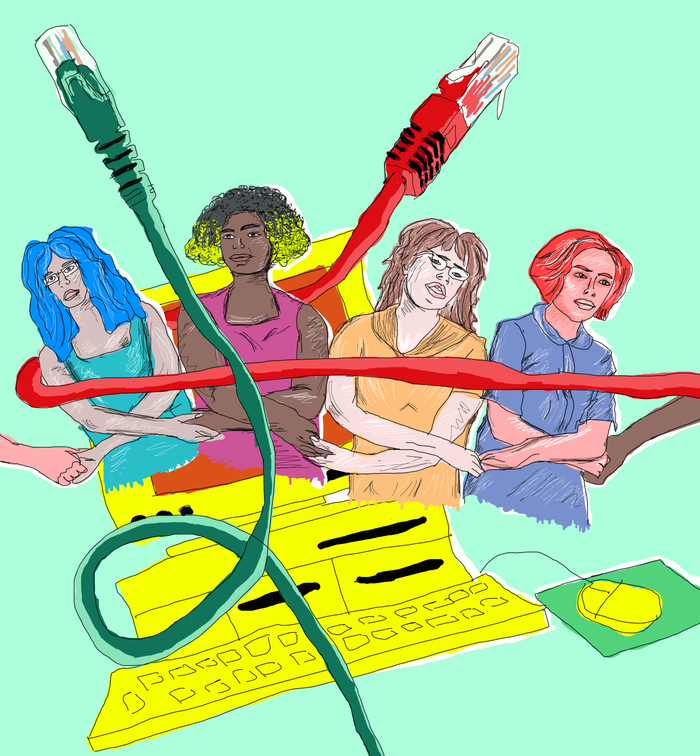
Last March was the beginning of an acute but common personal experience, of holding on to hope during a peak of injustice and oppression.
With the pandemic, we learned and reluctantly accepted the suspension of intimacy, closeness and the sweet randomness of human interaction, from going to work, to continuously looking for entertaining plans, to going back home, disgusted by having left it. We’re expected to do everything from behind a screen: think together, work, check up on family and friends, exercise, hang out and even have our political and personal breakdowns. It’s as close as we can get to one another.
Looking to arm myself with human proximity and comradery, I read everything my friends wrote. Some of them hadn’t written a word on social media in years, but isolation broke their silence. I asked on Twitter: “Are our hopes for political organizing, for searching for alternate ways of living and surviving innocent and foolish?” Responses from friends weren’t concerned with whether we were being foolish, but there was a consensus on the validity of “arming oneself with hope.” I held on to that wisdom from others, and read here on Mada Masr three pieces alluding to hope as a form of political resistance: 1, 2, 3.
Leftist hearts dreamed of finding alternatives as we watched the capitalist cycle’s inability to accommodate the pandemic, or any slight change. We saw the crudeness of governments’ sacrifice of poor workers. We saw the fragility of that illusion some of us had created — that a monthly income would be enough to live some sort of decent life. It was the moment I realized the tragedy of living without medical insurance.
At the beginning of the shutdown, I was on a previously planned trip to the United States, a trip built around exploration and relaxation, stemming from a bitter need to distance myself from my life in Egypt and its political and psychological impact on me. I quickly overcame the bitterness to live in a collective state of suspension, reflection and anxiety. In the company of a close friend, so far from my regular life, we discussed consumerism. We complained about the overwhelming state of individualism and what capitalist societies have done to us by attaching our value to our productivity and contribution to profit Hashem Hashem wrote about the “productivity of life” as a form of resisting the capitalist “productivity of death.” A Twitter comrade wrote about recapturing the notion of productivity, adapting it to how we really want to spend our time. It was an important discussion at a crucial time when nature had forced us to stop and reflect on our relationships with work. With them, I visualized what I know and believe: that survival is a collective action.
In the most difficult days of the quarantine, we wrote about surviving the pandemic with both sarcasm and hope and wondered: Did we survive the revolution? I didn’t know the answer, but I knew that the revolution had given me the words to understand what I was going through during the pandemic.
On Twitter, the like button is the equivalent of a smile, a hug from a friend, a gesture that you’re not alone. Tweets from loved ones ranged from those who missed human touch to others who criticized oppressive regimes — with only seconds in between. We tweeted about love, political arrests in Egypt, boredom and anguish. We sang along to Wegz’s “Dorak Gai” (Your Time is Coming), mourned our summer plans, shared beautiful poetry, and reminded ourselves every day not to cut our own hair. Scrolling through my liked tweets now, I realize that several friends have been arrested in this brief period, that they’ve been robbed of the most basic gestures of love.
What hope does to us
The internet has changed. Online life was no longer just an extension of the world. In isolation, virtual was redefined, or perhaps lost its meaning. There’s nothing virtual about communicating, theorizing, trying to understand, and organizing politically. There’s nothing virtual about emotions. There’s nothing virtual about insisting to live.
Consoling mourners: Sarah Hegazy
The day we woke up to learn we’d lost Sarah Hegazy, our hearts were broken. We sent love and condolences. We cried behind screens that lost their coldness and warmed up with love and solidarity from Egypt to Lebanon, to Syria and Palestine, to the Arab Maghrib, to the diaspora. Friends and strangers united in the same pain, a single elegy in the face of a flow of hateful comments denying Sarah her Egyptianness and her humanity.
A Twitter account with the handle @queersilwan (Queer Consolation) posted extracts from an anonymous blog titled “Queers Who Can’t Grief in Public.” Together we were part of a wake, in a space in which people could share their pain in anonymized safety. I spent the days following her death reading every word written about her and feeling warmth and pride.
Sarah finally gave meaning to pride, a word that had always felt distant to me, reserved for queers in European or American contexts. Sarah was an Egyptian queer communist feminist who insisted on defining herself in a world that didn’t welcome people like her. She defined her homosexuality against a world that continues to convince us that heteronormativity is the only way to live. She defined her communism in the face of societies that crush us with their capitalism. She defined her feminism in political spaces that are yet to get over the illusion and the joke of the heroic male leader.
In mourning Sarah, we listened to Mashrou' Leila and Om Kalthoum in celebration. I saw her smile hundreds of times. We sighed when we watched a video where she is humming along to Om Kalthoum, her hand holding another’s, perhaps a lover or a best friend. I watched the video once and deliberately ignored it many times. Now, watching it for the second time, it forces me to face the fact that the world wasn’t ready for her beauty, and that we have really lost her.
In his book Cruising Utopia: The Then and There of Queer Futurity, José Esteban Muñoz writes that “queerness is essentially about the rejection of the here and now and an insistence on potentiality or concrete possibility for another world.”
Sarah insisted on the potential for another world. And in a moment between rejecting all there is in this world and the dream, we lost her.
I remember Sarah when I hear Om Kalthoum and I feel a lump in my throat because she makes me face what I don’t want to lose, especially when I’m in Cairo. Most of the time, I don’t want to lose Cairo nor the dream of what all of our beauty could make in a city like this one. I imagine Sarah at her favorite coffee shop in Alexandria, without having to live the experience of exile. I imagine her as she wanted us to see her: a queer communist feminist who loved love and justice.
With permission from the Egyptian family: female TikTok influencers
Last July, a group of feminists launched a petition demanding the release of female TikTok influencers, as part of an anonymous campaign called #WithPermissionFromTheEgyptianFamily. More than 250,000 people signed the petition. The state had begun arresting female TikTok influencers in mid-April. At least nine women were arrested and charged with “violating Egyptian family values.” Mowada al-Adham and Haneen Hossam were sentenced to two years in prison. In January, their appeal was accepted and they were acquitted, but were hit with separate charges of human trafficking before they were released. Similarly, Manar Sami was sentenced to three years in prison and a LE300,000 fine in September. Meanwhile, Menna Abdel Aziz, a victim of rape and battery, was forced by the state to spend an abusive three months at a rehab facility as a defendant.
The campaign created a state of defiance around women’s right to express themselves and create online content. Every day, I join other women calling for the release of the TikTok influencers and working to shatter the illusory, oppressive concept of Egyptian family values that is used by prosecutors — and society at large — to control and punish women. Many users demanded that the National Council for Women support the detained women, calling them out on their classism in choosing which cases to lend support to after their vocal advocacy on behalf of victims of Ahmed Bassam Zaki and certain other cases that erupted this summer.
At the Ikhtyar (choice) Collective, we work to deepen feminist practices in knowledge production. We look to other political movements to extend our imagination beyond the Egyptian political impasse. The feminist internet movement, which began in 2006, is one that I’ve learned the most from. Its first campaign was led by a group of feminists in the global south to use information communication technology to fight violence against women. In 2014, feminists interested in technology and the internet developed the Feminist Principles of the Internet to become a basis for a feminist political organization in different contexts.
The literature of this movement shows us that the experience of women on the internet is loaded with the same patriarchal poison that surrounds us on the street. When I am online, my experiences and position in life stay with me, and the same goes for a women-hating man. The internet carries everything we hate in our societies, from misogyny to classism to homophobia to racism and more. We recently saw this in abusive content from male YouTubers, most notably, Nasser Hekaya, who targeted the TikTok women for their supposed insolence.
In building a feminist internet, we are working toward our dream world. We feed the machine with our knowledge, policies, values, pleasures, sexuality, words and theories. We are changing the rules of the game. For example, when our bodies and sexuality are threatened, and the internet is then filled with violence from men in the form of sextortion, trolling, cyber-misogyny and more, we throw away the shame and stigma that we are expected to carry as women onto those who threaten, prosecute us and commit crimes against us.
Ikhtyar works to transfer knowledge to Arabic material related to organizing the feminist internet, learning from the work of groups like the Association for Progressive Communications Women’s Rights Program. We studied how we censor ourselves, and we discovered the similarities between our maneuvers on the streets and online. In Ikhtyar’s report “Who’s the party for?,” we found that the “party” (hafla, referring here to an abusive ganging up) is often for feminists. The party could be mocking or intellectualism, and led by different kinds of users, but at its core, it is always patriarchal and regressive. The decision to work on this research was personal and political. It was an attempt to understand how the “partying” — in the form of violence or even an uncomfortable focus on us as women — changes our online practice.
The TikTok influencers are victims of the patriarchy and violence of online users as well as society in the “real world.” The state decided to punish nine women who used a space to express themselves, have fun and work, only because they were women who didn’t censor themselves.
What despair does to us
In early September, the arrests of the Fairmont witnesses and the smear campaign against them showed us how quickly hope can turn into despair and fear, how witnesses can turn into criminals, and how the internet can turn from a tool to a theater for scandal. This was only two months after the Egyptian timeline erupted with a clear drive that began with exposing alleged rapist Ahmed Bassam Zaki through the then-anonymous account Assault Police. The National Council for Women called on women to come forward, then the Public Prosecution arrested the accused. Those were achievements and a start of a feminist wave based on disclosing and sharing testimonies of women who suffered sexual violence.
People called for holding all men who perpetrate sexual violence accountable, be it at home, in offices, on the streets or anywhere else. A space opened online for young women to speak about feminist issues, away from the gatekeeping of women’s and human rights organizations. Family discussions were held in our homes around problems we’re usually silent about.
The attempt to transform a gang rape into a case of public opinion over the sexual morality of witnesses and campaigners was outraging in a familiar way. It often feels like the twists in cases or causes we care about in Egypt could break us politically, and psychologically. We seem to have gotten used to this in a way that’s difficult to describe. To fight despair, we have to practice stubbornness. We have to hold on to the knowledge that our words against their lies document a true narrative, a feminist narrative about our desire for justice.
Egypt hasn’t been any easier to belong in over the past year. But we left 2020 having made gains in organizing. Feminist engagement, for many of us, has become a daily practice, and in it we have found comradery and solidarity that challenge the cultures and “values” that allow all of this violence to take place and then insist on the injustice that follows. We are women who live in Egypt and mostly don’t want to leave, but want a better and safer life in it.
This period reminded me of myself in 2011. It reminded me of learning to respect the moment for the sake of a better life with an affinity and a collective dream of a merciful, accepting and just Egypt. This time around, the moment is directly defined by feminist concerns, in contrast to the 2011 uprising and the years of frustration and regression that followed. We don’t mention feminist concerns with timidity this time around. The only similarity between what happened in 2011 and what’s happening today is the feeling of hope.
آراء أخرى

The potentials and pitfalls of anonymity
«Anonymity confronted me with the fact that I would never be fully present»

We’ve broken the silence — now what?
«Agreeing that rape happens and that it’s bad is not a large enough common ground»
Liberal versus radical feminism: the fundamental contradiction
«The sooner those feminists understand this underlying tension and try to manage it, the better»
Your support is the only way to ensure independent, progressive journalism survives.
You have a right to access accurate information, be stimulated by innovative and nuanced reporting, and be moved by compelling storytelling. Subscribe now to become part of the growing community of members who help us maintain our editorial independence.
Join us
لا توجد تعليقات بعد