
Five Years On: Sarah Hegazy, survival and the myth of safety

When I heard of Sarah Hegazy’s death by suicide, I was far from Cairo, where I had spent my university years witnessing state violence unfold — forced disappearances of friends, classmates and colleagues; the intimate knowledge of makeshift remedies for bruises from rubber bullets; the precise vinegar-to-water ratio to soothe tear gas burns; the muscle memory of which back routes to take to the Zeinhom morgue without drawing attention when checkpoints pop up overnight. I watched military officers storm my campus in search of professors who had written publicly about labor movements and the political power of trade unions against the backdrop of three slow-motion regime changes, each bloodier than the last, and enough eyes-wide-open despair to fill the Mediterranean Sea twice over.
Sarah, who had sought asylum in Canada after being imprisoned and tortured for raising a rainbow flag at a Mashrou’ Leila concert in Cairo, died in exile. One moment of joy that unraveled into years of state-sanctioned punishment, trauma and forced exile: a moment of elation that, in the blink of an eye, became both a marked celebration of queerness and a condemnation of that identity in the eyes of the state. Sarah’s death forced me to finally grapple with a grief I had buried for a decade — tucked in the wreckage of a rearview mirror I refused to look at.
At the time of Sarah’s death, I was living in Toronto. After leaving Cairo in 2013, following the Rabaa al-Adaweya massacre and promising myself never to return (a promise I never kept), my young, naive and shell-shocked self — who didn’t know how to do anything other than run toward the fire — went to Afghanistan to work as a crisis intervention worker, then on to graduate school to complete my training as a trauma therapist specializing in refugee healthcare.
The hardest part of graduate school wasn’t the coursework; it was the culture shock of being in North America after spending my childhood in Saudi Arabia, Qatar and Egypt, and having to confront Canada’s clinical and disembodied way of living. That meant listening to white women talk about suffering without rolling my eyes, and learning terms like BIPOC (which I quickly learned stood for Black, Indigenous and people of color) and all the other identity politics and oppression olympics that came with acronyms I would have to memorize, all while participating in my own erasure to be legible to those around me. It was hard to live in a place where people didn’t realize the access and ease they had, or how much they took their freedoms for granted — still finding time to complain about things that felt obsolete and unimportant. I missed Cairo all the time, even though it had hollowed me out into a shell of a person I no longer recognized.
For years, I held onto the belief that there was another side — of trauma, of state violence, of survival. That belief carried me through long nights walking into the void of Toronto’s skyline, whispering under my breath, “there are other worlds, there are other worlds.” Looking back now, I realize how much of that time was shaped by the weight of holding that belief while surrounded by a system that never fully understood what asylum seekers needed in the aftermath of survival. It was that belief that led me into clinical work with refugees and asylum seekers.
During graduate school, I had to do two placements — 450 hours each, culminating in 900 hours of clinical training — and I stubbornly fought everyone from the dean to the placement directors, insisting on specializing in work with asylum seekers who had experienced torture. That’s what I knew, and I demanded the school make it possible for me to work in my field.
In Canada, there is no specialized program for refugee mental health. My interest in refugee work began in my undergrad years in Cairo, supporting Iraqi and Syrian resettlement initiatives. But even in grad school, I had to fight for every practicum that would let me work while carrying the weight of loss that Canada has no language or infrastructure for. The isolation of exile is compounded by a system that asks for resilience but provides no community to support it. This is not safety, it’s the illusion thereof — contingent on performance, proximity to whiteness and the erasure of the political. You can be yourself as long as you don’t act like what happened to you happened to you. Welcome to your new borders.
Still, I found a way to do my residency in the psychiatric emergency unit of a hospital with a catchment area that served low-income communities, working with people with recurrent suicide attempts. Then I began seeing clients regularly through my second residency at the Canadian Centre for Victims of Torture. This was years before Sarah died.
By the time I heard of Sarah’s death in 2020, I was working as a mental health therapist at a community health centre that worked specifically with non-status migrants, asylum seekers and refugee communities. I was part of a primary care team with doctors, nurses and other allied professionals. It was the height of the COVID-19 pandemic and I was working from home.
I had just woken up and was scrolling past the headlines without registering what had happened. I texted my best friend — someone I had met in Cairo and who now lives in New York: "Did you see the news? Sarah died."
Then I lay there, trying to clock time and place. I read the articles more carefully. Then I did what I did everyday: washed my face, made breakfast, tied my hair back, changed into camera-ready clothes and joined our counselling team’s morning check-in. I remember my manager saying something about the need to increase the number of clients we were seeing due to funding requirements, and I snapped at her — which was uncharacteristic of me, since I liked her. But the isolation of COVID, the lack of government support for the communities I worked with and being labeled an “essential worker” without any meaningful guidance had worn me down.
After the call, I looked at my schedule. I stared at the blinking cursor next to my first client’s name, and then it felt like a metal detector was being dragged over my body — pausing at my arms, my chest, my spine. With each pass, sensation drained until I collapsed to the floor. I went blank. Then I started crying and couldn’t stop. I sat with my back against the desk, knees shaking, my body dissolving into panic.
I called the manager I had snapped at and asked the medical secretaries to cancel my client appointments.
What do we really mean when we promise asylum seekers safety?
That was the beginning of the end of my running — from Cairo, from the grief I had shelved, from the false sense of safety I had tried to cultivate for a decade.
This isn’t supposed to happen, I told myself. They’re safe. The refugees and asylum seekers I work with, despite our inadequate institutions, are safe. This was the lie I told myself. A lie I needed to believe to work in a system that was failing the very people it claimed to serve. What I know now is that being safe does not mean that you have a life worth living.
My experience in post-migration work is primarily based in Canada, so that will be my focus. Refugee claimants seeking entry into Canada are often led — both directly and indirectly—to believe that simply reaching the border guarantees safety, that crossing into Canada is the threshold after which things get better. But that isn’t true.
Instead, what happens is that people fleeing war, surveillance and persecution arrive to find themselves shuffled into shelters with others facing homelessness and untreated mental illness. The wait for transitional housing stretches beyond two years in many cities. Refugee hearings can take anywhere between one to three years just to be scheduled. Even though refugee claimants are, by law, entitled to government-funded legal representation (i.e. legal aid), some lawyers — aware of their clients’ desperation — exploit the situation by demanding payment upfront, regardless.
Decades of professional experience from their country of origin are deemed inadequate, compounded by the systemic discrimination of “no Canadian work experience.” If they have children, they’ve often not been able to bring all of them, so mothers are left questioning their own right to safety while knowing their children remain unsafe. Specialized mental health services are scarce, and trauma is medicalized without context — stripped of its political roots, its cultural meanings, its collective shape. There is no space for mourning a lost homeland, or for naming grief as something other than personal pathology. Instead, refugee claimants are asked to perform stability — to be composed, employable, integrated — even while living in crisis.
Sarah’s death wasn’t just a breaking point in my memory or my professional work. It was a rupture in the narrative I had clung to: that the West, with all its broken promises, could still be a place of refuge. But what do we really mean when we say “refuge?” What do we mean by “resettlement,” when the trauma follows you through customs and lives like a frozen vial inside your veins?
I work in a field that asks asylum seekers to rebuild their lives after torture. We ask them to integrate into a system they don’t recognize and to participate in their own vanishing. We talk about recovery while demanding endless paperwork and interviews with border security. We call it support, but it's a catalyst for erasure.
We treat composure as a sign of credibility, when what asylum seekers need is the space to fall apart — without judgment, without a ticking clock measuring how quickly they can pull themselves back together to prove their worth through productivity, to earn their place in society by what they can contribute to the economy.
No one tells you that survival mode becomes a transitional home you can’t find the keys to. That after years of sustained fight-or-flight, the body devours itself. That functioning isn't living. That stability, when it arrives too late and at the cost of your whole self, can feel like defeat.
Being in survival mode year after year calcifies something in you. Your body forgets what it means to exhale. You become accustomed to being told you should be grateful — for not dying, for having lived. At least I have housing, at least I am not in prison, at least I am not being hunted, you tell yourself. What is the value of a life lived in the shadows of someone else’s definition of living?
The system teaches us to measure success in increments: eligibility, appointments, a work permit. But nowhere does it account for the slow erosion of self, or the grief of never arriving fully. Safety as defined by law is not the same as safety felt in the body. And if the body never feels safe, is the person truly free?
What does it mean to survive someone else's martyrdom?
It has been five years since Sarah Hegazy died. I still speak her name like a talisman. I reread the news articles as if repetition might undo them, astonished that such quiet, determined living could be met with such relentless punishment.
She died alone, in exile, in a city that promised refuge but offered no reprieve. Her mother had passed away not long before. And then one morning, for reasons only known to her, she refused to continue living.
What does it mean to die of a grief that no nation recognizes? What does it mean when your only crime is visibility — and the world deems you unforgivable?
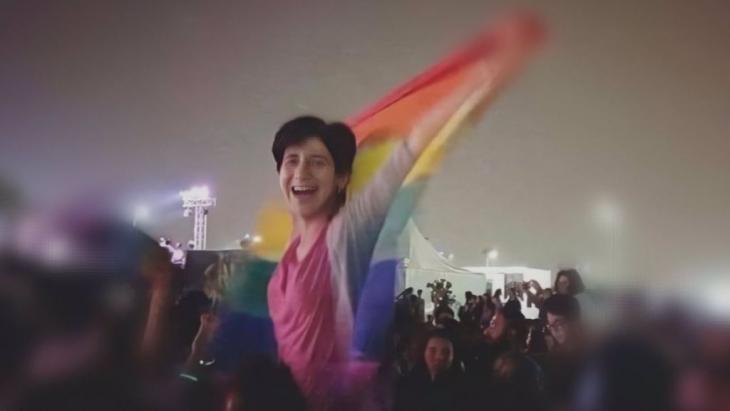
The image of Sarah at that concert in 2017 is frozen in time: lifted onto shoulders, arms raised with a rainbow flag. We should be allowed joy without consequence. One moment of visibility should not lead to a lifetime of exclusion.
When I see Sarah’s image, I whisper it like a prayer: “We should be allowed joy without consequence. One moment of visibility should not lead to a lifetime of exclusion.”
The machinery of exile accounts for borders and paperwork, but not for loneliness. Not for what it means to live without the anchor of familiarity.
And still, she tried. She sought asylum. She gave interviews. She wrote. She spoke about justice, about dignity. She survived long enough to reach the so-called "other side" — and still, it wasn’t enough.
In exile, survival is mistaken for success. Functioning is praised as thriving. And grief is expected to be private, even when its root is state violence.
There is a cost to not collapsing — a cost to appearing strong.
I’m familiar with the cost. The migraines; the insomnia; the dissociation; overworking to forget; being stuck in a cycle of crisis management, constantly in service to the fire burning somewhere — because there is always a fire. Eventually, you stop trying to protect yourself from the heat and forget where the smoke is coming from. The shame of still needing help after crossing a border that promised safety.
We talk about healing — God, I hate that word — as though it’s linear, as though it doesn’t involve breaking open again and again until the truth of your life no longer startles you.
Sarah was not merely a victim of the state — she was its threat. Her queerness, her socialism, her refusal to repent for either: all of it made her unbearable to the regimes that could not break her spirit, so they broke her body.
What does it mean to survive someone else’s martyrdom? To be left holding the question they could no longer answer: Is this life livable?
We have a terrible habit of reducing the dead to slogans. But Sarah Hegazy was not a slogan. She was a person, a comrade, a writer, a believer in liberation. She believed in a world where cruelty did not have to be forgiven for the future to exist.
She didn’t want vengeance. She wanted a world where none of this was necessary.
What do we owe the cities that we survived?
Cities are built to forget. Grief is collective even if you can't name it. The refusal to forget — in body, in memory, in story — is collective. Resistance to any mechanism that wants you to forget — or benefits from your forgetting — is a collective endeavour that requires all of us.
On a first date, I always ask: “What’s a city you would want to be friends with? Think about its personality and personify it.” Most people have an answer. For me, Cairo taught me what I was capable of. I think of her as a girl with tightly coiled black hair slicked back with oil, a leather jacket tied around her waist, a switchblade tucked against her right ankle. She has a deep contempt for bureaucracy, a cutting sense of humour and an unshakable ability to get things done. She shows you — quietly, ruthlessly — that your limits are further than you imagined, that what you think you can't endure, you already have. She’s the kind of friend who kicks you when you're down — not out of spite, but out of kindness, to show you you can get back up again, that there’s still fight in you and that sometimes, you have to fight for yourself before your city.
I try to remember Cairo for the life it gave me and not the life it took away. I don’t speak about it openly — not the early years mired in the disorienting impact of dissent. I talk about malban w eshta (Turkish delight and cream) from Mandarin Koueider, felucca rides, how it took me two years to see the pyramids, rooftop political reckonings and midnight walks in Zamalek with Naguib and Ibrahim. I measure every birthday against the one I celebrated in Cairo in 2012, where I laughed so hard it felt like a second wind in my lungs. But the grief still found a way to crack open against my will.
When I learned of Sarah’s death, I began having flashbacks and nightmares. I was always tired. I felt a permanent tremor in my hands. I panicked at every sound or jolt. One night, when a couple walked their dog beside me, I shrieked and broke down crying on the street.
I stopped seeing friends. I was unable to move, barely able to lift myself out of bed. I started drinking. I overdosed and ended up in the hospital. The guilt of living became so overwhelming I wanted to leave the world once and for all.
When I was finally diagnosed with post-traumatic stress disorder and panic disorder — eight years after leaving Egypt— I laughed at the psychiatrist when she told me. I cackled and looked at her blankly. I’m fine, I shrugged. More acronyms from the West.
The irony wasn’t lost on me. I had spent so long trying to rescue everyone else I never stopped to look closely enough at the wreckage I was running from. The terror of memory had become the terror of living.
Sarah, you held a flag — one that represented freedom to you and a threat to the state. You were punished for living and loving outside what the state deems acceptable. And then you were left with no choice but to leave. And even then, it was not enough.
I used to believe that if we could get people to the other side of war, torture, imprisonment — if we could just get them to safety — then everything would be okay. "Safety" was always elsewhere — usually a country that has signed the 1951 Refugee Convention.
But Sarah, you died in exile. In a country where the myth of safety is sold as a solution. Your death destroyed that narrative for me.
What is safety if it doesn’t include the tools to live? Can the West meaningfully hold space for the grief it claims to rescue?
I write this during the siege on Gaza. Entire family lines have been erased. The images of the Nakba in 1948 — families moving in caravans, clutching their belongings, searching for safety — now reappear in 2025 as familiar scenes on social media feeds. Over 55,000 people have been killed with impunity by Israel in broad daylight. The Madleen Freedom Flotilla was intercepted illegally. Medics, journalists, doctors, educators, students and humanitarian workers — all protected categories under international law — have all come under direct attack, raising urgent questions about the deliberate targeting of civilian infrastructure and the people who sustain it. What would you say if you saw this unfolding? What would you write?
I think of you watching from somewhere beyond this world. I think of your camaraderie with the dead. I think you would have reminded us that grief is not meant to isolate but to radicalize, to organize, to build something more honest than peace: solidarity by any means, solidarity by every means.
To remember you is to remember that survival isn’t a private matter. It is painfully collective.
May your final resting place be one that allows you to be your whole self — queer, Egyptian, socialist, daughter, sister, friend, comrade, activist, writer, feminist and, above all else, human.
May the forgiveness you offered us when you died not be in vain. May the rainbow flag you held up represent not only what is at stake — but what remains of what’s worth fighting for. May you know peace on your own terms.

Maheen Hyder
Maheen Hyder is a writer and trauma therapist based between Toronto and Marseille. Raised across Saudi Arabia, Canada, Qatar and Egypt, her work explores the emotional and political afterlives of…
آراء أخرى

On queerness and the jargon of authenticity
«a utopia free of any Western influence only exists in the delusions of some postcolonial academics»
Our lives are not conditional: On Sarah Hegazy and estrangement
«Here is what I did not know when I chose to be in London: we carry our homes in our hearts.»
A year after the rainbow flag controversy
«Even after my release, I was still afraid of everyone.»
Your support is the only way to ensure independent, progressive journalism survives.
You have a right to access accurate information, be stimulated by innovative and nuanced reporting, and be moved by compelling storytelling. Subscribe now to become part of the growing community of members who help us maintain our editorial independence.
Join us
لا توجد تعليقات بعد