
Explosion in Beirut: Destruction by the political class

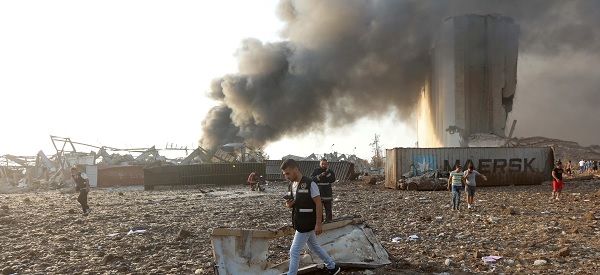
Twenty kilometers away from the blast. 900 meters above sea level. The earth shook for several seconds followed by an ear-splitting explosion. Apartment buildings convulsed and car alarms rang. In the distance, pink clouds appeared.
Two kilometers away in the garage of the al-Rum hospital. The floor and walls shuddered. Car windows shattered and their alarms all sounded in unison. People said it felt like the air had been sucked away. They thought the garage itself had exploded.
A few hundred meters away in the neighborhood of Gemayzeh. A friend sitting in a cafe heard something whizzing by him. Then a thud, as if someone had sat down heavily on the ground — a noise, but it wasn’t loud. He had fallen over. He closed his eyes for several seconds. When he stood up he found everything covered in dust. Nearby, a man lay on the ground with a barb of glass protruding from his eye. Another man was calmly removing shards of broken glass from his hands. The silence was quickly replaced by rising wails and calls for help.
Three scenes from three separate locations after the enormous explosion in the port of Beirut that devastated the capital on Tuesday.
In Lebanon, people have lived through a 15-year civil war and multiple smaller battles. They have witnessed car bombs and assassinations. They have watched Israeli missiles pounding into homes and buildings. Yet no one had ever heard an explosion so deafening. No one had ever seen such widespread destruction caused by a single blast.
The flood of speculation was immediate. Had Israel bombed a Hezbollah weapons storehouse? Was this mysterious explosion similar to the recent ones in Iran? Was this an attack related to the forthcoming UN tribunal verdict in the 2005 assassination of former Prime Minister Rafik Hariri? Was this blast targeting the UNIFIL forces anchored in the port of Beirut?
The government’s own narrative was the simplest of them all: There was no conspiracy. No Israeli airstrike. No act of revenge. This was simply a deadly combination of state neglect and rampant corruption which has permeated everything in Lebanon.
According to the Lebanese prime minister and other government officials, some dock workers were welding an iron door to a warehouse filled with an estimated 2,750 tons of highly explosive ammonium nitrate. A small fire broke out which the fire brigade arrived to extinguish. Then the entire harbor exploded.
The firefighters vanished. Over 100 people died and more than 4,000 were injured. The blast completely destroyed the port, which receives 70 percent of Lebanon's imports.
Over 300,000 people were made homeless after their homes were severely damaged. A warehouse of vital drugs and medicines was largely destroyed in the Karantina district. The al-Wardeya, al-Rum, and al-Karantina hospitals were severely damaged. Community groups began coordinating searches for the missing, in scenes reminiscent of the civil war. Hospital wards, which were already at capacity because of the coronavirus pandemic, were suddenly swamped with the bleeding and injured.
The explosion was so powerful that it equaled the force of a 4.5-magnitude earthquake and was heard in Cyprus, over 160 kilometers away. Some analysts estimate the blast was one fifth the size of the atomic bombing of Hiroshima. There are questions about the possible health effects of gases released by the explosion.
But how did this massive store of ammonium nitrate come to be in Beirut? And how did it remain there for all these years?
In September 2015, The Arrest News, an outlet that covers ship detentions, published a report stating that in 2013, a cargo ship that had left Georgia for Mozambique faced technical problems and was forced to dock at the Beirut port. Upon inspection, it was revealed that the ship was carrying 2,750 tons of ammonium nitrate. The ship was forbidden to sail. The ammonium nitrate was eventually unloaded and stored in Ward 12 in the Beirut port, where the government left it for five years, until it ignited yesterday.
Beirut was devastated in the blast.
The streets are covered in shattered glass. Entire neighborhoods have become unrecognizable and passersby are unsure of where they are. In the areas of Gemayzeh, Mar Mikhael, Al-Jaitawi, Ashrafieh, Hamra, Zarif, Al-Watawat, Dora, Karantina, and elsewhere, people walked in the streets, stunned. Some carried bags, others cats. Everyone was covered in blood.
It is still unclear how the Lebanese government intends to respond. The Supreme Defense Council convened and declared Beirut a disaster zone. The president has given the council five days to announce the results of an investigation. So far, the government has not claimed responsibility.
The prime minister appealed to allied countries for help. Several nations have dispatched medical teams and relief aid. France, the United States, Iran, Qatar, Kuwait, the United Arab Emirates, Iraq and the International Monetary Fund have pledged assistance. Egypt is preparing to send medical aid requested by the Lebanese government, and the Egyptian Medical Center in Beirut is taking in the injured.
The tragic explosion reinforced a tendency by the international community to divert aid to Lebanon from long-term economic support to direct humanitarian assistance.
A diplomatic source based in Beirut told Mada Masr the destruction will have dire consequences for any plan to save Lebanon. The government was already desperately trying to put together a reform package before the explosion. He said that Lebanon already required $10 billion to prop up its economy but with the damage caused by the blast, estimated at between $3 and $5 billion, the prospects of a solution look far more dire.
Lebanon could not afford this catastrophe. The country was already suffering an economic collapse that led to hyperinflation. A second wave of the coronavirus that followed the easing of a lockdown had hit. A popular uprising that began in October had ebbed and flowed in the streets. And all this with a ruling political class that was described by French Foreign Minister Jean-Yves Le Drian in his meeting last week with Lebanese Prime Minister Hassan Diab as “fighting over who is driving the Titanic while it is headed towards the iceberg to sink forever.”
The Lebanese political system is usually described as a sectarian quota system: Every political leader works to protect the interests of their community and views every issue from the point of view of their sect. Gibran Basil serves the Christians of the East. Walid Jumblatt, the Druze population, which is a minority in the region. Nabih Berri, the Shia. Meanwhile, the Sunnis have a number of politicians to raise their banner.
What happened yesterday belies all that. This is not a sectarian quota system. It is a system that politicians of all kinds exploit through sectarianism to accumulate wealth and protect a network of mafia corruption. This system protects the interests of generator manufacturers and prevents reform of the energy sector. This system protects the corrupt gas and diesel distributors and prevents competition for cheap, alternative environmental solutions. This system protects a monopolistic structure.
This perhaps explains people’s reactions. There is shock and there is overwhelming anger. There is nothing in between.
Novelist and researcher Sahar Mandour wrote on Facebook: “We won’t forgive. We won’t forget. You won’t stay long in your position of ‘crisis management.’ You are the crisis and you won’t be the solution. You are the explosion and you won’t be the cure. You are the war, the looters, the collapse before the explosion. What crisis and what wound have you been trying to cure for the last 50 years? You are more of the catastrophe. You are the reason behind the catastrophe. You killed us premeditatively and you will pay the price for it.”
Journalist Joelle Boutros wrote on Twitter: “It’s provocative how they are moving from one TV channel to the other. It’s provocative how shameless they are. It is as though they have nothing to do with what’s happening. It is as though they know they won’t be held accountable. But this time we won’t be quiet. Our anger won’t be soothed with your declarations and donations you pimps. Down with the media that gives you airtime.”
Academic and writer Samer Franjieh wrote a post on Facebook saying: “It is unacceptable to have hundreds killed while they are begging for aid. It is unacceptable to have all these wounded while they are still standing on their feet. It’s unacceptable to have thousands displaced from their homes tonight while their palaces are empty. Revenge. Only revenge. Blind revenge. Without a goal. Without tomorrow. Only revenge.”
Returning from the explosion site the day after the blast, former Prime Minister Saad al-Hariri's convoy passed the tomb of his father, the late politician Rafiq al-Hariri, in downtown Beirut. Perhaps he expected to be cheered, especially since the international tribunal hearing the case of his much-beloved father's 2015 assassination is soon to give a verdict. Instead, the people beside his father's grave threw stones at Hariri's convoy, chanting "thugs, thugs."
Lebanon today is alone, paying a price that has been accumulating over decades. Not only the price of a sectarian regime built in the last century, but also the price of rampant corruption and economic deterioration, whose main beneficiary is the ruling elite.

آراء أخرى

‘Treachery isn’t a perspective’: Boycotting Israel in Lebanon
«The issue is not about feeding a burning desire to communicate with the enemy»

Arab women in search of the disappeared
«The crime of forced disappearance has contributed to the emergence of social movements comprised of the wives and mothers of the disappeared in the Arab region,…»

Lebanon: ‘I am someone because I own this newspaper’
«Why would Lebanese media be better than the corrupt and sectarian system which it inhabits and perpetuates, and why should one be supportive of any of…»
Your support is the only way to ensure independent, progressive journalism survives.
You have a right to access accurate information, be stimulated by innovative and nuanced reporting, and be moved by compelling storytelling. Subscribe now to become part of the growing community of members who help us maintain our editorial independence.
Join us