
With as many as 1,000 residents of remote Darfur village buried in landslide, locals lead rescue while officials pledge to put aside differences
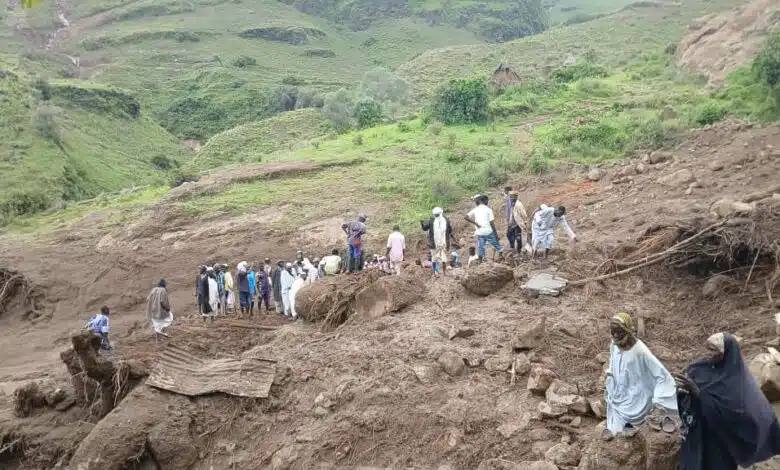
On Sunday night, residents of Suni village in eastern Jabal Marra received word from Tarsin, a village to their west: a landslide had struck. When people from Suni rushed to help, they could hardly even locate the village, a source in Suni said. The entire area was buried beneath mud and rocks.
How many people were killed in the deadly landslide that wiped out the remote village in Central Darfur remains unclear given the scale of the destruction. While the civilian authority affiliated with the Sudanese Liberation Movement led by Abdul Wahid Nur that first announced the news on Tuesday morning put the number at over 1,000 dead, the United Nations offered a more conservative if wide-ranging estimate in a statement issued on Tuesday, saying that between 300 and 1,000 were presumed dead.
Multiple sources who spoke to Mada Masr — a local source and a member of Jabal Marra’s emergency committee — put the village’s population at over 1,000 people, with only one person reportedly surviving the massive landslide.
Sunday’s landslide is the deadliest disaster ever recorded in the volcanic mountain range. Days of heavy rain saturated the slopes, loosening the earth and sending cascades of mud and rock down the mountainside, engulfing the entire village.
Residents of nearby village attempt to rescue victims of the Tarsin landslide, September 1. Courtesy of Sudan Liberation Movement spokesperson.
Many of Tarsin’s inhabitants were families displaced by the violence in North Darfur’s Fasher and Tawila localities since the RSF laid siege to Fasher in mid-2024, according to the local source. This is corroborated by Abdel Hafiz Aly, the member of Jabal Marra’s emergency committee, who told Mada Masr that roughly half the village’s residents were among these displaced families.
Most had built their homes along water runoffs — land left uninhabited and unfarmed, and thus free of disputes with locals — but these sites were wiped out in the landslide, Aly added.
Tarsin sits in a remote and isolated part of eastern Jabal Marra that has been beyond government control for more than two decades. It is one of the villages that emerged in the displacement belt that formed in the 1980s as a result of the conflict that erupted between Arab and Fur tribes over agricultural areas in Central Darfur. By turning to the mountains, farmers sought agricultural land away from the conflicts between herders and farmers over land use.
Since the outbreak of the Darfur conflict in 2003, the mountains have remained under the hold of the Sudan Liberation Movement led by Abdel Wahid Nur, while surrounding areas are now mainly controlled by the Rapid Support Forces and local militias.
With Tarsin completely buried, local efforts to recover the bodies have been severely limited, an SLM-Nur official told Mada Masr. Villagers and the local SLM administration alike lack the equipment and capacity to respond to a disaster of this scale.
On Tuesday, SLM leader Abdel Wahid Nur issued an appeal for coordinated local, regional and international efforts to retrieve the dead and prevent further disasters. He warned that nearby villages remain at risk and called for immediate evacuation and sheltering plans, urging the United Nations and relief agencies to intervene.
But aid access remains uncertain. A Darfur regional government source warned that humanitarian access to the area could be hampered, since clashes between SLM-Nur and the RSF over the past year have left eastern Jabal Marra cut off, with only a few routes open — all under RSF control. From the north, access runs through Fasher, under RSF siege; from the south, through Nyala, the paramilitary group’s main stronghold.
While the RSF issued a statement on Tuesday urging immediate relief efforts, it has continued to block humanitarian access to other parts of Darfur, and aid convoys in the region continue to be targeted. Still, on Tuesday, the office of Mohamed Hassan al-Taaishy, the prime minister of the RSF-led parallel government, said that he spoke by phone with Abdel Wahid Nur to discuss urgent needs and coordinate relief efforts, while the regional government official said that both the regional and federal authorities are ready to cooperate with the UN and with SLM-Nur to ensure humanitarian access.
Tarsin’s own inaccessibility poses another obstacle. With its rugged mountain terrain, the village can only be reached by animal-drawn carts. This isolation once shielded it through decades of conflict, allowing it to endure when other villages were transformed by the 2003 war in Darfur. But now it could hamper relief efforts, especially with more heavy rainfall expected.
While displacement had doubled Tarsin’s population and forced many to build homes along runoffs, part of what made the landslide so devastating was the region’s geology and the way villages are settled across Jabal Marra.

A researcher at the Geological Research Authority explained that torrential rains over the past week had saturated the soil, setting off mudslides that dislodged massive rock formations. The result, they said, was a “compound collapse.” This precarious geography is not unique to Tarsin. Across Jabal Marra, farmland spreads around the mountains while homes are clustered at their bases. With more rain expected over the following days, the research warned that many other villages are at risk of similar catastrophes.
A source at the meteorological authority told Mada Masr that the authority expects disasters of this magnitude to continue as the rainy season reaches its peak, especially in areas located near flood channels, valleys, or rocky hills and unstable eroded soil.
While the village falls outside of the influence of the government in Khartoum, officials linked to the military have expressed their willingness to lend assistance to Tarsin.
That started at the top, when Transitional Sovereignty Council Chair Abdel Fattah al-Burhan offered his condolences for the victims of the landslide on Tuesday, stating that all available resources are being harnessed to provide support and relief to those affected by this disaster.
Darfur Governor Minni Arko Minawi called what happened in Tarsin a "humanitarian tragedy" that transcends the borders of the region.
Minawi appealed to international humanitarian organizations to urgently intervene to provide support and assistance, saying that "the tragedy is beyond the capacity of the people of the region."
أخبار ذات صلة

Sudan Nashra: RSF launches drone campaign in Kordofan, Blue Nile, forces mass displacement | Clashes return to South Kordofan’s Dalang | Armed by RSF for Sudan battles, militias kill at least 169 in South Sudan, sources say | Rizeigat head leaves for Juba after Hemedti requests meeting amid tensions with RSF leadership
Subscribe to our Lens on Sudan newsletter here. The Rapid Support Forces launched drone campaigns in Kordofan and Blue Nile State this…
Sudan Nashra: Idris in Cairo as part of Egyptian-Turkish-Saudi coordination to prop up Sudanese military, Egyptian official says | RSF seizes Musa Hilal stronghold, stoking tribal tensions | RSF attacks North Darfur border town, engages Chadian forces | Hemedti in Uganda as head of parallel govt
Subscribe to our Lens on Sudan newsletter here. A week of heavy clashes in North Darfur has strained the region’s tribal landscape,…
Sudan Nashra: Idris carries his ‘peace initiative’ to Munich | Cabinet, TSC clash over executive powers | Leader of Darfur’s Mahamid tribe calls for unity conference as rift with RSF deepens | Military, RSF exchange drone strikes, civilian casualties mount
Subscribe to our Lens on Sudan newsletter here. As Prime Minister Kamel Idris continues his European tour pitching his roadmap to end…

Sudan Nashra: Military lifts Dalang’s 2-year siege | Washington, Riyadh reactivate truce track, Khartoum signals rejection | Egypt’s intelligence chief in Port Sudan for border security talks, RSF forces transit via South Sudan | Burhan in Doha for “direct financing”
Subscribe to our Lens on Sudan newsletter here. The Rapid Support Forces’ siege of Dalang — which had left the Kordofan city’s…
Your support is the only way to ensure independent, progressive journalism survives.
You have a right to access accurate information, be stimulated by innovative and nuanced reporting, and be moved by compelling storytelling. Subscribe now to become part of the growing community of members who help us maintain our editorial independence.
Join us