
Update: Journalists issue response to security forces’ storming of Journalists Syndicate
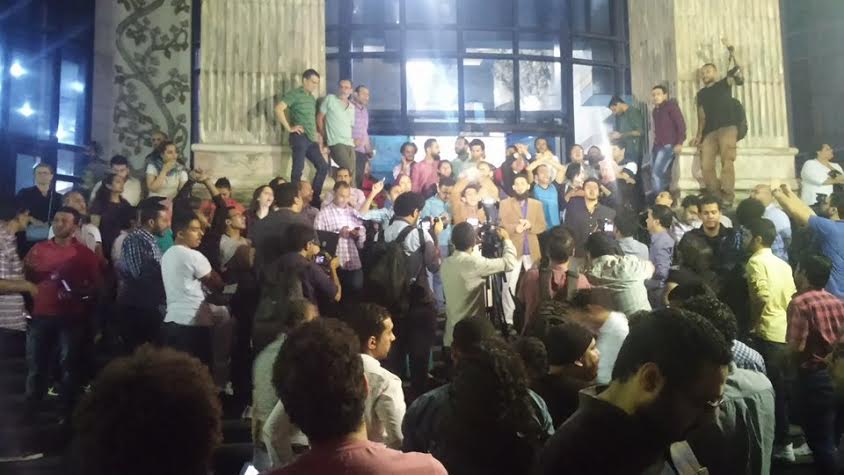
Dozens of journalists protested on the stairs outside Egypt's Journalists Syndicate after security forces stormed the building Sunday night.
President of the Journalists Syndicate Yehia Qallash told CBC TV that around 50 security personnel broke into the syndicate to arrest journalists Amr Badr and Mahmoud al-Sakka on Sunday evening. In statements to the press, Qallash called for the dismissal of Interior Minister Magdy Abdel Ghaffar and stressed that the syndicate would respond to the violations.
In his statement to CBC TV, Qallash called the decision to storm the syndicate unprecedented. The Ministry of Interior should have notified the syndicate if it had issued arrest warrants for Badr and Sakka rather than storm the building, Qallash continued.
Mada Masr’s reporter states that journalists gathered outside the syndicate chanted, “You said journalism and freedom. You gave us prison and arrests” and, “Arrest journalists, tomorrow you'll be put in prison cells.”
Later in the evening, a group of 32 journalists released a statement through the privately owned Al-Bedaiah newspaper in which they announced the commencement of a sit-in at the syndicate’s headquarters and placed responsibility for the security forces’ actions on President Abdel Fattah al-Sisi.
The journalists called the storming of the syndicate part of "a brutal assault on press freedom to stop them from doing their part in exposing crimes of the regime from the killing, torture and kidnapping of thousands of Egyptians to the forfeiture of Tiran and Sanafir islands."
The statement called for the release of all journalists who have been detained or imprisoned for their opinions and the dismissal of the interior minister as part of a larger imperative to hold all those responsible for "these crimes" accountable.
Khaled al-Balshy, head of the Freedoms Committee at the Journalists Syndicate and the editor-in-chief of Al-Badaiah, was among those who signed the statement.
The Journalists Syndicate will hold an emergency general assembly on Wednesday to discuss further action.
The syndicate had recently filed a complaint against the Interior Ministry and Cairo Security Directorate for violations committed against journalists during the April 25 protests.
The Interior Ministry responded to the incident in a post on their official Facebook page, stating that the general prosecutor had issued warrants of arrest for Badr and Sakka, but the journalists took refuge inside the Journalists Syndicate to "try to involve the syndicate in a confrontation with security forces and fabricate a sensationalist crisis that would bring about a state of chaos."
The ministry contended that eight police officers entered the syndicate adhering to all legal procedures and on the direction of the general prosecutor. Badr and Sakka – who have been charged with inciting protest and creating chaos – surrendered voluntarily once police entered the building, according to the statement.
The ministry concluded its statement by insisting that it respects the national role played by journalists as well as freedom of expression and opinion.
Egypt was ranked the second worst jailer of journalists worldwide by the Committee to Protect Journalists (CPJ) in December, 2015.
The storming of the syndicate came one day before World Press Freedom Day, and it is the first time that the building has been breached by security forces.
Earlier Sunday, security forces blocked the downtown Cairo streets leading to the Journalists Syndicate ahead of a planned Labor Day conference to be held at the syndicate and organized by independent trade unions.
The conference, called “United for Union Freedoms,” was to take place at 5 pm inside the Journalist’s Syndicate and aimed to address the grievances of independent unions and discuss their proposed amendments to existing trade union and labor laws.
Hundreds of police personnel were stationed in the vicinity of the syndicate, according to a Mada Masr reporter who arrived at there around 5.30 pm for the conference. Security forces near the syndicate included riot police, armed police and security personnel in civilian clothing, as well as riot police trucks, Central Security Forces trucks and prisoner transport vehicles.
The reporter stated that security forces would not allow people to enter the syndicate unless they were carrying a syndicate membership card, and that they were blocking off Abdel Khalek Tharwat Street and Champollion Streets.
The conference leaders relocated the conference Center for Trade Unions and Workers Services on Qasr al-Aini Street, where over a hundred attendees gathered, according to Mada's reporter.

Earlier in the day a protest was called in front of the Journalists Syndicate by the Coordinating Solidarity group, a coalition of syndicates that formed to protest the civil service law. It posted on its official Facebook page that the event was prevented by security forces.
“Labor leaders gathered to participate in a demonstration planned by Coordinating Solidarity to mourn workers on Labor Day, but police prevented them from reaching the Journalists Syndicate,” wrote Coordinating Solidarity. “The police stated that they were preventing workers from gathering in front of the syndicate.”
The decision to block access to the Journalists Syndicate follows a similar decision on April 25, when demonstrations were planned to protest of ceding of the Red Sea Islands Tiran and Sanafir to Saudi Arabia. Journalists were prevented from entering the syndicate and security forces blocked public streets leading to the syndicate.
The Journalists Syndicate filed a formal complaint against the Interior Ministry and Cairo Security Directorate for violations against journalists on that day. Violations included the arbitrary detention of journalists as well as allegations that the security services deployed plainclothes police officers, who attempted to storm the syndicate’s headquarters while denouncing the journalists inside as traitors and foreign agents.
The Front to Defend Egyptian Protesters published a report documenting 1,277 arrests across 22 Egyptian cities between April 15 and April 27, which was the period of the popular mobilization against Egypt’s decision to transfer of the two islands to Saudi Arabia.
Labor unrest has been increasing countrywide over the past year. In 2015, 1,117 strikes and other industrial actions were reported, according to Egyptian NGO Democracy Meter, and between January and April 493 labor actions were reported. "This currently represents an average of six industrial actions each day, and a 25 percent increase in such labor unrest in comparison to the same period last year,” the NGO wrote on May 1.
The state is also continuing to crack down on independent trade unions.

أخبار ذات صلة
Labor union elections are back, but with few promises
Bureaucratic hurdles, political messages and a legal stand against hopes for liberated labor unions in Egypt
Parliament issues amendments to trade union law
Critics of the trade union law amendments argue that they have been tailored to the interests of the state-controlled ETUF.
June 30, 3 years on: Independent labor movements suffer more losses than gains
Independent labor unions were among those who joined the June 30 movement, but 3 years on, they say that they have not reaped any benefits for their once strong support.
Trial to outlaw independent labor unions referred to Egypt’s highest court
A historic case seeking to outlaw Egypt’s independent trade unions, in which a verdict was due Sunday, was referred to the Supreme…
Your support is the only way to ensure independent, progressive journalism survives.
You have a right to access accurate information, be stimulated by innovative and nuanced reporting, and be moved by compelling storytelling. Subscribe now to become part of the growing community of members who help us maintain our editorial independence.
Join us