
Thousands under siege in Jabalia amid new Israeli invasion of northern Gaza that has displaced 177,000 Palestinians
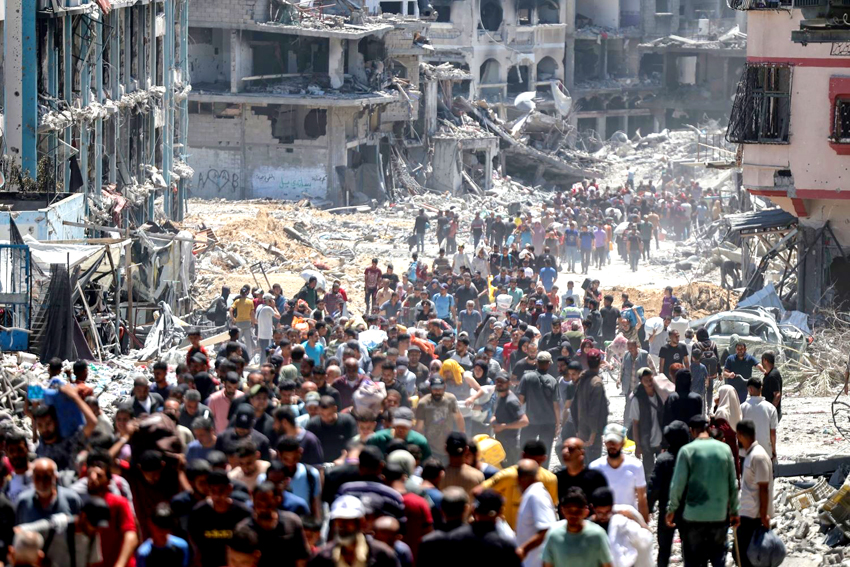
Residents of the Jabalia camp and several other neighborhoods in the northern Gaza Strip were besieged on Wednesday due to constant fire by the Israeli military, eyewitnesses told Mada Masr.
“I tried, with my family, to get out but the road was blocked with quadcopters which shot at us as soon as we got out of the house,” said Khaled Abu Oun, a resident who is unable to leave the area. “My brother's leg was injured so we had to pull him back to the house. He has been bleeding for two consecutive days and we have no food or water.”
For those who manage to leave their homes, fortifications constructed by Occupation forces to restrict passage out of the area have heightened the risk of exposure to Israeli fire. Roads leading south are also policed by Israeli soldiers who arrest and open fire on travelers.
The Gaza Media Office announced on Wednesday afternoon that 125 Palestinians have been killed and 177,000 have been displaced since Israel began its ground invasion of Jabalia on Saturday night.
Civil Defense Spokesperson Mahmoud Bassal told Mada Masr that there are hundreds of bodies that service workers are unable to reach due to the constant fire.
Israel began a heavy bombardment campaign on northern Gaza on Friday evening which residents likened to the initial days of the war, later launching an invasion of the north which has expanded over this week in line with Israeli plans to isolate northern Gaza and empty it of Palestinians.
As of Wednesday, the Jabalia camp, Tal al-Zaatar, the Beit Lahia housing project and the town of Beit Lahia as well as Sheikh Zayed were all under siege, according to Mada Masr’s correspondent in the area.
The Occupation closed the Abu Sharkh intersection — the only way for people displaced by the assault to exit the camp — with earthen barriers, eyewitnesses said. Residents still inside are already beginning to suffer from the lack of food and water.
Israel bombed Jabalia’s last bakery, in the Falouja area, according to Mada Masr’s correspondent. The strike lit the bakery on fire, damaging the supply of flour as well as the structure of the building.
Meanwhile, Israeli machinery continued their attempted incursions into the Jabalia, Atatra, Salateen and Tawam camps, heightening fears that civilians unable to leave the camp would be directly in the line of fire.
The Israeli military spokesperson issued evacuation orders the day prior for residents of Jabalia, Beit Hanoun and Beit Lahia, once again ordering citizens to move through al-Ternis Street and Salah Eddin Street to a designated humanitarian zone in the Mawasi area in southern Gaza.
But residents of the area told Mada Masr they are unable to evacuate amid the intensive Israeli attacks, with some unable to even leave their houses in fear of being shot.
Eyewitnesses added that tens of thousands of Palestinian citizens are still in their homes in the Wasat al-Mokhayam, Falouja, Shohadaa and Fakhoura areas, while tens of thousands of the displaced in shelters and schools are still unable to flee.
Shrapnel flew through the air on Tuesday evening amid heavy airstrikes on Falouja, Fakhoura, Tawba and Shohadaa, according to Mada Masr’s correspondent in the area.
Israeli soldiers are also launching successive missiles and gunfire toward civilian homes, said Abu Oun, who lives in the Fakhoura area. Despite the evacuation orders, Abu Oun told Mada Masr that the military “does not hesitate to kill anyone who moves.”
Bassal said Israeli soldiers are preventing civil defense teams from reaching these areas, directly targeting them with gunfire.
Massive home demolitions have taken place in the besieged area, Bassal added, saying that he is uncertain whether the Israeli military demolished them while their residents were still inside.
The Israeli military also ordered the immediate evacuation of the Kamal Adwan Hospital, Bassal added, saying that the hospital’s administration and staff are still working within the facility and do not intend to leave.
Despite the Occupation’s evacuation orders, which instructed residents to move south through Salah Eddin Street, Akram Talal, an eyewitness in Beit Lahia, told Mada Masr that the road too is unsafe.
Talal explained that when a number of displaced people reached the Zamou intersection on the Salah Eddin road, the Israeli military shelled and arrested a number of them, driving many to return northward.
The Israeli army has been relentlessly bombing the eastern and western neighborhoods of Beit Lahia, Talal added, warning that the situation is deadly.
Israel’s military launched a wide scale assault on the Gaza Strip on Saturday. It issued evacuation orders to residents south of the Nestarim corridor in central Gaza which it has occupied for months to control movement between the north and south.
The evacuation orders expanded the occupied area, displacing hundreds of people. Later on Saturday, a mosque and a school-turned-shelter were bombed, killing 26.
At the same time, a massive bombardment campaign rocked northern Gaza. By Sunday morning, Israel announced a new military operation, sending heavy machinery and military equipment into the northern parts of the Gaza Strip.
Israeli Prime Minister Benjamin Netanyahu has reviewed plans to empty the northern part of the strip of its residents according to news reports.
Similar plans were also floated in August, when an Egyptian security official told Mada Masr that Israel is working to split the strip in two. Israel wants Palestinians to be concentrated in the south of the strip and to “decrease the population volume in the north,” the source added. Reconstruction would then take place only in the southern areas, which would be subject to strict security measures.
أخبار ذات صلة

Hundreds of Gaza students demonstrate for right to study abroad
Hundreds of university students trapped in the besieged Gaza Strip gathered on Monday outside the Journalists Syndicate’s headquarters in western Gaza City…

In meeting with Board of Peace director-general, Hamas refuses UN disarmament plans until Israel commits to withdrawal
Hamas has refused to commit to the plans proposed by the United Nations for its disarmament, citing lack of advancement in Israel’s…

Israel agrees to limited reopening of Rafah border crossing — details pending
Israeli Prime Minister Benjamin Netanyahu’s office announced on Monday that it has agreed to a “limited reopening” of the Rafah border crossing…

Sisi touts ‘stabilization’ agenda at first Davos appearance in over 10 years
President Abdel Fattah al-Sisi advertised Egypt’s “stabilization” agenda in Davos on Wednesday, saying the country’s focus on steering away from regional conflicts…
Your support is the only way to ensure independent, progressive journalism survives.
You have a right to access accurate information, be stimulated by innovative and nuanced reporting, and be moved by compelling storytelling. Subscribe now to become part of the growing community of members who help us maintain our editorial independence.
Join us