
The referendum naysayers
Ashraf Galal sits in his supermarket a few feet away from a polling station in Alexandria as voting proceeds on Tuesday. He is not as elated as the voters taking photos with the military men securing the polling station. Galal says he would like to vote “no,” but is too scared to do so.
“I am scared to say that I do not approve of all that’s been happening; there is intimidation of those voting ‘no,’ and I feel that my vote doesn’t make a difference anymore,” he says quietly, with his eyes fixated on the military police close by.
Galal says that he has participated in all the elections that have taken place since 2011, but that this time around he has asked his whole family to stay home for the day and will himself remain in his shop.
The arrests of “no” campaigners ahead of the referendum have raised fears that voting no means risking arrest.
Prior to the referendum, heavy campaigning for a “yes” vote was supported by the government and the media. Conversely, a “no” vote was associated with terrorism and harming the interests of the country. Throughout the week before the referendum, seven “no” campaigners were arrested and faced criminal charges, which may have scared some of those intending to vote against the constitution from going to the polls.
Hundreds of arrests over the last couple of days of voting have also raised fears among “no” voters. 249 were arrested on the first day of voting nationwide, according to the Interior Ministry.
Masrawi news website reported that a voter was arrested on Tuesday after invalidating his vote by writing anti-government slogans on the ballot, calling the regime “stupid” and writing “glory to the martyrs.”
According to Masrawi, police forces arrested the voter in the polling station after the judge overseeing the station reported the writing on the ballot.
Privately owned Al-Youm Al-Sabea reported that a voter was arrested after writing “no to military trials” on the ballot paper. This has not been reported elsewhere, however, or confirmed by the No to Military Trials campaign.
These arrests and other incidents suggest that the secrecy of the ballot — an inherent right for voters and a component of the integrity of the electoral process — has been compromised.


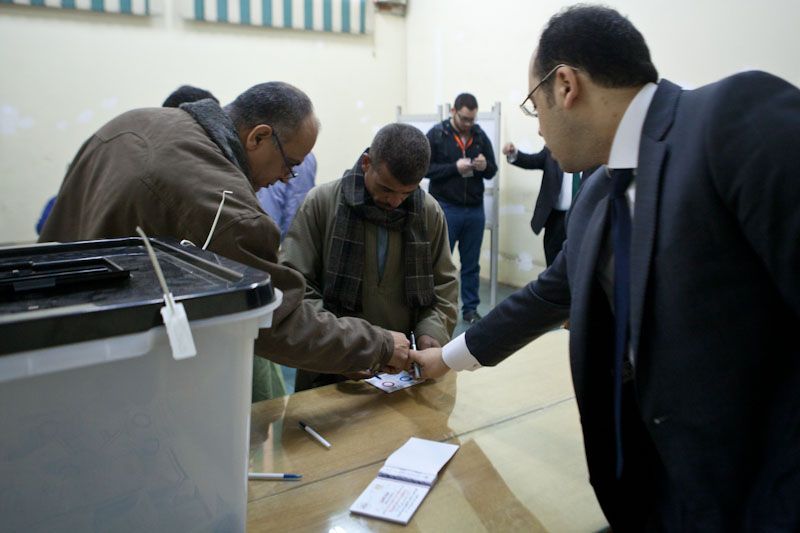
A voter in Nasr City said that she had to vote in front of the judge and not behind a curtain, as is customary, and that security forces were also present in the room.
A picture of Islamic preacher Amr Khaled was posted on social media, revealing his ballot with a ticked “yes” circled as he dropped it into the ballot box.
In previous elections, judges would instruct voters to fold their ballots before putting them in the box to ensure secrecy.
Salma Sami, a member of the Dostour Party, reported on her Facebook page that she was taken to a police station on Tuesday after the judge in her polling station objected to her writing slogans on her ballot to invalidate her vote.
Sami says that the administrative workers saw her writing on the ballot and told her that was not allowed. She relates that the worker snatched her ballot and her mobile phone to see if she had taken a picture of it. The judge then wrote a report and police officers took Sami to the station, where she was released shortly after.
Mostafa Ibrahim, a 27-year-old Alexandrian, voted “no” as a direct response to pressure to vote “yes,” even though he supports Sisi and approves of the constitutional draft.
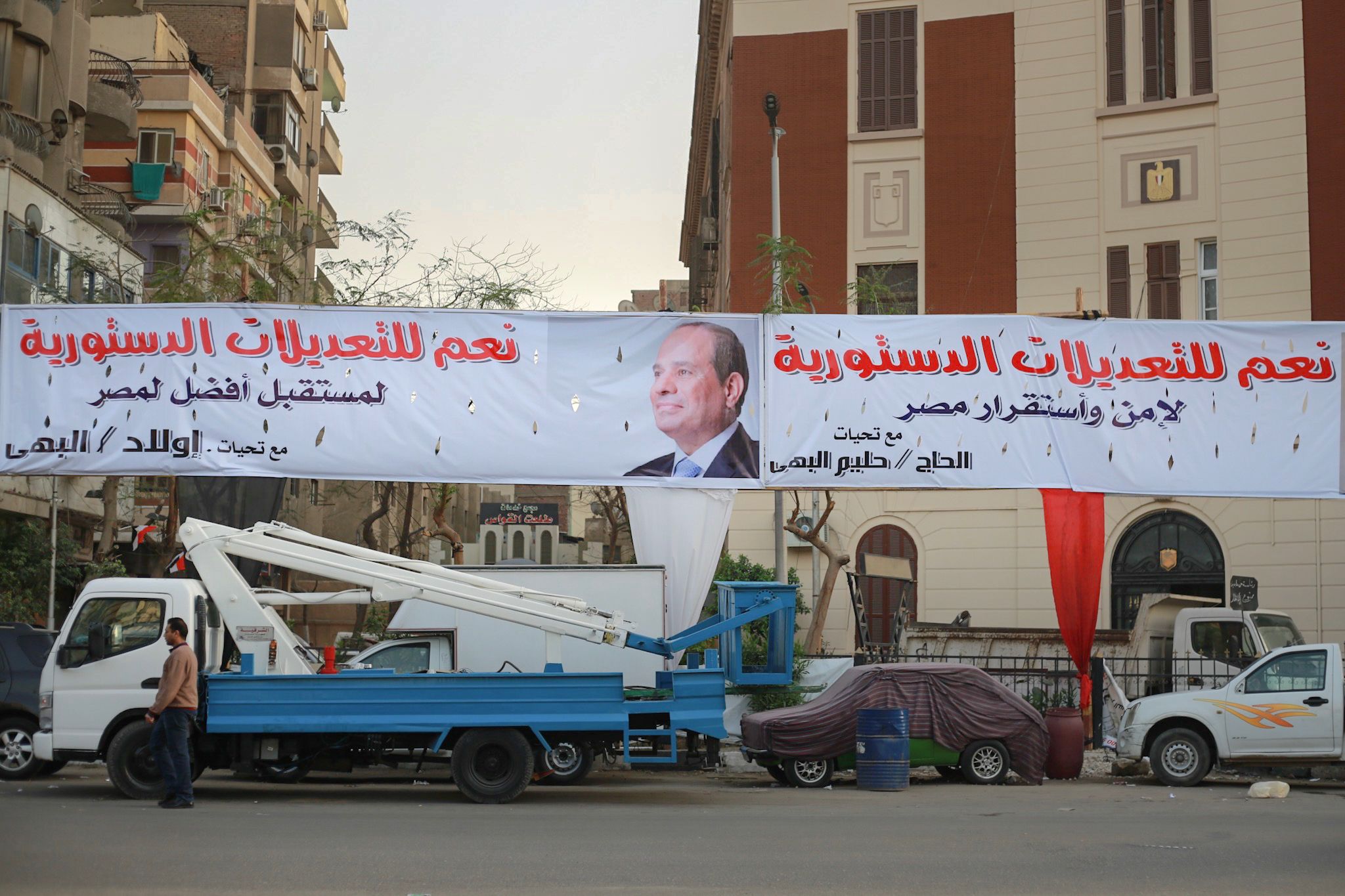
“The constitution is good, but I don’t like all of this fuss to pressure people to say ‘yes’ so I voted ‘no’ just to prove that I can say whatever I want,” he says, while pointing at numerous banners campaigning for a “yes” vote all over the street.
While most voters interviewed by Mada Masr were voting “yes,” there were some going against the tide.
Heba Youssef, who works in human rights, says she voted “no” in large part because of the presence of military trials in the constitution. “I am not going to vote for a return to military rule,” she says.
Youssef says that since the fall of Mubarak she has taken part in every poll or vote. During the presidential runoffs between Mohamed Morsi and Ahmed Shafiq, she nullified her ballot. “This time though, even though I think there is something wrong with the whole process, I didn’t consider that as an option. The more ‘no’s’ there are, that says something. We know that it will be a yes, but the closer the yes and no votes, the better,” she says.
Wael Khalil, a political activist also voted “no.”
“We don’t only vote for a text. The context is important. So while I think as a text it is slightly better than the 2012 constitution, I voted no,” he says.
“The draft allows for freedom of opinion, and grants all sort of other freedoms. But when you say, for example, privacy is guaranteed and then allow private phone calls to be aired on television, I don’t trust you. Not to mention there has been no investigation into the thousands killed since the ouster of Morsi.
“I participated in June 30, but that doesn’t mean I have to accept these crimes. In fact, as a participant in June 30, it is my duty to say, not in my name! We wanted early presidential elections, not this.”
Many of those opposed to the draft did not even consider taking part in the poll.
Saad Mohamed, a civil servant and Muslim Brotherhood supporter is boycotting.
“I have voted in every poll and election since the fall of Mubarak. And for what? People’s voices don’t count,” he explains.
“We have returned to the Mubarak era. And the proof of that is that people are too scared to speak,” he adds.
The Muslim Brotherhood called for a boycott, describing the constitution and the process of drafting it as “null and void.”
A middle-aged boycotter in the upmarket district of Zamalek comments, “As long as the youth don't agree with what is happening, then the constitution is invalid. They are the future.”
Mohamed Ezzeldin, a 40-year-old gas station attendant in Sayeda Zeinab says he is not voting, suggesting the result has already been decided.
“First the Brotherhood decided for us, now the military. My vote doesn't matter and I have work to do,” he says.
Ali Soleiman, 21, a student in the same area, is boycotting because the whole process is “invalid.”
“People who want to vote ‘no’ have not been able to and have been arrested. It has been manipulated by the media and the government for their own interests. I also voted ‘no’ in the last two constitutions for the same reason, but this time I just see no point at all,” he says.
“We were told the first time that voting ‘yes’ meant stability and was for the January 25 revolution; the second time it was to enter heaven and for stability, and now it is again for stability and security,” he adds.
“I also say “no” because of Sisi and his group. He said he fights terrorism, and he doesn't. He says it’s for stability and there is no stability. I also see there are many improved articles but they are not enough to make me vote ‘yes’ when the process is illegitimate,” he explains.
In Suez, steelworker Amr Youssef says he is not interested in voting for the new constitution.
“I had voted ‘yes’ in the referendum for the 2012 Constitution, and although it passed, it was suspended less than a year later. I feel that my vote doesn’t count or matter to the ruling authorities, that’s why I’m not voting this time around,” he says.
Zeinab al-Sayed, a 21-year-old student at Helwan University, was voting in the Basateen area. Unwilling to reveal how she voted, she says, “No one would dare say they were voting ‘no,’ even if they were. People in my line had posters of Sisi.”
Sherif al-Minyawi, 20, says he is not voting because, “It’s not the right time to be asking people to pay attention to, or make a decision on, something as important as the constitution, even if it can be changed later.”
“This is a step the country should be taking together, not when the people are this divided,” he adds. “It's one thing to vote on different options, but it's something else entirely when you have two sides pitted so strongly against each other.”
In his view, the people voting today are not voting on the new draft of the constitution. As he said, they are stuck in a mindset of “Morsi versus Sisi, and who is a terrorist or who is a traitor.”
At a nearby cafe, Karim Mohamed Kamel, 20, said he doesn't vote anymore and hasn't voted since the first round of presidential elections.
“We all know what the outcome will be, so why waste my time in line? Even if everyone votes ‘no,’ it'll still be yes,” he says.
While he’s not opposed to a “yes” vote, and stresses that he’s not affiliated with the Brotherhood, he sees no need to voice his opinion.
He did not read the draft constitution, nor did a group of young men sitting with him. When asked for the main reason why they weren't voting, all five claim they believe the outcome has already been determined and that their voices won’t make a difference.
Only one of them expressed reservations about, as he put it, “voting for the army.”
Ahmed Sharaf, 20, said, “When anyone [other than the MB] wants to protest against the army for whatever reason, and there's bound to be groups of people who will, the response will be just as violent and extreme and we'll be caught in the same mess again.”

أخبار ذات صلة
Voting in the dark: Ramming the constitutional amendments through
“What difference does it make what [voters] know or don’t know?” says one parliamentary source.
Ballot-box politics: What has pushed Egypt’s opposition to vote ‘no’?
Unlike in previous votes, more opposition members are calling for a 'no' vote than for a boycott.
National referendum on constitutional amendments to begin 3 days after parliamentary approval
A national referendum on amendments to the Constitution will be held this weekend
A disintegrating coalition: Rifts re-emerge after Dostour Party’s default leadership election
Rifts have re-emerged within the Dostour Party days after the default election of Khaled Dawoud as party president
Your support is the only way to ensure independent, progressive journalism survives.
You have a right to access accurate information, be stimulated by innovative and nuanced reporting, and be moved by compelling storytelling. Subscribe now to become part of the growing community of members who help us maintain our editorial independence.
Join us