
Supreme Court rules against bank’s attempt to punitively relocate trade unionist

Egypt’s Supreme Constitutional Court issued a historic verdict on Sunday in which it rejected an appeal filed by a bank seeking to punitively relocate an employee who is a trade union representative.
According to the state-owned Middle East News Agency, the court ruled that Egypt’s national labor legislation protects all elected union representatives from such relocations.
Article 48 of Egypt’s Trade Union Law stipulates that an elected union leader may not be relocated from his or her workplace during their term in office, unless they agree to such a relocation in writing.
The verdict was welcomed by independent labor federations, unionists, and workers’ rights organizations. The Center for Trade Union and Workers’ Services (CTUWS) issued a statement on Sunday saying, “Constitutional Court upholds freedom of association and deals a blow to its enemies.”
“This verdict is a slap in the face of those who have recently raised their voices to claim that independent trade unions are illegal or unconstitutional — in hopes of re-monopolizing the country's union movement under the ruling regime's control,” the statement added.
The bank in question had filed an appeal before the court arguing that Article 48 of the Trade Union Law 35 (1976) was unconstitutional.
State-owned media outlets and the CTUWS asserted that the courts verdict safeguards the independence of trade unions and labor federations in light of Egypt’s 2014 Constitution and international labor agreements, which the Egyptian state has ratified.
In giving its verdict, the court referred to constitutional article 76, which protects the rights and independence of union board members from dissolution or other punitive measures.
Several international treaties, including the International Labor Organization’s Conventions 87, 98, and 135, which the Egyptian state ratified over four decades ago, stipulate that union representatives must be granted the necessary rights to carry out their roles in representing fellow employees in the workplace.
Talal Shokr, a member of the CTUWS and the Independent Pensioners’ Union, expressed cautious optimism over the verdict.
“This verdict does not mean that independent unions and their organizations will now be free from harassment by employers or from the state-controlled Egyptian Trade Union Federation,” he said.
From 1957-2011, the ETUF had served as the country’s only legally recognized labor federation.
Shokr added he expected the ETUF would continue to seek to outlaw, or at least marginalize, Egypt’s relatively-new, independent union movement, in order to re-consolidate its control over labor unions, while protecting their interests and privileges.
Indeed the ETUF’s official website includes a number of links calling on the state to ban independent unions, which first emerged in Egypt back in 2008.
“However, this verdict represents a big step forward, especially in terms of protecting the rights of elected union members who belong to independent labor organizations,” Shokr said, adding, “We are still awaiting the issuing of the courts findings and a report regarding Sunday’s verdict.”
The name of the bank in question and other details of the case have not yet been made public, according to the independent union organizer.
The ruling regime’s efforts to redraft union and labor laws, including the rights to arbitration, collective bargaining, protests and strikes, are still in their preparatory phase.
“The Ministry of Manpower and other cabinet officials are still drafting a trade union law to replace Law 35 (1976). This remains a mysterious and isolated process, Shokr asserted.
He added, “We’ve also received some disturbing comments regarding these drafts, including proposals to limit union representation to only one union committee per workplace. Such provisions, if issued, could serve to further restrict the rights of independent trade unions.”

أخبار ذات صلة
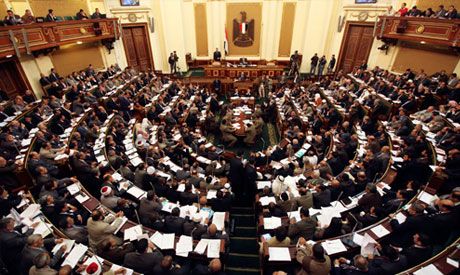
The Senate passed a labor bill: What’s in it? Who had a hand in putting it together? What’s next?
The new bill has languished for over 5 years in Egypt's Parliament

Egyptian Iron and Steel workers stage sit-in to protest liquidation: ‘Here you have a house, outside you have a house, but outside you’ll reside in humiliation’
“Did you not do your jobs? And you over there, did you not do your job?”

Hundreds stage sit-in at Workers Cultural Foundation, call on Sisi to intervene amid trade union federation mismanagement
"Workers are hungry, and the administration couldn't care less about them”
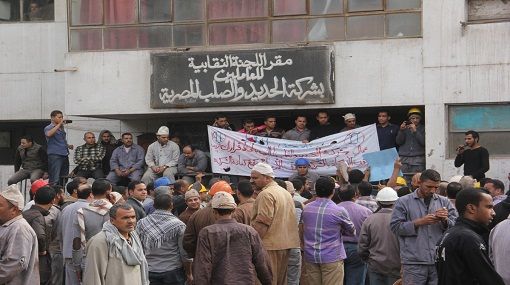
The Egyptian Iron and Steel Company: A symbol of optimism grows old
Many employees believe that the company will be liquidated in as soon as two months.
Your support is the only way to ensure independent, progressive journalism survives.
You have a right to access accurate information, be stimulated by innovative and nuanced reporting, and be moved by compelling storytelling. Subscribe now to become part of the growing community of members who help us maintain our editorial independence.
Join us