
Stop the press: Rights group details state’s grip on print media
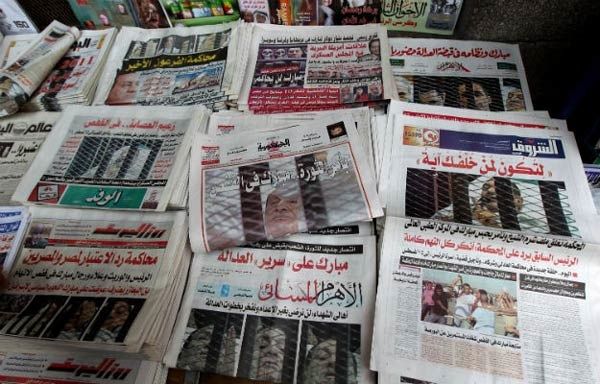
A period of fewer restrictions on print media associated with the 2011 revolution came to an end under the current regime, according to a report by the Arab Network for Human Rights Information.
In its report, “A phone call from a sovereign body,” the Arab Network for Human Rights Information (ANHRI) detailed violations against the press in Egypt through the halting of printing, or confiscation of publications, after former President Mohamed Morsi’s ouster in July 2013, with a particular focus on the period that followed the ratification of the 2014 Constitution.
Security bodies are notorious for having “close connections” with state newspaper institutions, who are the sole owners of print and distribution houses. It is rare that they resort to “direct intervention” by issuing an order to confiscate a newspaper. Rather, a phone call is all it takes to ask the print houses not to print or distribute the edition in question, ANHRI asserted. Under President Abdel Fattah al-Sisi, the report claimed such phone calls, by an anonymous “sovereign body,” returned.
The report maintained this puts Egypt in a legal “grey area.” While newspaper editors do not hesitate to admit that orders were received from a “sovereign body,” legally this entity remains unknown, as there is no record of official written or oral orders. At the same time, national institutions absolve themselves of any responsibility for banning newspapers, while acknowledging that responding to orders is “voluntary and normal,” the report claimed.
ANHRI suggests it is impossible to identify the “sovereign body” responsible without the cooperation of national institutions.
“Violations remain, despite the difficulty in holding the state and its institutions directly responsible in most cases, since it is the direct violator of press freedoms,” the report stated.
“The state however cannot evade its constitutional responsibility for guaranteeing press freedoms and preventing any intervention from any official or unofficial body,” it continued.
The report details the banning of newspapers in over 10 cases in 2014, ranging from confiscation to orders to stop printing to the raiding of print houses. It also details complaints filed by the Interior Ministry against newspapers, as well as violations against journalists.
A couple of weeks ago, privately owned Al-Masryoun, Al-Sabah and Sout al-Omma newspapers had several issues pulled from circulation, citing requests from state monitoring bodies, in the latest incidents of censorship.
Former Al-Masry Al-Youm board member Hesham Qassem told Mada Masr, “We still live in the post-July [2013] revolution state, where security manages everything, and the intelligence has a representative that supervises what's being published.”

أخبار ذات صلة
Fears mount for mental state of imprisoned blogger Mohamed Oxygen after refusal to attend mother’s funeral
“It’s true that remaining silent is his legal right, but it also indicates a level of despair"
Arabic Network for Humans Rights Information suspends activities after receiving ‘unofficial message’
Eid said he faced difficulties that made registration seem impossible.
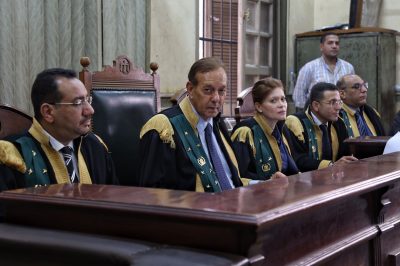
Four more NGOs in the clear in decade-old foreign funding investigation
'We have yet to actually see our personal and NGOs’ assets unfrozen and travel bans lifted'
Government source: Authorities inclined to close long-running case targeting NGOs yet travel bans may remain
The case goes back nearly a decade
Your support is the only way to ensure independent, progressive journalism survives.
You have a right to access accurate information, be stimulated by innovative and nuanced reporting, and be moved by compelling storytelling. Subscribe now to become part of the growing community of members who help us maintain our editorial independence.
Join us