
Sisi forms the National Council to Confront Terrorism and Extremism
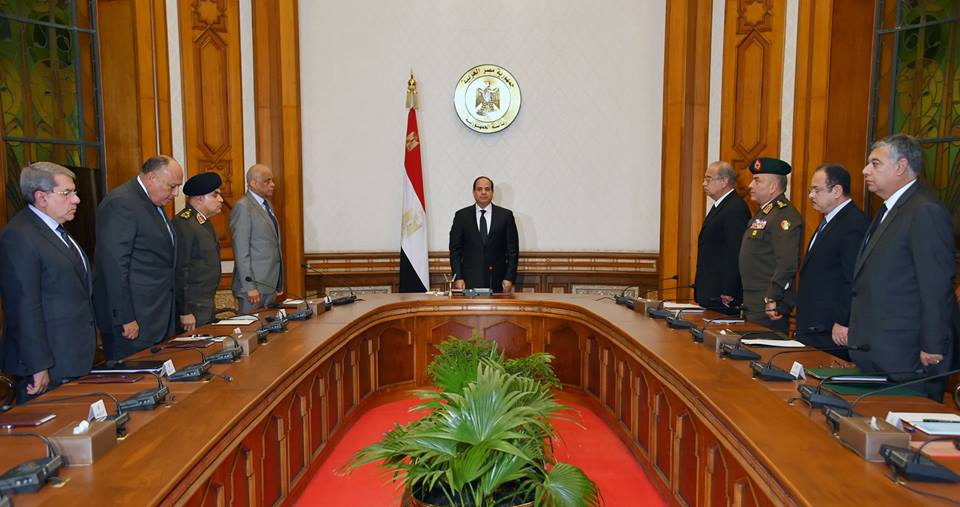
The National Council to Confront Terrorism and Extremism (NCCTE) was created by President Abdel Fattah al-Sisi on Wednesday, three months after he had announced his intentions to form the council following the bombing of two churches in the cities of Alexandria and Tanta during Palm Sunday celebrations.
According to the decree, the council is meant to “mobilize institutional and societal capabilities to limit the causes of terrorism and remedy its effects.”
The council brings together many public figures, including actor Mohamed Sobhy; Major General Fouad Allam, the former head of the National Security Agency; Osama al-Azhary, a presidential consultant for religious affairs; Ali Gomaa, former state mufti; as well as poet Farouk Goweida. The council also includes journalist Abdel Moneim Said; Mohamed Saber Arab, the former culture minister; psychiatrist Ahmed Okasha; lawyer Ragai Attiyya; Dia Rashwan, a journalist and the head of State Information Service; Hoda Abdel Moneim Labib, a Supreme Media Regulatory Council member; Hani Labib Morgan, a journalist and writer; and security consultant Khaled Okasha.
The council also includes 10 ministers: the ministers of interior, foreign affairs, education, higher education and scientific research, youth and sports, social solidarity, justice, communications and information technology, endowments and defence. In addition to the ministers, the prime minister, speaker of parliament, commander of the Armed Forces, grand imam of Al-Azhar, head of the Coptic Church, head of the General Intelligence Service and head of the Administrative Oversight Authority.
The council will construct a comprehensive strategy to confront terrorism, study legislation related to fighting terrorism, and author “necessary plans to inform the international community about the truth of terrorist organizations.”
The council will also oversee the implementation of procedures relating to the seizure of funds of terrorist entities, a function already carried out by a committee formed in 2014, which has since been sued for carrying out a function that is legally viable only through courts.
The president will call the council to convene every two months or at his discretion.
Confrontations between Egyptian security forces and militant groups has spiked in the past years in North Sinai and Nile Delta governorates. The Islamic State continually attacks churches and monasteries, leaving scores dead.

أخبار ذات صلة

IEDs in Sinai: Bygone war claims new victims
A young man was killed in Wefaq village, in the south of Egyptian Rafah, on Sunday when an improvised explosive device, one of two found in the area, detonated. He…

In public address amid war on Gaza, Sisi warns against acting out of ‘anger,’ ‘fervor,’ ‘illusions of power’
Sisi adressed what he said “is being talked about” regarding national security
Sisi announces cuts to subsidy ration card program
"One child, another, six, without considering how you’re going to pay for them or educate them"
The state and subsidized bread: Stuck between a strained budget and public anger
The government appears to be tight-lipped about any potential changes to the subsidy system for now
Your support is the only way to ensure independent, progressive journalism survives.
You have a right to access accurate information, be stimulated by innovative and nuanced reporting, and be moved by compelling storytelling. Subscribe now to become part of the growing community of members who help us maintain our editorial independence.
Join us