
Similar oaths, different speeches
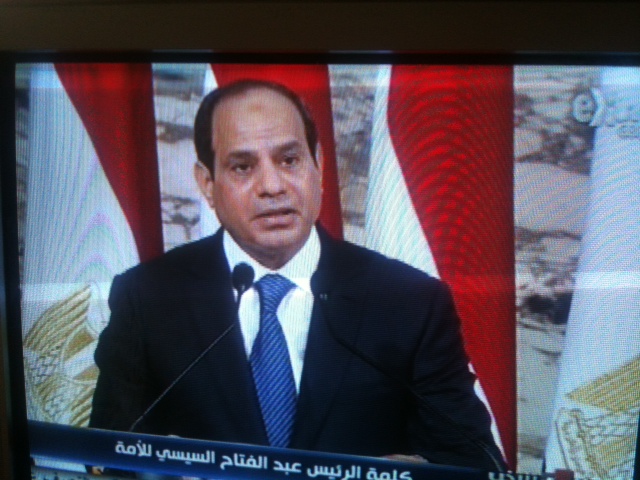
On Sunday Egypt witnessed one more presidential inauguration ceremony, following the victory of Abdel Fattah al-Sisi, the former military commander, in the presidential elections held last month.
In previous inauguration ceremonies, speeches following the oaths of the incoming president have normally reflected the moment and the political persona of the oath giver.
In 1953, Ahmad Naguib, Egypt’s first president, swore in before the Revolution Command Council, which was formed by the Free Officers movement following their coup d’etat against the monarchy. But as marginalized as he was known to be during his brief rule, Naguib wasn’t the one addressing the people on the day of his inauguration.
In recalling the day of Naguib's oath, state-owned Al-Ahram newspaper reminded people that Gamal Abdel Nasser, who would later pull power away from Naguib and become president himself, was holding the microphone during the ceremony. He asked the masses to repeat after him, “God, we hold you witness, you are the great listener. We support General Mohamed Naguib as the leader of the revolution and president of the Egyptian republic. We also vow to preserve the republic with all that we possess — strength and perseverance — and to liberate the nation with our souls and money. Our motto will always be unity, order and work, and God is witness to what we say. God is great. Long live the republic. God is great. Dignity for Egypt.”
In 1954, Abdel Nasser pronounced his oath before Maglis al-Umma, which was then Parliament. Nasser was chosen through the first popular referendum, in which he earned a 99 percent majority, following the Revolution Command Council’s overthrow of Naguib.
In his poetic speech, this time for his own inauguration, Nasser said, “On this day, the Egyptian people have announced to the world that they have opted to walk on the sacred path for the sake of their own independence and lives. On this day, which Egypt witnesses for the first time in its history, a referendum is conducted on the constitution in Egypt and for the first time a referendum is conducted on the presidency for one of Egypt's sons.”
In 1970, Anwar Sadat also pronounced his oath before Maglis al-Umma, after the latter chose him to follow Nasser who had died. Sadat pronounced the regular oath, vowing to “preserve the republican system, to respect the constitution and the law, to fully protect the interests of the people and to safeguard the independence of the nation and the safety of its lands.”
He then moved on to a speech in which he told people that he had received their orders, praying to God that he would earn their satisfaction, as well as that of Nasser, the role model.
In 1981, Hosni Mubarak took over also by a referendum, following Sadat’s assassination and pronounced the same oath before the People’s Assembly. The parliamentary speaker back then asked attendees to repeat after him three times, “long live the Arab Republic of Egypt.”
In his ensuing speech, Mubarak spoke about the brutal times Egypt went through following Sadat’s assassination. He referred to him at length as the "father" and vowed to provide Egypt with stability, not only at the political level, but on an economic level as well.
In 2012, when Mohamed Morsi took over following the first post-revolution presidential elections, he swore in before the Supreme Constitutional Court. The move followed a Constitutional Declaration issued in the same month that stipulated that the presidential oath must be sworn before the court in the wake of the earlier dissolution of Parliament.
Morsi pronounced the conventional oath, whereby he vowed to: “preserve the republican system, to respect the constitution and the law, to fully protect the interests of the people and to safeguard the independence of the nation and the safety of its lands.”
Following the oath, Morsi went on to pronounce a brief speech, whereby he saluted the people and the Supreme Constitutional Court. In the speech, Morsi mostly spoke about his commitment to the independence of the judiciary, a paradoxical oath given the ongoing struggle between the parliament dominated by the Muslim Brotherhood from which he hails and the judiciary. Morsi would later claim judicial immunity over his decrees, a move that would cost him substantive loss of legitimacy.
When Adly Mansour took over in the aftermath of Morsi’s ouster on July 4, he also swore in before the Supreme Constitutional Court in the continuing absence of parliament.

أخبار ذات صلة

Government vs sexual violence
The sexual assault of nine women on the day of the inauguration of President Abdel Fattah al-Sisi on June 9 has directly translated into a heated government response. Besides visiting…
Egypt calls on YouTube to take down sexual assault video
Newly inaugurated President Abdel Fattah al-Sisi’s administration has called on YouTube to take down a video of a mob sexual assault in…
Forensics: No signs of rape in Tahrir sexual assault cases
Cases of mass sexual assaults against several females in Tahrir Square during Sunday's celebrations for the inauguration of President Abdel Fattah al-Sisi…
Sisi visits Tahrir Square mob sexual assault victim in hospital
President Abdel Fattah al-Sisi visited the survivor of a sexual assault in military hospital on Wednesday, where she is recovering from a recent attack that took…
Your support is the only way to ensure independent, progressive journalism survives.
You have a right to access accurate information, be stimulated by innovative and nuanced reporting, and be moved by compelling storytelling. Subscribe now to become part of the growing community of members who help us maintain our editorial independence.
Join us