
US to assemble international maritime security force to protect shipping lines after Houthi attacks
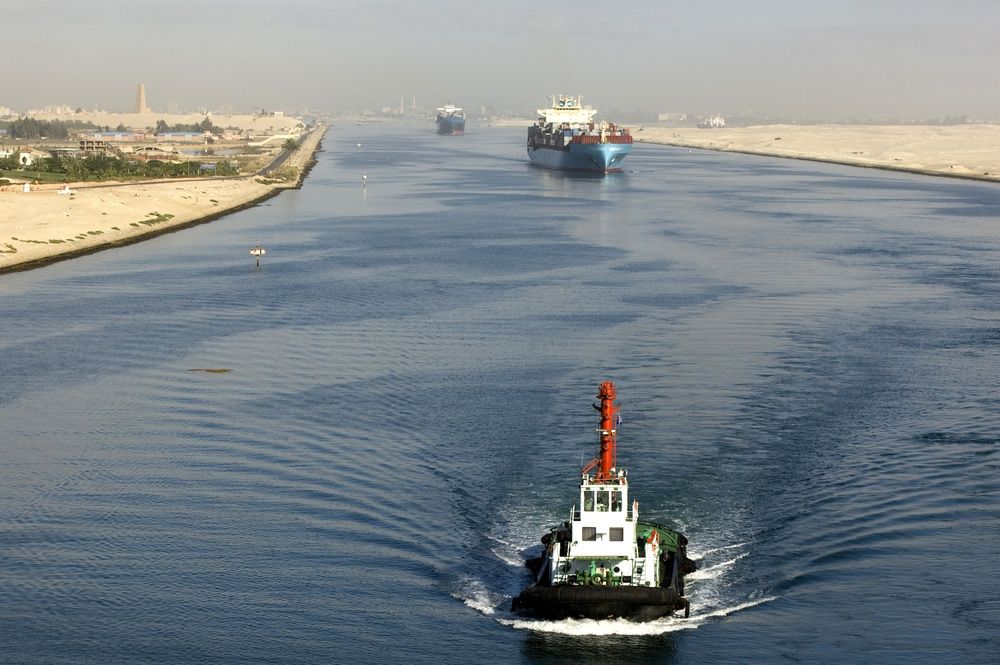
The United States announced Monday that it is putting together an international force to protect ships passing through the Red Sea as shipping lines reroute traffic away from the Suez Canal following several attacks conducted from Yemen by the Houthis on ships passing through the Gulf of Aden.
Amid the ongoing Israeli assault on Palestine, the Houthis have said they will target all ships bound for Israel.
In doing so, the Yemeni force has struck at the heart of global shipping routes. Multiple companies have decided over recent days to reroute vessels away from the Red Sea and take the longer route around the Cape of Good Hope.
Egypt’s domestic economy, which rests upon revenues collected from ships passing through Suez, also stands to bear an impact from the developments to the south of the canal.
In response, Operation Prosperity Guardian is to be launched, said US Defense Secretary Lloyd J. Austin III on Monday. The new multinational security initiative is to focus on the Red Sea, where the Houthi attacks “threaten the free flow of commerce, endanger innocent mariners, and violate international law,” said Austin.
On board Operation Prosperity Guardian are many Global North powers, including the UK, Bahrain, Canada, France, Italy, the Netherlands, Norway, the Seychelles and Spain.
Beginning with their first attack on November 19, the Houthi force known officially as Ansarallah has repeatedly stated its intention to target all ships bearing the flag of the Zionist entity, or ships operated or owned by Israeli companies.
The first attack targeted the Galaxy Leader, a Bahamas-flagged ship associated with an Israeli billionaire, with 22 people aboard. The ship is still being held in Hudaydah port. The occupation forces denied its ownership or the presence of Israelis on this ship’s crew.
Later attacks targeted and seized the Liberian-flagged Central Park ship carrying loads of phosphoric acid on November 26, aimed a missile at the Norwegian ship Strenda claimed to be carrying oil for Israel on December 11 and claimed on Saturday to have struck with missiles two Mediterranean Shipping Company (MSC) container ships — Alanya and Platinum 3 — on their way to Israel.
Ansarallah spokesperson Yahya Saree denounced the Israeli aggression and genocidal war on Gaza and the Occupied West Bank on November 19, saying, “If the international community is keen on the security and stability of the region without expanding the conflict, it must put an end to the Israeli aggression on Gaza.”
Over recent days, global shipping companies have decided to steer clear of the Red Sea entirely. MSC said on Friday, after the group attacked one of its vessels, that it would no longer send any ships to transit the Red Sea.
Container ship companies Evergreen, A.P. Moller-Maersk (Maersk), BP, ZIM Pacific, Hapag-Lloyd, HMM and CMA CGM, among others, have also issued notices that their ships will no longer use the Red Sea route.
As a result, ships operated by most of these companies will reroute, avoiding the Suez Canal and Bab el Mandeb Strait and heading instead around the Cape of Good Hope in South Africa to reach European and Asian ports, increasing the ships’ transit time and affecting both the Egyptian and the global economy.
It’s not yet clear how much the developments are set to affect Egypt’s government, which is facing a foreign currency shortage and for which Suez Canal revenues represent around 15 percent of foreign currency inflows.
In his first comment on the situation, Suez Canal Authority Chairman and Managing Director Osama Rabea said on Sunday that navigation through the canal is flowing as usual, adding that, until Sunday, only 55 vessels had been rerouted away from the Suez since November 19 out of the 2,128 vessels that transited the canal over the same period.
Rabea said that 77 vessels had transited the canal on Sunday alone, among them a number of vessels affiliated with the shipping lines, which announced they had temporarily rerouted ships away from the Suez.
Rabea also said that the Suez Canal Authority is prepared for several security scenarios in the Red Sea, but will not announce those at the present time.
But with an increasing number of companies deciding to avoid the Red Sea, Secretary Austin convened a virtual ministerial with ministers, defense chiefs and senior representatives from 43 countries, as well as the European Union and NATO in Israel, to discuss the increased threat to maritime security.
He also condemned Houthi attacks on international shipping and global commerce as unprecedented and unacceptable.
Ships taking the alternative route via the Cape of Good Hope will be much slower, entailing a major impact on the world economy, according to the Washington Institute of Near East Policy. In one example, a ship that was rerouted took an additional 12 days to reach the Spanish port of Malaga. Longer transit times create additional costs, including more fuel burned, with knock-on effects for sellers and consumers alike, said the institute. Bloomberg also reported that rerouting via the Cape of Good Hope has already impacted natural gas prices in Europe.
أخبار ذات صلة

UPDATE: Four dead, 3 missing after oil rig sinks off Red Sea Governorate coast
An oil rig sank off the coast of the Egyptian Red Sea on Tuesday night, killing four staff members w

‘Accounting games:’ The sukukification of Ras Shokeir
The wording of a presidential decree published in the Official Gazette on Tuesday has stirred considerable debate over its potential implications. The…

As Ethiopia seeks Red Sea access via Somaliland, why is Egypt supporting Somalia?
Egypt is building on its longstanding relationship with Somalia and resentment for Ethiopia.
IPCC, experts say climate research funding for Egypt, Africa insufficient to adapt to threats of climate change
Many measures can be done, but we need to find entry points"
Your support is the only way to ensure independent, progressive journalism survives.
You have a right to access accurate information, be stimulated by innovative and nuanced reporting, and be moved by compelling storytelling. Subscribe now to become part of the growing community of members who help us maintain our editorial independence.
Join us