
Crowds take to streets of Wad Madani to celebrate military rebuffing RSF attack that sent thousands fleeing, even as resumption of fighting looms
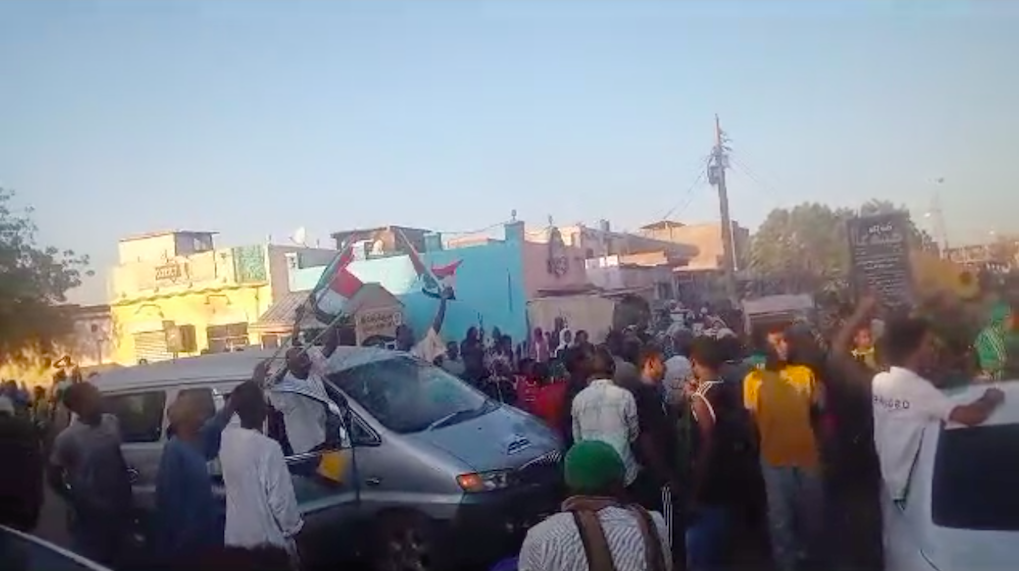
Following days of clashes that have already sent 14,000 people fleeing from a city that has served as a refuge for tens of thousands displaced by war in the Sudanese capital, large scale civilian processions took to the streets of Wad Madani on Sunday afternoon to celebrate the military’s success in repelling an attack by the Rapid Support Forces.
Mada Masr’s correspondent in the city, the capital of the Gezeira state located 85 kilometers southeast of the tripartite capital, observed crowds of people marching toward the Sudanese Armed Forces headquarters in Wad Madani.
A military source in the field told Mada Masr that the Sudanese military was able to successfully push back the RSF unit that attacked the city from their operations in Khartoum.
However, the jubilation in the city may be short lived, as the military source told Mada Masr that they expect the RSF unit to attack again.
The attack on Wad Madani by the RSF, which has increasingly looked to shore up its supply lines to Khartoum, began in the east of the city in the early hours of Friday morning. The RSF deployed maneuver combat vehicles armed with DShK machine guns, dual and quadruple cannons, and Katyusha rocket launchers, said eyewitnesses, who also said that the forces were using dozens of civilian vehicles and hundreds of motorcycles.
The Sudanese Armed Forces responded with two air raids, targeting the RSF’s operation in the Abu Haraz area. The military also used artillery fire to deter the attack.
Clashes between the warring forces were primarily concentrated in northeastern Abu Haraz and in the Um Alilah village, which houses a massive fuel depot. The confrontation also spilled over into the neighborhoods of Inqaz, Riyadh, and Hantoub and Ab Shaneq, where gunfire trapped thousands of residents in their homes.
The RSF initially sought to take command of Hantoub bridge — a key artery through Wad Madani — and attack the military headquarters (1st Infantry Division) and government institutions located on the opposite side of the river.
Eyewitnesses told Mada Masr that shells struck the Dabagha and Ashir neighborhoods on the western bank, as well as Hantoub on the eastern bank.
Journalist Ayman Mastour, who resides in the Riyadh neighborhood, told Mada Masr, “my family and I are currently trapped in the Riyadh neighborhood due to the clashes. Civilians are getting injured as several shells are falling on houses.”
In the Dabagha neighborhood in the western part of the city, displaced individuals were forced to evacuate after bullets started raining down on their shelter.
The sound of fighting could be heard on the city’s outskirts until late on Friday evening. Authorities in the city imposed a curfew from 6 pm to 6 am, but thousands of residents had already begun to flee Wad Madani, as fears mounted that the city could be engulfed in the brutal fighting that many fled when they were forced out of Khartoum during the beginning of the civil war in April.
Large crowds of people began moving on Friday and Saturday in large groups via Wad Madani’s main roads toward the central transportation hub in the city, the popular market, and bus stations that can transport them further south, particularly to Sennar city. With Sudan affected by fuel scarcity, fares for these buses are now significantly higher than they once were.
In the market, several traders relocated their merchandise and closed their shops as a precaution against looting and robbery. Mada Masr’s correspondent observed thousands of civilian vehicles leaving Wad Madani to protect themselves from potential looting by members of the RSF if they succeed in advancing.
On Friday night, Sudanese Armed Forces’s First Infantry Division commander Ahmed al-Tayyib said in an official statement that the military had managed to repel the attack and disperse RSF troops.
Yet reinforcements from Khartoum arrived to support the RSF’s ranks, and the militia resumed its attack for a second day on Saturday, Mada Masr’s correspondent in the city observed.
The United Nations announced on Saturday that 14,000 people have fled the area so far, with several thousand having already arrived in other cities.
Why has the Rapid Support Forces launched an offensive on Wad Madani?
Over recent weeks, the Sudanese Armed Forces have tightened its grip on the RSF’s supply lines in the Sudanese capital of Khartoum, where the civil war began in April this year.
Their supply lines have been all but cut off. The Shambat Bridge, which served as a major military supply line for the RSF from the west of the country into their stronghold in Omdurman was destroyed on November 11.
The RSF later attempted to use the bridge over Jabal Awliya dam, located in the southern reaches of Khartoum, as a crossing point, but it too was destroyed on November 18. When repairs began, it was targeted again by drones believed to belong to the Sudanese Armed Forces.
A military source who spoke to Mada Masr on condition of anonymity said that the RSF has been forced to look for alternative supply sources for their forces in the capital, as the militia’s room for maneuver has been reduced in the tri-city area and as the Sudanese Armed Forces have made advances in the northern and western satellites of Greater Khartoum.
The RSF has attempted to find new supply lines, heading as far as 150 kilometers east, toward the strip connecting Kassala, which borders Eritrea, and the Gadaref state, bordering Ethiopia, said a military source who spoke to Mada Masr on condition of anonymity.
The military source noted that, in recent weeks, the military has seized a number of RSF weapons and ammunition.
A former military official speaking to Mada Masr on condition of anonymity said that the RSF's attack on Wad Madani — a city that doesn’t represent a strategic military location but is rather an important economic hub outside of Khartoum — could be an attempt to achieve a military victory for the militia outside of Khartoum in order to apply pressure on the leadership of the Sudanese military amid ongoing political consultations between the two sides to the war.
Wad Madani serves as a crossing point to connect Sudan’s central states to its eastern and western states, now that life in Khartoum has all but ground to a halt amid the ongoing conflict.
In the political arena, Democratic Unionist Party Secretary-General Mohamed al-Hadi Mahmoud condemned what he described as the widening of the war and the attack on the Gezira State.
Mahmoud told Mada Masr that this attack is a war crime, calling on the RSF to cease expanding the scope of the war and focus instead on continued work on the Jeddah talks toward a humanitarian ceasefire for the provision of aid.
أخبار ذات صلة

Sudan Nashra: Sudanese bid to rejoin global financial system unlikely to succeed amid wartime realities, sources say | Burhan seeks political backing for state control of aid in brief Jeddah visit | Idris’s intra-Sudanese dialogue proposal lacks seriousness, party sources say | Sudan Shield Forces arrive in Blue Nile | Military launches ground attacks in North Kordofan
Subscribe to our Lens on Sudan newsletter here. A Sudanese delegation pressed for Khartoum’s re-entry into the international financial system on the…
Sudan Nashra: Dengue outbreak in Khartoum, medical sources say capital still unprepared | Measles outbreak causes daily deaths in North Darfur displacement hubs | Mahamid RSF commander, forces defect to the military | RSF-SPLM-N shelling kills 6 in Dalang, military foils new offensive
On the third anniversary of the war, Khartoum — recaptured by the military last year and held up as a symbol of…
Sudan Nashra: Nyala healthcare workers on strike | Burhan abolishes deputy, assistant commander-in-chief positions | Sudanese military intelligence head in high-level talks with Tripoli’s chief of staff | Military operation to retake Blue Nile’s Kurmuk underway
Subscribe to our Lens on Sudan newsletter here. A series of announcements this week has fleshed out the April 2 decision by…
Sudan Nashra: Military retakes North Kordofan’s Bara, RSF attacks villages to its west | White Nile’s Kosti, South Kordofan’s Dalang under RSF fire | Military signals push to integrate armed movements, but leaders worry over loss of leverage
Speaking at a military camp in Khartoum on Saturday, Sudanese Armed Forces Assistant Commander-in-Chief Yasser al-Atta signaled the start of a process…
Your support is the only way to ensure independent, progressive journalism survives.
You have a right to access accurate information, be stimulated by innovative and nuanced reporting, and be moved by compelling storytelling. Subscribe now to become part of the growing community of members who help us maintain our editorial independence.
Join us