
President Mansour makes final address before handing over to Sisi
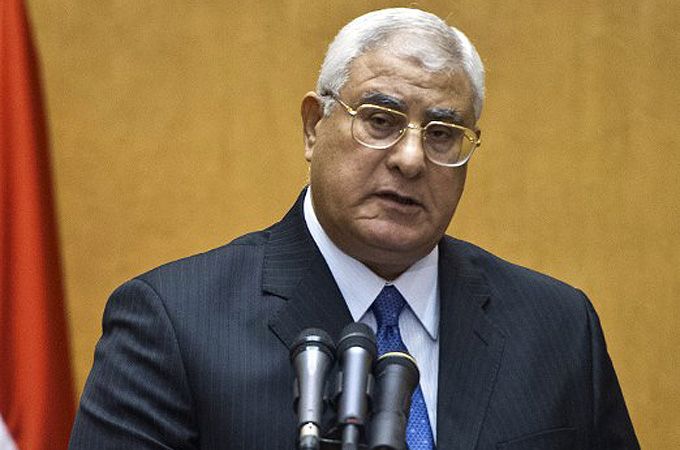
In his last public announcement as interim president, Adly Mansour addressed the nation with a speech full of nationalistic rhetoric and historic references to Egypt’s former glories. His speech comes one day after the announcement of Egypt’s official presidential results on Tuesday night.
Serving as acting president from July 4, 2013 to June 4, 2014, this former chief of the Supreme Constitutional Court sang the praises of Egypt’s police and Armed Forces, along with messages of thanks to Arab monarchies — Saudi Arabia, the United Arab Emirates, Kuwait, Bahrain, and Jordan — for supporting Egypt’s interim authorities since the ouster of the elected Islamist President Mohamed Morsi at the hands of Sisi’s Armed Forces on July 3.
During his 17-minute speech — likely his longest televised address — Mansour talked of concluding Egypt’s transitional phase and relaying the torch to the country’s (former) military strongman, newly-elected President Abdel Fattah al-Sisi, who is said to have received a 96.91 percent approval rate from a voter turnout of 47.5 percent.
The 69-year-old exclaimed that he had come “to administer the country, but not rule it.” He was handing over the reins to Sisi (59 years old) to serve as ruler.
Stepping aside for Sisi’s presidency, Mansour commented: “It is time to pass on the national banner to the elected president, so that he may continue along the path and lead the country towards progress and prosperity.”
He added that “the provision of bread would not come at the expense of human dignity,” and “security would not come at the expense of liberties.”
“I congratulate you on your political consciousness, on your patriotic sentiments, and on your keen sense of responsibility,” said Mansour, in honor of Egyptian voters who lined up to cast their ballots despite “the exceptional heat wave.”
There was no mention of how the two election days (May 26 and 27) were extended for a third day amidst lower-than-expected turnouts, or the threats issued by Prime Minister Ibrahim Mehleb regarding the imposition of a LE500 fine on boycotters.
Mansour said that voters had fulfilled their duties in the latest presidential election, which he described as being “a successful national event” and “an important milestone,” even though this was the seventh election/referendum since the January 25 uprising against Hosni Mubarak in 2011.
Mansour described the presidential elections as “a great accomplishment.” He went on to thank “the Egyptian State and its institutions,” claiming that they had “remained neutral and equidistant from both presidential candidates” — although Egypt’s state-owned media has repeatedly championed and campaigned for Sisi, while security services have cracked down on many of his opponents.
He described the outlawed Muslim Brotherhood, whom the government classified as a terrorist organization (on December 25, 2013) as power-hungry advocates of “blind terrorism.”
Mansour claimed that the Brotherhood espoused “a monopoly of religion,” along with “a general climate of political tension, economic crises and confusion.” He added that Brotherhood-sponsored terrorism had allegiance to “no religion or homeland.”
He asserted that the first success in the country’s political roadmap was the approval of the new constitution on January 2014, which received a 98.1 percent approval rate and a 38.6 percent turnout rate.
Mansour spoke of the determination of the Egyptian populace to bring down two dictatorships in less than three years, and praised the “heroic police forces and brave Armed Forces” for making the “June 30 Revolution” possible.
In conclusion he said: “Now is the time for work, not time for sloganeering.” Similar messages by interim authorities have been used to denounce the right to protest and strike.
During his 11 months in office, Mansour has been perceived as a patriotic figure by many, while on the other hand being seen as Sisi’s “yes man.” His detractors have even derogatorily referred to him as “Adly Tartour” or “Adly the Puppet.”
Mansour has been eclipsed and dwarfed by Sisi’s popularity ever since the judge assumed the interim presidency on July 4.
He has praised the military institution in each of his speeches, while also discrediting Sisi’s opposition — although he did praise losing presidential candidate Hamdeen Sabbahi in Wednesday’s televised address.
In his capacity as acting president, Egypt has arguably witnessed its bloodiest crackdowns, with estimates suggesting the deaths of over 1,400 protesters, and the issuing of death sentences against more than 1,000 others.
Amongst his last presidential decrees, Mansour increased Sisi’s future monthly salary by 2100 percent (from LE 2,000 to LE 42,000) and canceled several presidential pardons issued by former president Morsi. Moreover, he passed into law the restrictive “Protest Law,” which grants police forces sweeping powers to disperse and arrest anti-regime protesters.
In a pre-recorded TV interview conducted early last month, Sisi commented that he would uphold the “Protest Law,” as it exists in order to protect the state and its interests. Sisi added that he would not tolerate “irresponsible protests.”
Adly Mansour is due to transfer his presidential authorities to Sisi on Sunday during his official inauguration ceremony.

أخبار ذات صلة

Who controls Egypt’s religious institutions? How the top of the executive, security apparatus loom over the 3 institutional houses of Islam
Objection to the potential selling of endowments has primarily come from Al-Azhar.

How the justice system shuts women out
Among the 335 new appointees, all graduates of public law schools, there was not a single woman.
Sisi seems to reverse position on local council elections, speaker blames ‘deep state’ for delay of bill in Parliament
The delay may point to a power struggle between security and intelligence agencies, sources say.
A presidential directive to freeze Parliament
New parliamentary formation to be engineered by the National Security Agency
Your support is the only way to ensure independent, progressive journalism survives.
You have a right to access accurate information, be stimulated by innovative and nuanced reporting, and be moved by compelling storytelling. Subscribe now to become part of the growing community of members who help us maintain our editorial independence.
Join us