
Power outages sweep Egypt again amid high demand, decline in natural gas output

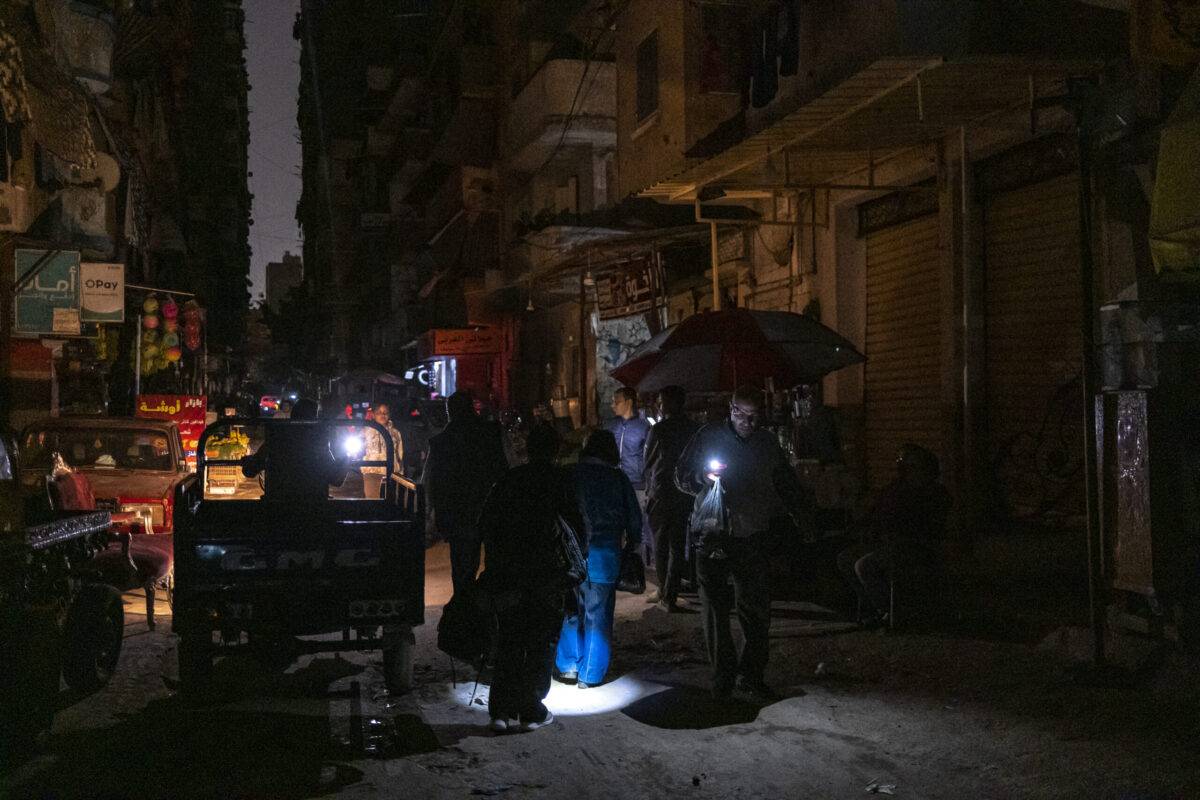
All around the country lights, fans and AC units are going off — in some areas for as much as four to six hours at a time — as a crisis in Egypt’s energy supply coincides with the hottest weeks of the year.
Government officials have rushed to respond to over a week of ongoing electricity cuts, pointing to the summer surge in demand for power consuming the natural gas which powers most of the national network.
More chronic issues could also be at play, said a number of political and energy sector sources who spoke to Mada Masr, pointing to maintenance issues at some of the country’s power stations and a steady decline in Egypt’s natural gas production over recent years, with capacity issues exacerbated by the downstream effects of the ongoing economic crisis.
The power outages are part of the strategy to manage high consumption during the heatwave, the government has said. The high demand has increased the load on the national grid, according to officials, thereby consuming high quantities of natural gas which is used as the country’s main source of fuel to produce electricity.
"We are currently in a period of temporary load relief until the network regains normal pressure," said Prime Minister Mostafa Madbuly last Wednesday, explaining the reason for the cuts.
Following a week of unpredictable blackouts, national distributor the Egyptian Electricity Holding Company issued a Sunday evening statement announcing a supply schedule and addressing widespread public anger, as people complained on social media of being trapped in escalators or caught short without power for key home appliances.
Power cuts will last only one hour at a time, they said, starting at any point between 10 minutes before or 10 minutes after the turn of the hour, while “vital” installations affecting “all” citizens, such as security or health facilities, will be spared the power outages, said Electricity Ministry spokesperson Ayman Hamza last Saturday.
Yet some areas remain more affected than others. “There are areas in Upper Egypt where power outages go on for six hours while the North Coast is lit up,” said news anchor Lamis al-Hadidy pointing to the class differential in supply to the country’s low-income south versus its monied, touristic north during a Sunday edition of her OnTV show.
The unpredictable schedule, technical sources said to Mada Masr, is because “the load reduction plan is central, and its implementation on the ground is not equally distributed as the officials' statements indicate.”
A plan determining how much the load must be reduced, and how much each regional electricity distribution company should contribute to that reduction while excluding sensitive areas such as those supplying hospitals is designed by the Electricity Ministry and then circulated to regional electricity distribution companies, said one electrical engineer working in the private sector and a second engineer at the South Cairo Electricity Distribution Company, both of whom spoke to Mada Masr on condition of anonymity. It then falls to the regional distribution companies to determine how to implement the plan.
“The distribution can be uneven or deliberately avoid certain areas,” said the first engineer.
Stretching the national distribution network is a surge in demand as temperatures spike to over 40C in Cairo and higher in the country’s south. "The government was forced to plan to reduce loads after maximum domestic consumption at peak times reached 35 gigawatts," said the head of the energy committee in the Federation of Egyptian Industries, Mohamed Saad Eddin.
The higher load on the grid has also increased the pressure on the resources used to fuel national power stations, namely natural gas and fuel oil (mazut). Natural gas is the main source of fuel used to generate electricity, supplying between 75 and 96 percent of the country’s electricity since 2019.
Mazut is used to fill in some of the remaining quotient, with the proportions adjusted according to fluctuations in supply and global prices for the fuel types: more mazut was used and less gas consumed domestically at points in recent years, for example, in order to allow for the government to raise revenue by exporting some natural gas resources from Egypt.
A shortage in those natural gas and mazut supplies in comparison to increased demand is part of the reason for the cuts, Electricity Minister Mohamed Shaker told the privately-owned Al-Shorouk at the weekend.
Just how long-term those shortages are, however, isn’t clear yet. Following a series of discoveries including the mammoth Mediterranean Zohr field, Egyptian declared in 2018 that it had reached self-sufficiency in natural gas. With domestic production capacity and imports from neighboring Israel sufficient to meet domestic demand and more, Egypt even set out plans to act as a regional “hub” by exporting gas to fuel-hungry Europe.
Yet domestic production has begun to decline in recent years. Output reached its lowest in three years this May, with sources telling Mada Masr previously that production is down at the once-plentiful Zohr field, which supplies around 38 percent of national output.
The field's gas production in April reached 2.1 billion cubic feet per day, the energy data and analysis firm MEES reported, noting that the figures are 23 percent below the field's supposed production capacity of 3.2 billion cubic feet per day and 11 percent below the estimated production limit of about 2.6 billion cubic feet per day.
Operational problems in the Zohr field appeared years ago when a water leak sprung in the wake of government decisions to accelerate the pace of gas extraction from the field. According to a study of petroleum sector experts in multiple companies that launched a project in the Zohr field to try to support its continuity in advance, Italy's Eni accelerated the start of production from the Zohr field, after compressing the timeline to just 28 months, instead of 6 to 8 years, to achieve "President Abdel Fattah al-Sisi's aspirations."
Fitch Solutions likewise said in a report last week that Egypt's gas production rates are falling rapidly due to a prior acceleration of gas production that has sped the depletion of existing fields in the absence of future projects — with the exception of the Narges field off the coast of Sinai — giving a negative outlook for gas production in the long term.
Without engaging with the long-term questions around the natural gas supply, the government issued a denial this week to refute a connection between the current outages and the impact of its speeding up operations at Zohr.
In addition to high demand and dwindling supply, former deputy head of the Petroleum Authority, Medhat Youssef pointed to maintenance issues, telling Mada Masr that rising temperatures also cause the efficiency of old power plants to decrease, while wind stillness reduces the productivity of wind power plants and dust affects the efficiency of solar power plants.
Sources at the Ministry of Electricity and Renewable Energy who spoke to Attaqa, an American media, research and advisory platform specializing in energy markets, also said in exclusive statements that many power stations need maintenance as most cannot handle the high level of demand for electricity in the summer.
Other factors may include the shortage of foreign currency reserves, which has sent Egypt’s economy spiraling over the last 18 months.
More mazut could have been used to supply the deficit in natural gas resources amid high demand, said a member of the Energy Committee in the House of Representatives speaking to Mada Masr on condition of anonymity. But, they continued, "there was not enough mazut available, which is probably due to the lack of foreign currency."
A shortage of currency also threatens to disrupt supply long term, with the UK’s United Oil & Gas announcing a few days ago a significant drop in its profit rates, pointing to the fact that it has been unable to transfer profits from its Egypt operations abroad.
Until now, there’s no clear sense of when the power outages will end. Madbuly said that the load reduction plan would be implemented only until the middle of this week, while an Electricity Ministry source quoted in the intelligence-affiliated Youm7 news outlet on Monday said that the crisis would be over by mid-August.
The head of the energy committee in the Federation of Egyptian Industries, Mohamed Saad el-Din, told Mada Masr that the petroleum ministry expects the current crisis to end in 10 to 15 days.
Electricity Minister Mohamed Shaker and Petroleum Minister Tarek al-Molla held a meeting on Monday in the new administrative capital to develop a vision for proposed solutions, which was due to be presented to the president on Tuesday morning, according to a parliamentary source who spoke to Mada Masr on the condition of anonymity.
Speaking to Mada Masr, the Electricity Ministry spokesperson said that “I have no idea how the meeting ended.”
أخبار ذات صلة
Govt temporarily lengthens power cuts nationwide, 3 hours of outages in Cairo
Cabinet announced Sunday evening a temporary one-hour increase to the nationwide power cuts.
Egypt announces emergency measures to deal with energy crisis
The measures could possibly be extended into September
Cabinet signs off on deal with company previously convicted of bribing Egyptian officials
In its January 13 meeting, the Cabinet approved a request from the state-owned Egyptian Electricity Holding Company (EEHC) to ink an energy deal…
Govt weighs higher fertilizer export quota to offset rising fuel costs amid Iran war
The government is holding consultations to increase the price of gas it supplies to fertilizer manufacturers — the single largest energy-consuming industry in…
Your support is the only way to ensure independent, progressive journalism survives.
You have a right to access accurate information, be stimulated by innovative and nuanced reporting, and be moved by compelling storytelling. Subscribe now to become part of the growing community of members who help us maintain our editorial independence.
Join us