
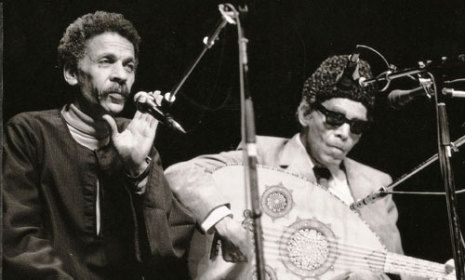
The poet Ahmad Fouad Negm died Tuesday morning at the age of 84. “Al Fagoumy,” as his friends used to call him, lived an extraordinary life that was a physical embodiment of everything he believed in.
Coming from a poor village in Sharkiya, spending most of his early years either in orphanages (where he first met singer Abdel Halim Hafez) or in prison (where he was first sent for forging papers), Negm wrote about poor people and about Egypt like no one else.
Armed with fierce bravery and naughtiness, with street wisdom and a sense of humor, he and musician Sheikh Imam formed a partnership that practiced reactionary thought and rebellion against tyranny and defeat throughout the 1960s and beyond.
Their repeated visits to prison was the smallest price they could pay. Negm was given 11 years during the rule of Anwar Sadat for a poem he wrote making fun of the latter's TV appearances:
He stretched his mouth
and said
‘I seek refuge.’
The coward
the son of a coward
ate our lunch,
found that we are kind people
so ate our dinner.
It’s ironic that Sadat knew for sure that Negm would be in power much longer than himself.
He even made fun of diva Omm Kalthoum, in a poem called “The Dog of the Lady” — which is much riskier than making fun of presidents. Her dog had bitten a poor man in Zamalek.
No wonder that Negm’s words echoed around Tahrir Square during and after the 18 days of the 2011 revolution, sounding as fresh as they were in the days they echoed around Cairo University many years ago.
Even though he was a very famous figure in the scene of Egyptian dialect poetry, and even though he wrote many songs for famous singers and TV shows, he lived very simply, in a small room on the rooftop of a building in one of Cairo’s poorest neighborhoods, Boulaq, enjoying a very free-spirited life.
He seemed to never stop loving life and hating dictators and making jokes through the darkest of all conditions.
In response to silly TV shows that tried to convince people to not feel bad about their poverty, saying it was good that no one could afford meat because it was unhealthy, he wrote:
So what do you think Dr Mohsen,
you unreliable source?
Let us eat meat and die,
and you can eat beans and live.
He leaves behind his sixth wife and children of various ages, including Nawara Negm, a revolutionary journalist and blogger.
* Translations by Andeel.

أخبار ذات صلة
Sex in Arab cinema
In 1929, the Ministry of Interior banned Wedad Orfi's Masat al-Hayah (The Tragedy of Life). The reason: "The story as we saw it revels in self-indulgence, overshadowing the good part…
The Past Will Return, but is sincerity enough?
Dina Hamza's much-anticipated film Gaye al-Zaman (The Past Will Return) closed Hybrid Reels, the celebrated 20-day non-fiction program at Zawya, with yet another full house. The Past Will Return is extremely…
A Gulfie record collector writes
The seminal 1970s Kuwaiti comedy show Darb al-Zalaq (The Slippery Path) tells the story of Hussain, a janitor who comes into wealth after the government buys his house during the…
Searching for new sound: Serious music and redefining authenticity
Redefining "authentic music" as serious music capable of introducing a new sound expands the scope of our listening experience, says Rami Abadir.
Your support is the only way to ensure independent, progressive journalism survives.
You have a right to access accurate information, be stimulated by innovative and nuanced reporting, and be moved by compelling storytelling. Subscribe now to become part of the growing community of members who help us maintain our editorial independence.
Join us