
New visa regulations spark confusion
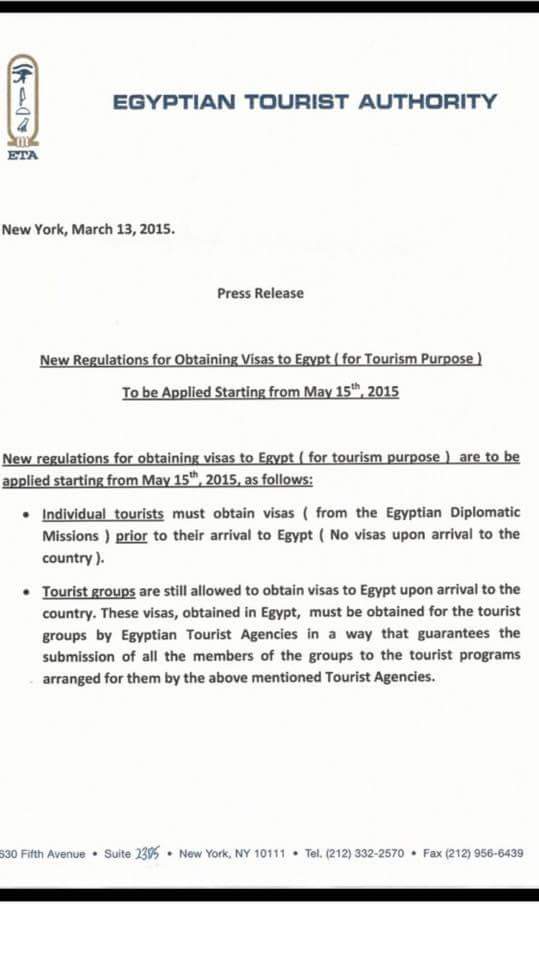
Individual tourists will be required to apply for a visa prior to travelling to Egypt starting in May, according to new regulations announced in a press release issued by the Egyptian Consulate in New York on March 13, 2015.
A copy of the press release has been circulating widely on social media, causing a wave of confusion among frequent travelers to Egypt, as well as those working in tourism.
The new regulations mandate that starting from May 15, 2015, “individual tourists” must obtain visas from Egyptian diplomatic missions prior to their arrival to Egypt. This means that, unlike current procedure for tourists visiting Egypt from the UK, EU, Australia, Canada, Croatia, Georgia, Japan, New Zealand, Norway, Macedonia, the Republic of Korea, Russia, Serbia, Ukraine and the US, visas will no longer be able to be obtained upon arrival at the airport in Egypt.
The new regulations exclude “tourist groups,” who will still be permitted to obtain visas upon arrival in Egypt, but the press release fails to define who this includes, according to the head of the Egyptian Tourism Federation, Elhamy al-Zayat.
Zayat told Mada Masr that he found the term “groups” confusing, since it could mean anything from five to 30 people. Such groups will have to obtain visas through Egyptian tourist agencies “in a way that guarantees the submission of all members of the group to the itinerary arranged for them by the agencies,” the regulations mandate.
When asked about the reason for this decision, especially at a time when Egypt is trying to restore its reputation as a safe place for tourists, Zayat said that the federation learned of the decision “like everyone else,” and that they hadn’t been consulted regarding it.
“I can only work with the regulations handed to me, it’s not my problem whether they have security motives or not,” he said.
Some activists have implied that the decision is an attempt by the government to stop foreign activists and researchers from entering the country.
But while Zayat plans on abiding by whatever orders the federation receives from the government, he believes that it will definitely affect tourism in Egypt.
“This will certainly affect cultural tourism, since these types of tourists usually travel independently. The hit won’t be as big for beach and resort tourism, since people already come in groups organized by travel agencies,” he clarified.
Zayat is not the only one worried about the ramifications of this decision, as tour company manager Moustafa Khalil tells Mada Masr: “The issue is that the new regulations are not clear,” he says, adding that “tourism has already hit rock bottom, and this move means there will be fewer and fewer tourists."
Khalil was under the impression that only tourists from North and South America would be subject to the new regulations, but a statement posted on the Egyptian Consulate in Paris' Facebook page on March 12 announced that French tourists will be subject to the same restrictions, echoed in a statement from Slovenia.
Meanwhile, state-owned Al-Ahram newspaper reported that “any person wishing to enter Egypt will need to obtain a visa before departure.”
Swept up in the confusion among governmental bodies, Zayat told Mada Masr that the federation is yet to receive details on which nationalities fall under the new regulations.
He said that a meeting would be held with the minister of tourism on Thursday, when he’ll be informed of not only the nationalities implicated — tourism from the Gulf is another major market at stake — but also the procedures that have to be taken to acquire Egyptian visas.
This is not the first time similar decisions regarding visa regulations have been made. In September 2011, the Cabinet announced a plan to implement the same regulations “due to security concerns.” The decision was lifted three days later, following widespread objection from both tourism workers and officials, such as the chairman of Egypt’s Tourism Authority, Amr al-Ezaby, who said that it would “harm the flow of tourism to Egypt ... and its purpose is not understood.”
The number of tourists has fallen drastically in Egypt over the past four years. For the first five months of 2014, tourists visiting Egypt dropped by 24 percent in comparison to 2013 — the worst decline since 2011. The number of visitors fell by 40 percent from 2010, according to the state-run statistics agency CAPMAS. Tourism employs 12 percent of the work force and makes up between five and 10 percent of GDP, not including indirect industries.
Meanwhile, statistics of GDP growth released by the government earlier in March 2015 showed that tourism, which grew steadily from July to September and contributed 1.3 percentage points to GDP growth in the first quarter, has been declining since November.
*Correction: An earlier version of this article incorrectly stated the number of Egyptian consulates in the US. This was amended on March 18, 2015.

أخبار ذات صلة
Egyptian Embassy in Washington releases report praising Sisi
President Abdel Fattah al-Sisi’s first 100 days in office were celebrated in a report published this week by the Egyptian Embassy in Washington DC,…
Kidnapped Egyptian embassy staff released in Libya
The five Egyptian embassy staff kidnapped in Libya were all released on Monday, shortly after Egyptian authorities released Shaaban Hadiya, chairman of the Operation…
Egyptian embassy staff kidnapped in Libya
At least four Egyptian embassy staff have been kidnapped in Tripoli, the Libyan capital, according to statement by the Ministry of Foreign…

Looking back to see the present through the Grand Egyptian Museum
The coincidental nature behind the establishment of the Grand Egyptian Museum
Your support is the only way to ensure independent, progressive journalism survives.
You have a right to access accurate information, be stimulated by innovative and nuanced reporting, and be moved by compelling storytelling. Subscribe now to become part of the growing community of members who help us maintain our editorial independence.
Join us